

What a matched set actually includes
When a supplier advertises a stair runner and hallway runner set, they typically mean two pieces cut from the same roll of carpet in the same dye lot, one sized and finished for the stairs (often with pre-bound edges ready to be stepped and tacked or gripper-fitted), and one sized as a straight hallway runner with its own bound or fringed edge. Buying them as a set removes the dye-lot mismatch risk that comes from ordering two pieces separately, months apart, from what's nominally the same colour.
Not every set is sold at a fixed size though. Many suppliers sell the hallway piece by the linear foot or metre off a roll, cut to your specified length once you've measured your own corridor, while the stair portion may be quoted per step or as a fixed length based on your flight's step count. Always confirm which parts of the set are fixed-size and which are cut-to-order before you commit, since return policies often differ between the two.
Checking fibre and construction before buying a set
Because the two pieces in a set usually share a fibre and construction, it's worth checking that the fibre suits both locations equally well. A soft wool runner that's ideal underfoot on stairs might be softer than ideal for a hallway that sees muddy shoes directly off the street, so ask the supplier whether the hall piece can be finished in a slightly tougher fibre while keeping the same colour and pattern as the stair piece, rather than assuming the set must be identical in every respect.
| Check before ordering | Why it matters |
|---|---|
| Fixed size vs cut-to-order | Affects returns policy and whether you must measure precisely first |
| Same dye lot confirmed | Avoids a subtle colour mismatch between the two pieces |
| Edge finish (bound, fringed, serged) | Stairs and hall often need different edge treatments |
| Underlay compatibility | Stair runners typically need a specific underlay grade; hall runners may not |
Ask what happens if one piece needs reordering
If the hall portion is damaged or measured wrong and needs recutting later, ask upfront whether the supplier can guarantee an exact dye-lot match months down the line, since many weaves change subtly between production runs.
How much runner do I need?
For the stair portion of a set, use a 13-step US flight as your reference: 10 in tread run, 7.5 in riser height, 0.75 in nosing wrap allowance, giving 18.25 in per step. Across 13 steps that's 237.25 in (19.77 ft). Add a 24 in finishing allowance for the top and bottom for 261.25 in (21.77 ft), then apply a 7% waste margin for approximately 23.3 ft. This is the figure to give your supplier when ordering the stair piece of the set.
In UK metric, the same flight works out to 25 cm tread, 19 cm riser, 1.9 cm nosing wrap for 45.9 cm per step, 596.7 cm across the flight, plus a 60 cm finishing allowance for 656.7 cm, then a 7% waste margin lands at roughly 7.03 m. For the hallway piece, measure your corridor's straight-line length separately and add roughly 10% for waste, since hall runners in a matched set are almost always ordered as one uncut length rather than stepped.
- Measure the stair flight and hallway corridor separately before contacting a supplier.
- Confirm which piece of the set is fixed-size and which is cut-to-order.
- Ask for the dye lot number on both pieces to be recorded on your order.
- Check whether stair rods or a gripper fitting system are included or need buying separately.
- Get written confirmation of the total combined length and price before paying a deposit.
Know your numbers in 30 seconds
Enter your step count, tread depth and riser height — the stair runner calculator gives you the exact length to order, in metres and feet, with waste included.
Open the stair runner calculatorBudgeting for a set versus buying separately
A matched set is sometimes priced at a modest discount versus buying the same total length as two entirely separate orders, since the supplier is cutting from one roll in one operation rather than pulling two different batches. That said, the saving is usually smaller than people expect, typically single-digit percentage points, so don't choose a set purely for a discount if the fibre or weight isn't quite right for one of the two locations. The real value of a set is the guaranteed colour match and the convenience of one order, one delivery and one invoice.
Before placing an order, work out your stair figure with a stair runner length calculator so you're quoting an accurate number rather than a rough guess, since most suppliers charge for what you order, not what you actually needed, and a runner cut too short on the stairs is a much costlier mistake to fix than a hallway piece that's slightly long and needs trimming.
Fitting sequence for a matched set
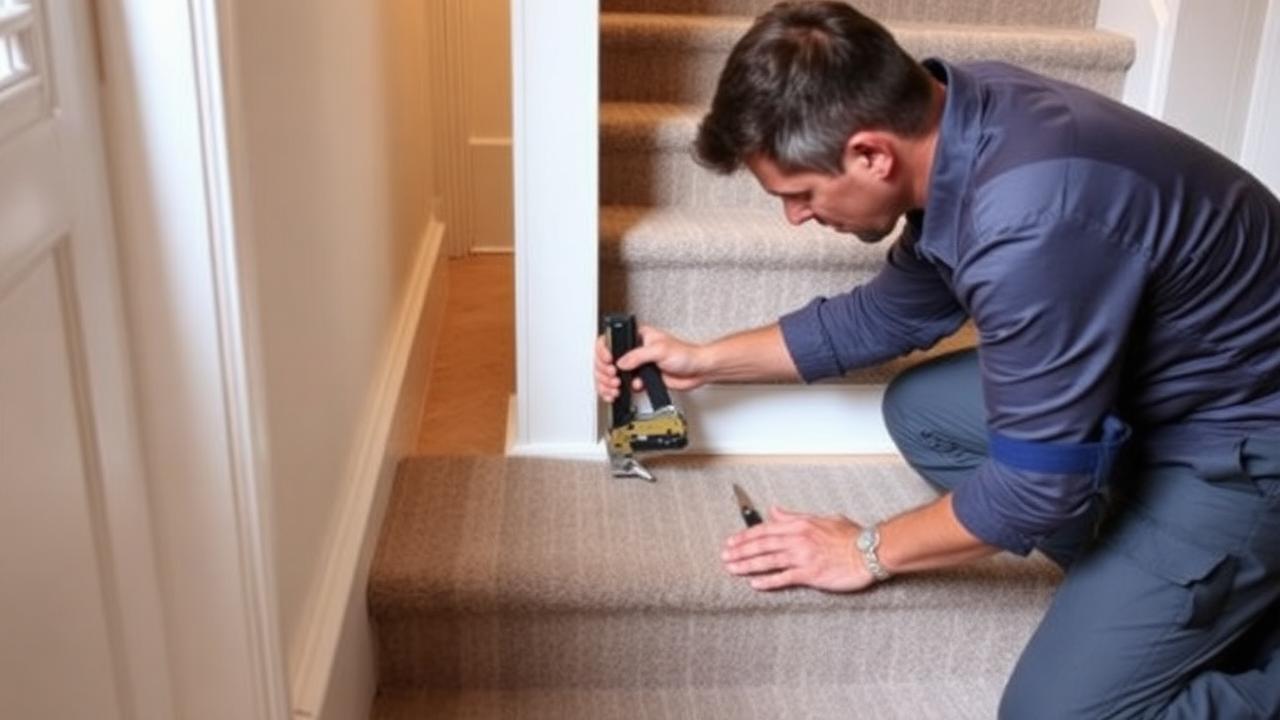
Fit the stair portion first if you're using one installer for the whole set, since the hallway piece's starting edge can then be set precisely against the finished stair edge rather than guessed at in advance. Most fitters will lay the hall runner so its leading edge sits just short of the bottom step, allowing a small gap for the stair runner's own finishing fold, and this detail is far easier to get right when both pieces are on site and fitted in the same visit rather than weeks apart.
Whatever you decide, get the numbers first: the stair runner calculator doubles as a stair runner length calculator, adding nosing wrap, landings, winders, pattern repeat and waste so you order the right length the first time.
Still deciding on material, width or pattern? Our hub on stair runners compares weaves, widths, backings and fitting styles side by side, then hands the numbers straight to the calculator.
Frequently asked questions
What's included in a stair runner and hallway runner set?
Typically two pieces cut from the same roll and dye lot, one finished for stair fitting (often pre-bound for stepping) and one as a straight hall runner. Some sets are fixed-size, others are cut to your measurements once you order.
Is a matched set cheaper than buying stair and hall runners separately?
Sometimes, but usually only by a small margin since the supplier saves on cutting and dye-matching rather than material cost. The main benefit of a set is the guaranteed colour match, not necessarily a large price saving.
Can the two pieces in a set use different fibres?
Many suppliers can finish the hall piece in a slightly tougher fibre while keeping the same colour and pattern as the stair piece, since hallways often see harder wear from direct outdoor traffic. Ask before ordering rather than assuming they must be identical.
How much stair runner do I need for a 13-step flight?
Roughly 23-24 ft (7-7.3 m) for a typical 13-step flight with 10 in (25 cm) treads and 7.5 in (19 cm) risers, once nosing wrap, finishing allowance and a 7% waste margin are included. This is separate from the hallway length.
Should I measure the hallway before or after ordering the stair piece?
Measure both before contacting a supplier so you can order the whole set in one transaction with confirmed matching dye lots. Ordering the hallway piece later risks a subtle colour mismatch if that batch has since changed.
What edge finish should the hallway piece have?
A bound or fringed edge is standard for a hall runner, whereas a stair runner piece is often left with a rougher edge ready to be stepped and bound after fitting. Confirm with your supplier which finish applies to which piece.
Do I need different underlay for each piece?
Usually yes. Stair runners typically need a firm, specific-grade underlay rated for stair use, while hallway runners on a flat floor can often use a general-purpose underlay or none at all if laid over hard flooring.
What happens if I need to reorder just one piece later?
Ask your supplier upfront whether they can match the dye lot months or years later, since many weaves change subtly between production runs, and a later reorder of just one piece carries a real risk of a visible colour mismatch.
Know your numbers in 30 seconds
Enter your step count, tread depth and riser height — the stair runner calculator gives you the exact length to order, in metres and feet, with waste included.
Calculate the stair portion with the stair runner calculatorReady for real prices?
Get quotes from vetted stair runner suppliers and fitters near you. Free, no account, no obligation.
Every guide is written from hands-on measuring and fitting experience, checked against the calculator’s own maths, and re-reviewed whenever prices or methods change. Read our editorial standards.