
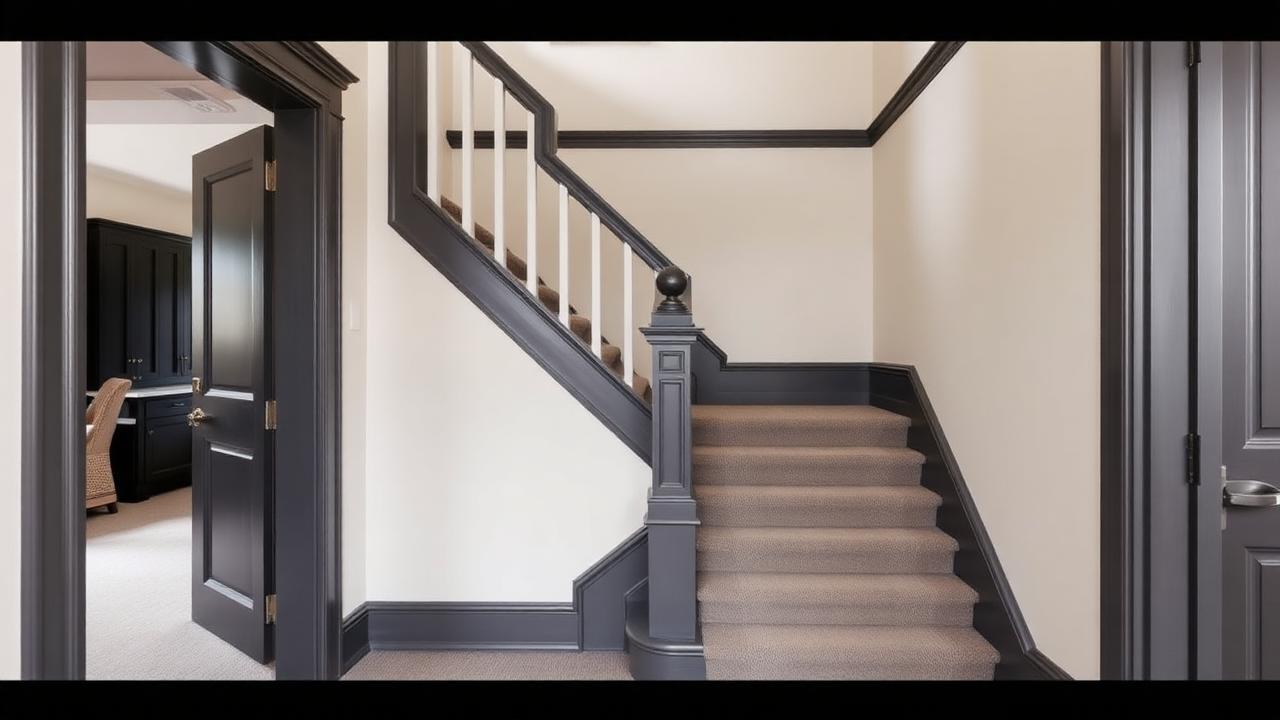
Treat the whole run as one design brief
Every house I've worked on where the hall, stairs and landing genuinely look considered started with a single design brief covering all three areas, not three separate decisions made room by room over several months. That doesn't mean identical carpet everywhere, it means one colour story and one pattern logic that flexes: perhaps a solid colour on the hall and landing with a bordered stair runner in between, or a patterned runner on the stairs that echoes a simpler version of the same tone in the flat areas either side.
A good starting question is where your eye actually lands when you walk through the front door. On most houses, that's straight up the staircase, so the stair runner is doing the most visual work and deserves the boldest choice, striped, patterned, a strong colour, while the hall and landing carpet either side can afford to be calmer since they're supporting rather than leading the design.
Idea one: a patterned runner with plain flanking carpet
A striped or Persian-style patterned stair runner set against plain wall-to-wall carpet in the hall and landing is one of the most reliable combinations, because the pattern is contained to the stairs where it has the most visual impact, and the plain areas either side don't compete with it. Pick the plain carpet's colour from one of the pattern's secondary tones, not the dominant one, so it reads as coordinated rather than randomly picked.
Idea two: one solid colour, three different pile heights
Where a client wants a calmer, more unified look, the same solid colour across hall, stairs and landing but in slightly different weights, a tougher, denser weave in the high-traffic hall, a mid-weight wool-blend on the stairs, a softer plush on the landing where footfall is lightest, gives a coherent look while matching each carpet's durability to how hard that section actually gets used.
Landing carpet takes less wear than you'd think
A landing usually sees far less direct footfall than the stair treads themselves, since people cross it rather than standing on it, so it's a reasonable place to spend slightly more on a softer, less hardwearing but nicer-feeling carpet than you'd choose for the stairs.
Idea three: a bordered runner that continues onto the landing
Rather than treating the landing as separate flat carpet, some households continue the stair runner itself, same width, same border, straight across the landing floor before it meets the upstairs hall carpet. This works especially well on a half-landing or a small top landing where a full change of carpet would look choppy over such a short run, and it keeps the visual line of the runner unbroken from bottom step to top.

How much runner do I need?
Take a 13-step US flight, 10 in tread run, 7.5 in riser height, 0.75 in nosing wrap allowance, giving 18.25 in per step, 237.25 in (19.77 ft) across the flight. Add a 24 in finishing allowance for 261.25 in (21.77 ft), then a 7% waste margin for roughly 23.3 ft, covering the stairs only. If a half-landing sits partway up, add its depth (typically 3-4 ft, or 90-120 cm) as a separate flat section, since landings are measured by area rather than the per-step formula used on the flight.
In UK metric, the same flight is 25 cm tread, 19 cm riser, 1.9 cm nosing wrap for 45.9 cm per step, 596.7 cm across 13 steps, plus a 60 cm finishing allowance for 656.7 cm, then a 7% waste margin for roughly 7.03 m. A half-landing of 90-120 cm depth by your stair width (say 90 cm) adds roughly 0.8-1.1 sq m of additional flat carpet, quoted separately by most suppliers from the runner itself.
| Area | Typical sizing basis | Example (13-step flight) |
|---|---|---|
| Stairs | Per-step formula + waste | 23.3 ft / 7.03 m |
| Half-landing | Flat area (depth x width) | 0.8-1.1 sq m |
| Top landing / hall | Straight length or room area | Measured separately |
Know your numbers in 30 seconds
Enter your step count, tread depth and riser height — the stair runner calculator gives you the exact length to order, in metres and feet, with waste included.
Open the stair runner calculatorColour and pattern pitfalls to avoid
The most common mistake in a combined hall, stairs and landing scheme is choosing the pattern or colour for each area in isolation over multiple shopping trips, so by the time all three are fitted, subtle inconsistencies in undertone show up that weren't visible when each sample was viewed alone. Keep a physical sample of every carpet under consideration in one folder and review them together before ordering any single piece, ideally in the actual hallway daylight rather than a shop.
Stair runners in particular reward accurate measuring before you commit to a design, since a bold pattern or stripe that's cut wrong at the top or bottom step is far more visible than a plain colour cut the same way. Run your figures through a stair runner calculator before ordering, and treat the landing and hall as separate measurements rather than trying to estimate them from the stair total.
Whatever you decide, get the numbers first: the stair runner calculator doubles as a stair runner length calculator, adding nosing wrap, landings, winders, pattern repeat and waste so you order the right length the first time.
Still deciding on material, width or pattern? Our hub on stair runners compares weaves, widths, backings and fitting styles side by side, then hands the numbers straight to the calculator.
Frequently asked questions
Should hall, stairs and landing carpet all match exactly?
Not necessarily. A single colour or pattern story that flexes in weight and finish between areas usually looks more considered than an identical carpet everywhere, since each area sees different foot traffic and benefits from a slightly different weave.
What's a good idea for a small top landing?
Continuing the stair runner itself across the landing, same width and border, before meeting the upstairs hall carpet avoids a choppy change of carpet over a short run and keeps the visual line unbroken.
Should the landing carpet be tougher or softer than the stairs?
Softer is often fine, since a landing typically sees less direct footfall than the stair treads, as people cross it rather than stand on it. It's a reasonable place to prioritise comfort slightly over pure durability.
How do I stop a patterned stair runner clashing with plain hall carpet?
Pick the plain carpet's colour from one of the pattern's secondary tones rather than its dominant colour, so the plain area reads as coordinated support rather than a mismatched separate choice.
How much extra carpet do I need for a half-landing?
A typical half-landing 90-120 cm (3-4 ft) deep by your stair width adds roughly 0.8-1.1 sq m of flat carpet, quoted separately from the stair runner since it's priced by area rather than the per-step formula.
Can I use a bold pattern on the stairs and keep the hall plain?
Yes, this is one of the most reliable combinations since the stairs naturally draw the eye and can carry a bolder pattern, while plain hall and landing carpet either side supports it without competing.
What's the biggest mistake in planning these three areas together?
Choosing each area's carpet in isolation on separate shopping trips, which leads to subtle undertone mismatches that only become visible once all three are fitted. Compare samples together before ordering any single piece.
Do landings need a different waste allowance to stairs?
Yes, landings are measured as a flat area (depth x width) rather than using the stair per-step formula, so waste is typically a smaller percentage since there's no stepped cutting involved, usually 5-8% depending on any pattern matching needed.
Know your numbers in 30 seconds
Enter your step count, tread depth and riser height — the stair runner calculator gives you the exact length to order, in metres and feet, with waste included.
Plan your stair section with the stair runner calculatorReady for real prices?
Get quotes from vetted stair runner suppliers and fitters near you. Free, no account, no obligation.
Every guide is written from hands-on measuring and fitting experience, checked against the calculator’s own maths, and re-reviewed whenever prices or methods change. Read our editorial standards.