
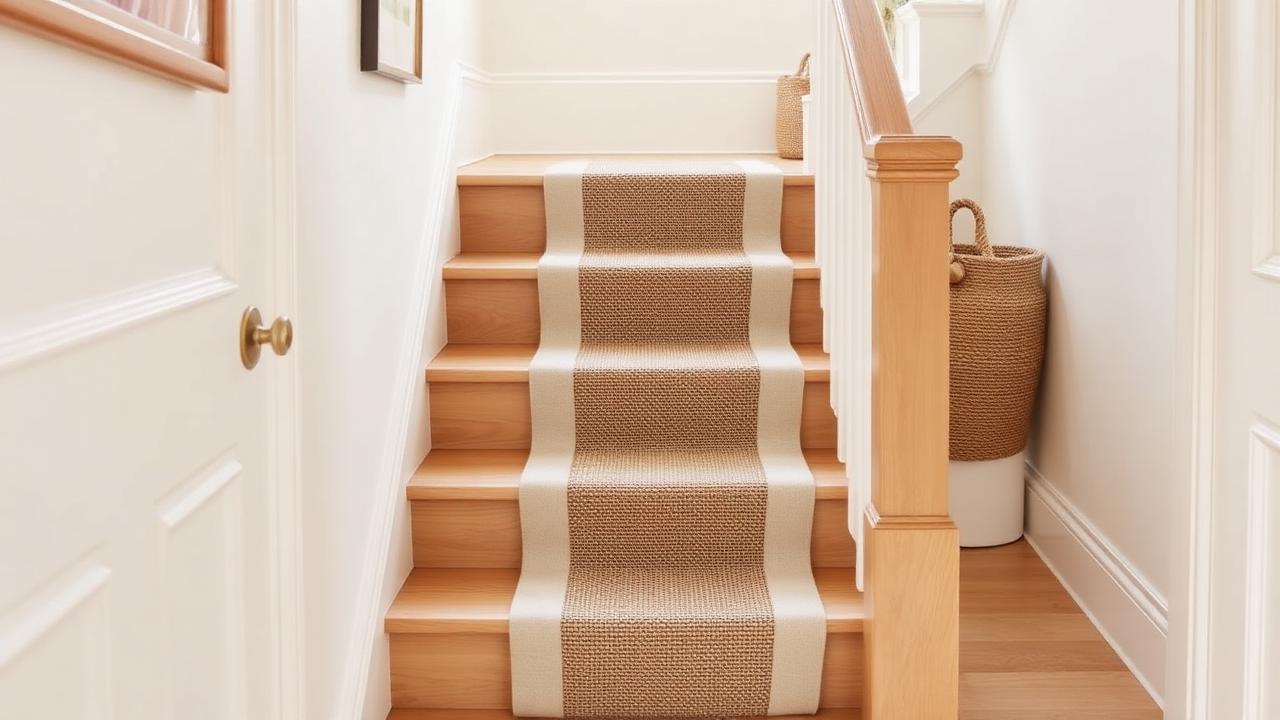
How broadloom rolls are sold
Carpet mills manufacture broadloom in standard widths — 12ft (3.66m) is the most common in the US, while UK and European mills commonly produce 4m and 5m widths alongside a narrower 3.66m option that matches the US standard. When you buy a stair runner carpet roll, you are buying a length cut from that full-width roll, which then needs to be cut lengthwise down to your runner width (commonly 27in, 30in or 36in) — a job for a carpet fitter with the right straightedge and cutting tools, not something to attempt with a utility knife on your own.
Because you are paying for the full 12ft width even though you only use 27-36in of it, roll-based buying only makes financial sense if the retailer sells the roll priced per running foot at the full width and lets you buy a shorter length, or if the leftover width can be used elsewhere in the home (a hallway, landing, or a second stair runner from the same dye lot).
Roll width and yardage planning
| Roll format | Standard width | Best for |
|---|---|---|
| US broadloom roll | 12ft (144in) | Cutting multiple narrow runners from one dye lot |
| UK/EU broadloom roll | 4m (157in) or 5m | Larger projects, matching landing carpet |
| Narrow specialty roll | 26-36in | Runner already at or near finished width, minimal waste |
For a single 13-step staircase needing a 30in-wide runner, buying a narrow specialty roll already close to that width wastes far less material than cutting down from a full 12ft broadloom roll — unless you specifically want the leftover width for a matching landing or hallway.
Calculating length from the roll
Total roll length needed follows the same math as any stair runner: (number of steps × yardage per step) + top and bottom allowance + landing allowance, with an added waste margin for pattern matching if the carpet has a repeat. A typical 13-step flight with a Hollywood fit and a 12in tread depth needs roughly 16-18 linear feet of runner length before waste; a waterfall fit typically needs slightly less, around 14-16ft, because it does not tuck into the riser angle.
- Always add 10-15% extra length for cutting error and pattern matching, more if the carpet has a large repeat.
- Order the full flight length in one continuous cut where possible — seaming a stair runner partway up a flight is visually obvious and structurally weaker.
- Confirm the mill's roll length in stock before ordering a custom colour; some patterns are only woven in limited production runs.
| Item | US price range | UK price range |
|---|---|---|
| Broadloom, mid-grade nylon, per sq yd | $18-32 | £15-27 per sq m |
| Broadloom, wool, per sq yd | $45-85 | £38-71 per sq m |
| Cutting and binding service (per edge, per linear ft) | $1.50-3 | £1.20-2.50 |
| Full roll-to-runner conversion, 13 steps | $250-650 | £210-540 |
Run your exact step count and width through the stair runner length calculator to convert a per-square-yard roll price into a realistic total, since roll pricing is quoted by area while runner needs are ultimately a linear-length question.
Dye lot matching matters on rolls
If you plan to buy more of the same roll later — for a landing, an additional flight, or a repair patch — buy the full expected quantity in one order. Carpet dye lots vary batch to batch, and a second order months later frequently will not match exactly.
Know your numbers in 30 seconds
Enter your step count, tread depth and riser height — the stair runner calculator gives you the exact length to order, in metres and feet, with waste included.
Open the stair runner calculatorWhen roll buying makes sense vs a pre-cut runner
Buying by the roll makes the most sense when you need a specific colour or pattern not available as a pre-made runner, when you are matching a landing or hallway to the same stairs, or when you are ordering enough total yardage that the wider roll's leftover material has genuine use elsewhere. For a straightforward single flight with no matching areas, a pre-cut, pre-bound runner is usually simpler and not meaningfully more expensive once cutting and binding fees are added to the roll price.

Reading a roll invoice: what each line actually charges you for
A carpet roll quote from a flooring retailer usually itemises four separate charges, and it is easy to miss one until the final bill arrives. The material itself is priced per square yard (US) or square metre (UK), based on the full roll width even if you only need a narrow strip. Cutting down to runner width is a separate labour line, typically charged per linear foot or metre of cut. Binding or serging both long edges is another separate line, usually priced per linear foot per edge, so a 20ft runner with both edges bound is effectively 40ft of binding labour. Finally, delivery or collection of the cut roll is sometimes bundled and sometimes billed separately, particularly for wool broadloom that needs careful handling to avoid creasing.
I always ask suppliers to itemise these four lines separately rather than quoting one lump sum, because it makes comparing two retailers' pricing on the same stair runner carpet order genuinely apples-to-apples, and it flags early if one supplier has quietly left out binding or delivery.
Typical itemised cost breakdown, 13-step flight, 30in wide
| Line item | US typical range | UK typical range |
|---|---|---|
| Material (mid-grade wool, per sq yd/sq m equivalent) | $180-340 | £150-285 |
| Cutting to width (approx 20ft run) | $30-60 | £25-50 |
| Binding both edges (approx 40ft of edge) | $60-120 | £50-100 |
| Delivery/collection of cut roll | $0-45 | £0-38 |
| Total, before fitting | $270-565 | £225-473 |
Minimum order lengths and why short orders cost more per foot
Most mills and large retailers set a minimum roll-cutting order, commonly 15-20ft (4.5-6m), below which the per-foot price rises noticeably because the setup and handling cost is spread across less material. If your staircase only needs 12-14ft of finished runner, ask whether the retailer has a smaller in-stock remnant roll rather than cutting a fresh length from a full bolt, since remnant pricing is often 20-35% cheaper than a fresh cut below the minimum order threshold.
- Below the minimum cut length, expect a 10-25% per-foot price premium at most mills.
- Ask specifically about remnant or end-of-roll stock before ordering a fresh cut for a short single flight.
- Combining a stair order with a hallway or landing order in one cut often clears the minimum and avoids the premium entirely.
- Some retailers waive the minimum-order premium for wool but not for synthetic broadloom, so ask fibre-by-fibre.
Whatever the fibre, get your exact linear footage confirmed with the stair runner calculator before you call round for quotes, since a supplier cannot tell you whether you are above or below their minimum order threshold until you give them a firm number rather than an estimate.
Ask what happens to the offcut
Cutting a 30in runner from a 12ft roll leaves roughly 9ft of width as offcut for every linear foot ordered. Some retailers keep this as scrap included in the price; others will let you take the offcut for a small additional charge, which can be enough for a small hallway rug or stair landing patch.
Frequently asked questions
What is a stair runner carpet roll?
Broadloom carpet sold as a continuous roll (typically 12ft or 4m wide) that is cut down to a narrower runner width and bound, rather than a pre-made finished runner.
How wide is a standard carpet roll?
US broadloom is most commonly 12ft (144in) wide; UK and European rolls are commonly 4m or 5m wide, with a 3.66m option matching the US standard also available.
Is buying a carpet roll cheaper than a pre-cut stair runner?
Often yes per square foot of material, but cutting and binding fees narrow the gap, and buying a full-width roll for a narrow runner wastes material unless the leftover has another use.
How much carpet roll do I need for 13 stairs?
Roughly 16-18 linear feet with a Hollywood fit or 14-16ft with a waterfall fit for a standard 12in tread depth, plus 10-15% extra for cutting error and pattern matching.
Can I cut a carpet roll into a runner myself?
It is not recommended. A professional fitter uses a straightedge and proper cutting tools to keep the cut perfectly parallel; a hand-cut edge is very difficult to bind evenly afterward.
Should I buy extra roll length for future repairs?
Yes, if you may need a landing match, a second flight, or a future repair patch, buy the total expected quantity upfront, since dye lots can vary between separate orders.
Know your numbers in 30 seconds
Enter your step count, tread depth and riser height — the stair runner calculator gives you the exact length to order, in metres and feet, with waste included.
Estimate my carpet roll costReady for real prices?
Get quotes from vetted stair runner suppliers and fitters near you. Free, no account, no obligation.
Every guide is written from hands-on measuring and fitting experience, checked against the calculator’s own maths, and re-reviewed whenever prices or methods change. Read our editorial standards.