
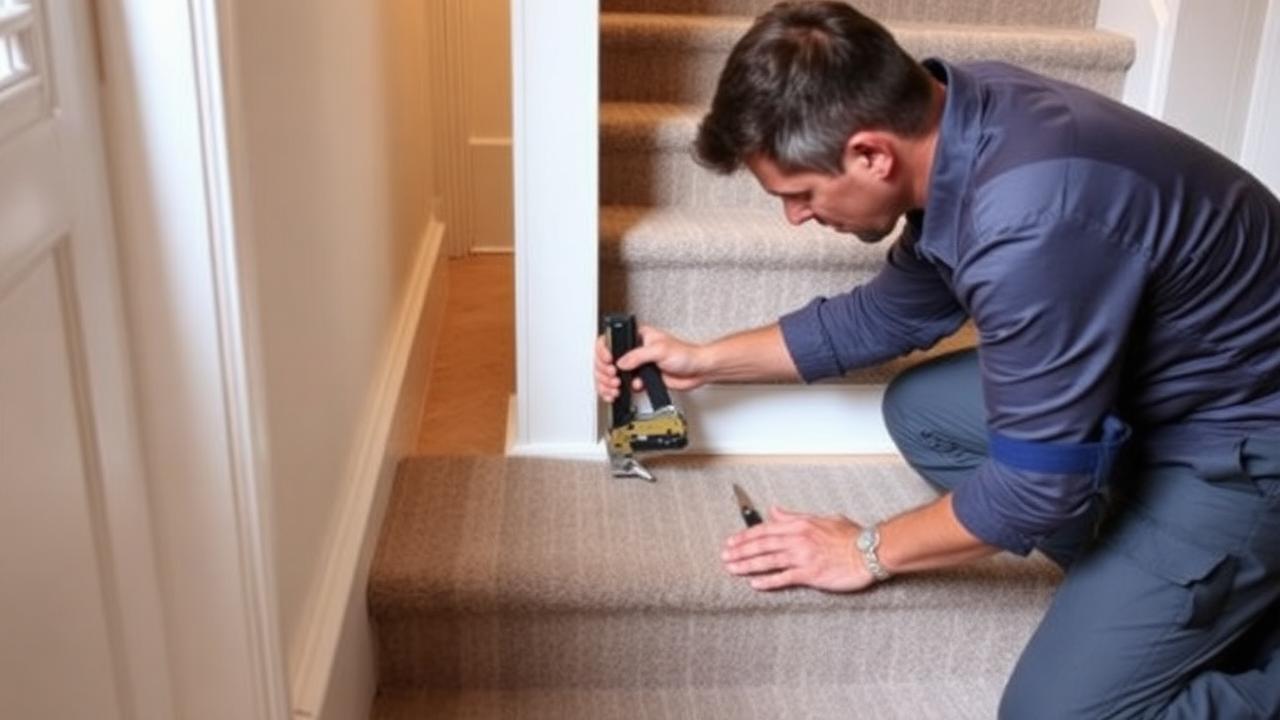
The three big cost drivers
Fitting cost for a stair runner is not a single number because three separate variables move it independently. Carpet grade is the most obvious - a budget synthetic runner and a premium hand-loomed wool runner can differ by three or four times in material cost per square yard or metre before labour is even added. Staircase shape is the second driver: a straight flight with no turn is the simplest, fastest job to fit, while a flight with a winder, half-landing, or full turn requires the installer to cut and pattern-match around an angle, which takes considerably longer and carries more risk of a wasted cut. Finishing method is the third: a simple tucked-and-tacked or fully glued finish is quicker to fit than a runner held with decorative stair rods, where each rod bracket has to be positioned, drilled and fitted individually down the flight.
Underlay or padding is a smaller but still real line item, typically adding a modest amount per running foot or metre, and it's worth confirming whether it's included in a quoted labour rate or billed separately, since some installers bundle it and others itemise it.
Typical price ranges by scenario
| Scenario | Typical US range (per running ft) | Typical UK range (per linear m) |
|---|---|---|
| Straight flight, synthetic carpet, tucked finish | $30-50 | £40-60 |
| Straight flight, wool carpet, tucked finish | $50-80 | £60-90 |
| Straight flight, stair rods finish | $55-90 | £65-100 |
| Turned flight or winders, any fibre | $70-140 | £80-150 |
Compare like for like
When comparing quotes, check whether padding, old-runner removal and finishing hardware (rods or fixings) are included in the headline number or billed as extras - two quotes with very different totals sometimes cover the same actual scope.
How staircase shape changes the labour bill
A straight flight of 12-14 steps with no turn is the benchmark scenario most quotes are built around, and it's genuinely the fastest job - often completed in half a day to a full day by an experienced installer. Add a single 90-degree turn or a winder section and labour time typically increases by 40-70% for that section alone, because the installer has to cut the carpet to follow the angle, often re-piecing a separate offcut to keep any pattern aligned across the turn. A full switchback staircase with two turns, common in some multi-storey homes, can take two to three times longer than an equivalent straight run of the same total step count.
How finishing method changes the price
Tucked-and-tacked or fully glued finishes are the quickest and cheapest to fit, since the runner is pulled taut and secured invisibly beneath the nosing or along the tread edge. A bound or serged edge finish, where the runner's raw edges are visible and neatened rather than tucked away, is a similar labour cost but changes the carpet's finished width, which needs planning before ordering. Stair rods are the most labour-intensive finishing option, since each rod requires a bracket to be positioned and fixed at every riser, and rods also typically add their own material cost on top of the carpet - budget an additional $8-20 per rod in the US or £8-18 per rod in the UK depending on finish (brass, black, chrome) and rod length.

How much runner do I need?
Fitting cost is usually quoted per running foot or linear metre, so knowing your own length in advance lets you convert any per-foot quote into a total figure instantly. For a 13-step straight flight with a 10 in (25.4 cm) tread going and 7.5 in (19 cm) riser rise, each step consumes roughly 17.5 in (44.5 cm) of runner, totalling about 227.5 in (5.78 m) across 13 steps. Add a combined top-and-bottom finishing allowance of 20 in (50.8 cm), landing near 247.5 in, or about 20.6 ft (6.28 m), then add a 5-10% waste margin for a final order of roughly 21.6-22.7 ft (6.6-6.9 m). Multiply that length by a quoted per-foot fitting rate to get your expected total labour cost before adding carpet cost separately. A stair runner calculator does this length calculation automatically, and a stair runner length calculator is the fastest way to convert a per-foot quote into a total number you can compare across installers.
Know your numbers in 30 seconds
Enter your step count, tread depth and riser height — the stair runner calculator gives you the exact length to order, in metres and feet, with waste included.
Open the stair runner calculatorExtra costs that sometimes get missed
- Removal and disposal of an old stair runner or carpet, often charged separately if not explicitly included.
- Tread repair or levelling if old, damaged or uneven treads are found once the old covering comes up.
- Underlay or padding, sometimes bundled into a labour rate and sometimes itemised on its own.
- Stair rod hardware cost, separate from carpet and labour if you choose a rod finish.
- Call-out or minimum job charges some installers apply to very short flights.
Getting an accurate quote
The most reliable quotes come from an in-person measurement rather than a phone estimate, since staircase shape, tread condition and finishing preference all affect the final number. Bring your own calculated length to the appointment so you can ask directly how the installer's per-foot or per-metre rate compares with your expected total, and always ask for the quote broken into carpet, labour, padding and finishing hardware separately rather than a single combined figure.
Whatever you decide, get the numbers first: the stair runner calculator doubles as a stair runner length calculator, adding nosing wrap, landings, winders, pattern repeat and waste so you order the right length the first time.
Still deciding on material, width or pattern? Our hub on stair runners compares weaves, widths, backings and fitting styles side by side, then hands the numbers straight to the calculator.
Frequently asked questions
What determines stair runner fitting cost the most?
Three factors matter most: carpet grade, staircase shape (straight versus turned or with winders), and finishing method (tucked, glued, bound, or stair rods). A turned staircase with premium wool and rod fittings can cost two to three times more per foot than a straight flight with synthetic carpet and a tucked finish.
What's a typical total cost range for fitting a stair runner?
As a general range, expect $30-90 per running foot installed in the US, or £40-100 per linear metre in the UK, for most residential jobs. Turned staircases, premium fibre, and rod finishes tend to push toward the higher end of that range.
Do stair rods add much to the cost?
Yes, noticeably. Rod fitting is more labour-intensive than a tucked or glued finish since each rod bracket is positioned and fixed individually, and the rods themselves typically add $8-20 per rod in the US or £8-18 per rod in the UK on top of carpet and labour.
Why do turned staircases cost more to fit than straight ones?
A turn or winder requires the installer to cut carpet to follow the angle and often piece in a separate offcut to keep any pattern aligned, which typically increases labour time by 40-70% for that section compared with an equivalent straight run.
Is underlay or padding included in the fitting cost?
It depends on the installer - some bundle padding into their quoted labour rate, others itemise it separately. Always ask directly so you can compare quotes on the same basis rather than assuming it's included.
How can I estimate my total fitting cost before getting a quote?
Calculate your own runner length using a stair runner calculator, then multiply that figure by a typical per-foot or per-metre fitting rate for your region and carpet grade. This gives you a ballpark to compare against any quote you receive.
Are there hidden costs I should ask about?
Common ones include removal and disposal of an old runner, tread repair if damage is found once the old covering is lifted, and minimum job or call-out charges for very short flights. Ask about all of these upfront before assuming a quoted figure is final.
Does the type of carpet backing affect fitting cost?
Indirectly, yes. A backing not designed for stairs may need extra handling or reinforcement to wrap nosings properly, which can add labour time. Carpet specifically finished for stair or runner use is generally quicker and more predictable to fit.
Know your numbers in 30 seconds
Enter your step count, tread depth and riser height — the stair runner calculator gives you the exact length to order, in metres and feet, with waste included.
Calculate your runner length to estimate total fitting costReady for real prices?
Get quotes from vetted stair runner suppliers and fitters near you. Free, no account, no obligation.
Every guide is written from hands-on measuring and fitting experience, checked against the calculator’s own maths, and re-reviewed whenever prices or methods change. Read our editorial standards.