

Two different jobs hiding under one search term
People searching for a stair runner for carpet stairs are usually doing one of two things. Some want to lay a decorative runner directly over existing fitted carpet without removing it — a layering job covered in detail elsewhere. Others have carpeted stairs and want to replace the whole carpet with a runner and expose the timber either side, which is a different and more common renovation. This guide covers both, but the material and width choices differ depending on which one you are doing, so work out which job you actually have before you shop.
If you are replacing fitted carpet with a runner
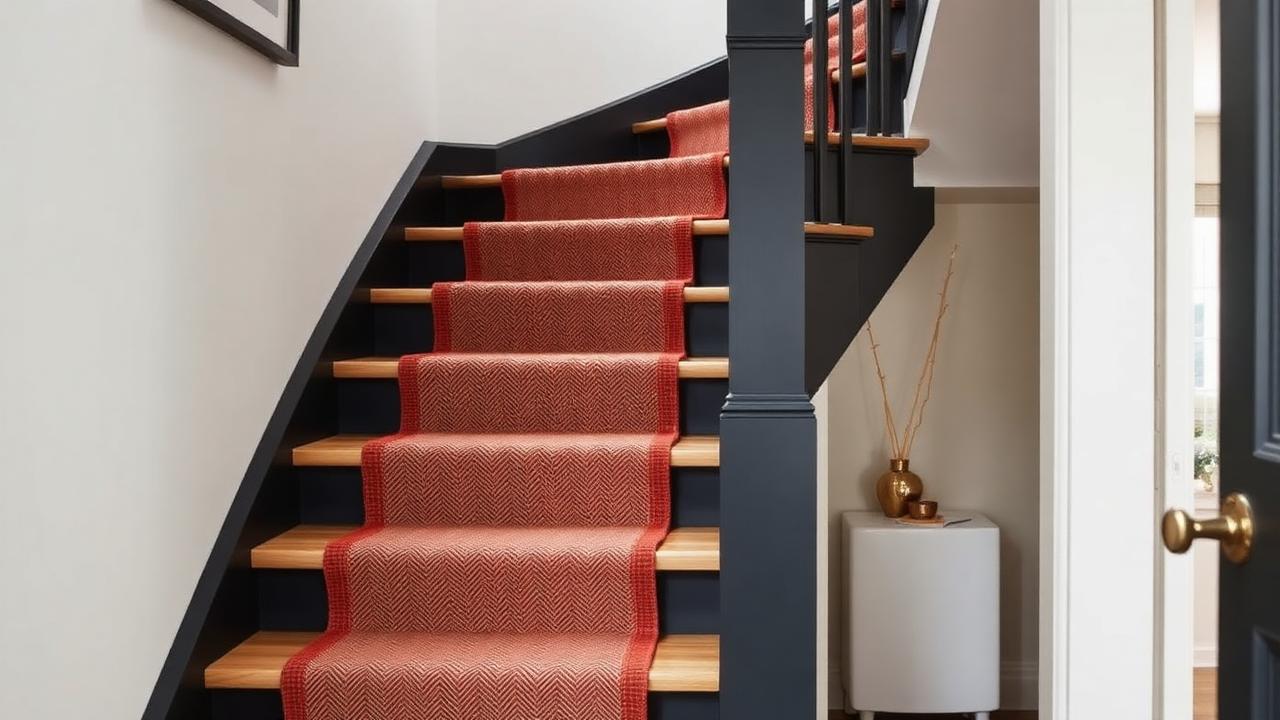
This is the far more common outcome of the search term, and it is usually a good move: fitted stair carpet wears out unevenly, is expensive to replace edge-to-edge, and hides the treads that many buyers now want exposed. Removing the old carpet reveals what condition the treads and risers are actually in, which is the deciding factor for the whole project.
- Strip the old carpet and gripper completely, then check every tread and riser for cracks, old nail heads or uneven boards.
- Fill, sand and seal or paint the exposed timber either side of where the runner will sit, since this is now a visible surface.
- Measure the flight properly with a stair runner calculator to get total length, width and pattern allowance before ordering.
- Choose a width that leaves an even margin of exposed timber each side — commonly 3-4.5 in (7.5-11 cm) on a standard 36 in (91 cm) stair.
- Fit fresh stair-grade underlay cut to the runner width, not the full tread width.
- Fix with staples, gripper, or rods depending on whether you want a permanent or removable installation.
If you are layering a runner over existing fitted carpet
This route avoids strip-out but only works if the existing carpet is flat, tight and not already worn thin. Choose a runner under about 8 mm (0.3 in) pile height so the combined stack stays manageable, and use a thin grip pad rather than full underlay beneath it, since the base carpet already provides cushioning. Longer staples rated for double-thickness fixing are essential — standard staples will not reach through two layers into solid timber.
Check tread depth before layering
Adding a runner on top of existing carpet raises the tread surface by several millimetres and can subtly reduce the effective nosing overhang. On stairs with shallow treads to begin with, this is worth measuring before you buy — a reduced nosing is a genuine trip risk, not just a cosmetic detail.
Material choice for a stair-over-carpet project
| Material | Works over existing carpet? | Works replacing carpet? | Notes |
|---|---|---|---|
| Flat weave wool or wool-blend | Yes, if under 6-8mm pile | Yes, best all-round | Low profile, durable, takes stain treatment well |
| Loop pile Berber | Only in low-pile versions | Yes | Hides footprints and vacuum lines well |
| Thick shag or plush pile | No — too bulky combined | Yes, on exposed treads only | Comfortable but unstable stacked on carpet |
| Sisal or jute natural fibre | No — too stiff to double-stack | Yes, on dry, low-traffic stairs | Coarse texture, not ideal for bare feet |
| Washable synthetic runner | Yes, most are thin and dense | Yes | Practical for households with pets or kids |
Costs for each route
Replacing fitted carpet with a runner usually costs more upfront because of the strip-out, timber preparation and finishing, but it delivers a permanent, higher-value result. Layering over existing carpet is cheaper and faster but is really a stopgap measure of a few years rather than a permanent fix.
| Item | Typical US | Typical UK |
|---|---|---|
| Strip-out and disposal of old carpet | $3-6 per step | GBP 2.50-5 per step |
| Timber prep, fill and finish, per flight | $150-400 | GBP 130-350 |
| Runner material, mid-range wool | $26-55 per sq yd | GBP 22-48 per sq m |
| Layering over existing carpet, material + fitting | $40-75 per step | GBP 32-62 per step |
| Full replacement, material + fitting | $60-140 per step | GBP 50-115 per step |
Sizing and pattern allowance either way
Whichever route you take, the length of runner needed is the same, because it is determined by the number of steps and their tread and riser dimensions, not by what is underneath. A stair runner length calculator adds the wrap-around allowance for each nosing automatically, which is easy to underestimate by eye — most people guess 10-15% short on a flight with more than twelve steps.
If your chosen carpet has a directional pattern such as a stripe or herringbone, order 5-10% extra to allow for squaring the pattern to the first tread, regardless of whether you are laying over carpet or bare wood.
Codes and practical safety
Neither IRC R311.7 in the US nor Approved Document K in the UK cares what is underneath a stair runner, but both require the finished tread to be securely fixed, slip-resistant and free of loose edges that create a trip hazard. A runner layered over old, worn carpet that continues to degrade underneath will eventually fail this test even if it looked fine on installation day, so budget for periodic re-inspection if you choose the layering route.
Choosing carpet weight for a stairs-over-carpet build-up
Because the finished stack on carpeted stairs already includes whatever pad and pile the base carpet brings, the runner you choose on top should generally be lighter and denser rather than heavier and plusher, even if a heavier pile is what you would pick for bare treads. A dense, low- to mid-pile wool or wool-blend weighing roughly 40-55 oz per square yard (1350-1900 g per square metre) keeps the combined stack manageable, while anything heavier starts to compress unevenly over the softer base layer beneath it and can develop visible tread-shaped depressions within a year or two of daily use.
Matching pattern and pile direction across the flight
| Base carpet | Runner choice | Result |
|---|---|---|
| Plain, light-coloured carpet | Bolder pattern or stripe runner | Runner reads as the deliberate feature, base carpet recedes |
| Patterned or textured carpet | Plain, self-coloured runner | Avoids visual competition between two patterns |
| Dark or heavily textured carpet | Runner with a defined bound edge | Keeps the runner's outline crisp against a busy background |
Know your numbers in 30 seconds
Enter your step count, tread depth and riser height — the stair runner calculator gives you the exact length to order, in metres and feet, with waste included.
Open the stair runner calculatorWhatever you decide, get the numbers first: the stair runner calculator doubles as a stair runner length calculator, adding nosing wrap, landings, winders, pattern repeat and waste so you order the right length the first time.
Still deciding on material, width or pattern? Our hub on stair runners compares weaves, widths, backings and fitting styles side by side, then hands the numbers straight to the calculator.
Frequently asked questions
Should I remove old carpet before fitting a stair runner?
If the old carpet is worn, loose or thick-pile, remove it first for a longer-lasting, safer result. If it is flat, tight and low-pile, a thin runner can be layered on top as a shorter-term solution, but this is a compromise rather than a best practice.
What is the best runner material for stairs that already have carpet?
A flat weave wool or wool-blend under about 6-8 mm pile height works best because it adds minimal bulk. Thick shag, plush pile, or stiff natural fibres like sisal are poor choices for layering since they combine badly with an existing carpet underneath.
How wide should a stair runner be on a standard carpeted staircase?
For a full replacement exposing timber either side, 27-30 in (69-76 cm) suits most 36 in (91 cm) stairs, leaving an even margin each side. For a layered runner over existing wall-to-wall carpet, width is more flexible since there is no exposed timber to balance against.
Do I need new underlay if I am replacing fitted stair carpet with a runner?
Yes, fit fresh stair-grade underlay cut to the runner width only, not the full tread width. Old underlay left from the fitted carpet is usually compressed and past its useful life, and reusing it undermines the durability of the new runner.
Can I fit a runner myself over existing carpeted stairs?
Yes, this is one of the more DIY-friendly stair carpet projects since it avoids the skill-intensive steps of stripping gripper and finishing exposed timber. Use a heavy-duty staple gun with double-thickness-rated staples and work from the top of the flight down.
How much runner do I need for a typical 13-step staircase?
Most 13-step straight flights need roughly 14-16 linear yards (13-15 linear metres) of runner once nosing wrap is included, but this varies with tread depth and riser height. Use a stair runner calculator with your own measurements rather than a rule of thumb.
Will a runner over old carpet look bulky or uneven?
It can if the base carpet is uneven or the new runner is too thick. Choosing a low-pile, dense-weave runner and confirming the base carpet is completely flat first avoids most of the visible bulk and ripple problems people run into.
Is a runner cheaper than replacing fitted stair carpet entirely?
Layering a runner over sound existing carpet is cheaper than a full carpet replacement in the short term, saving on strip-out labour. A full carpet-to-runner conversion costs more upfront but avoids the compromises of a layered installation and lasts considerably longer.
Know your numbers in 30 seconds
Enter your step count, tread depth and riser height — the stair runner calculator gives you the exact length to order, in metres and feet, with waste included.
Measure my staircaseReady for real prices?
Get quotes from vetted stair runner suppliers and fitters near you. Free, no account, no obligation.
Every guide is written from hands-on measuring and fitting experience, checked against the calculator’s own maths, and re-reviewed whenever prices or methods change. Read our editorial standards.