
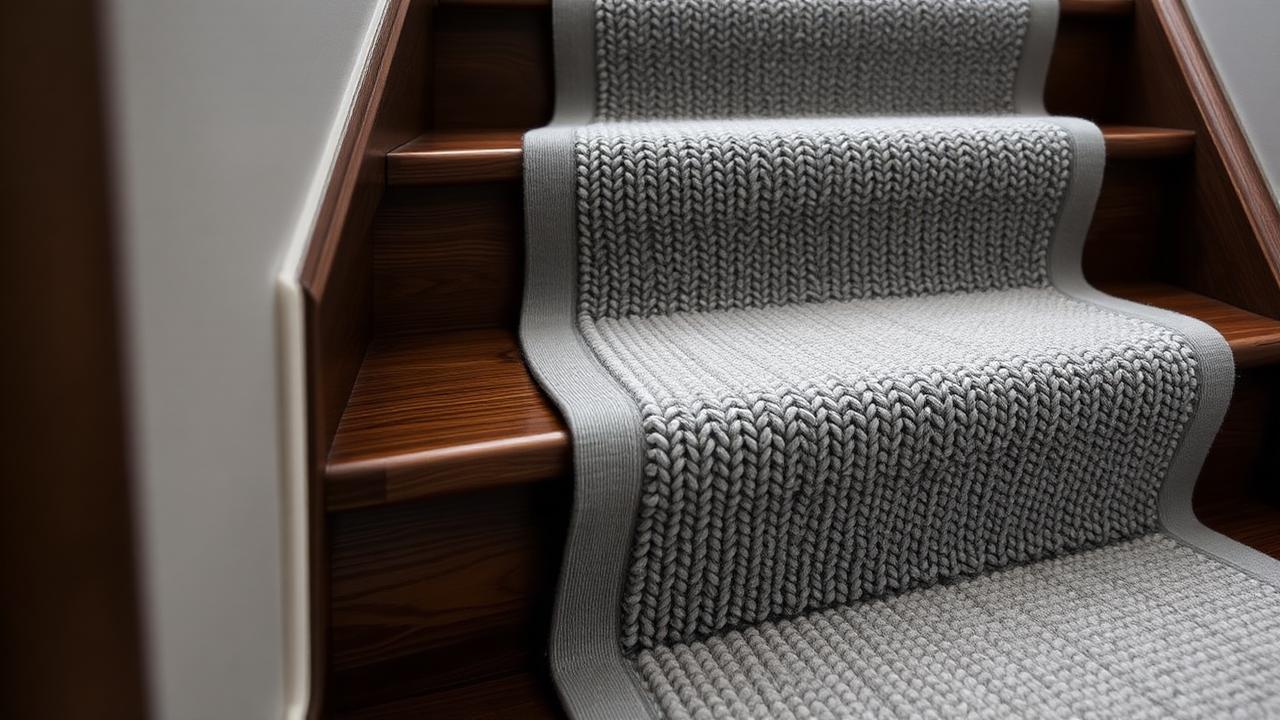
What 'washable' means on a stair runner
Genuinely washable stair products fall into two categories. The first is a set of individual stair treads, usually 22-30in wide by 8-10in deep (about 55-75cm by 20-25cm), one pad per step, held down with an adhesive or gripper strip on the underside. Each pad lifts off in seconds and goes into a domestic washing machine on a cool, gentle cycle. The second is a continuous runner in a low-pile synthetic fibre, sold in 2-3m (7-10ft) sections or as a full flight roll, which is removed from the stairs entirely, folded to fit a machine, and washed the same way a bathmat would be. Neither category is a fitted-and-forgotten product; both require you to take the covering off the stairs to clean it properly, which is the trade-off for washability.
What is not washable, whatever the label says, is a fitted wool or wool-blend runner stapled or gripper-fixed down the full flight. Those are cleaned in place, by vacuuming and occasional professional hot-water extraction, because wool shrinks, felts and loses its twist if machine-washed, and a fitted runner cannot physically go into a washing machine anyway. If a supplier calls a fitted wool runner 'washable', they almost always mean the surface can be spot-cleaned or steam-cleaned, not that you can remove and launder it.
Materials that actually survive a wash cycle
| Material | Machine-washable? | Typical pile | Notes |
|---|---|---|---|
| Low-pile polyester | Yes, cool cycle | 3-6mm | Dries fastest, most common washable range |
| Chenille cotton-poly blend | Yes, gentle cycle | 5-8mm | Softer underfoot, slightly slower to dry |
| Cotton flatweave / rag | Yes, most machines | Flat | Traditional look, colours can bleed if not colourfast |
| Polypropylene loop | Hand-wash or hose only | 4-7mm | Too bulky for most drums once wet |
| Wool / wool-sisal fitted | No | 8-12mm | Spot-clean and extraction only, never machine wash |
The reason polyester and chenille dominate the washable category is fibre behaviour, not marketing. Polyester absorbs almost no water into the fibre itself, so it does not swell, shrink or distort when agitated wet, and it releases most of its moisture in a spin cycle. Wool fibre has microscopic scales that lock together under moisture, heat and agitation — the exact mechanism that makes wool felt is the exact mechanism a washing machine provides in abundance, which is why wool runners are never sold as machine-washable.
Non-slip backing: the part that matters most
A washable runner or tread pad is only as safe as its backing, because low-pile synthetic fibre on a bare timber or laminate stair is inherently slippery underfoot without one. Look for a rubber, latex or PVC-dot backing rated for stair use specifically, not a generic rug backing intended for a flat floor. Good backings are also machine-washable themselves at low temperatures; cheaper ranges have a backing that hardens, cracks or peels away from the fibre after 15-20 wash cycles, at which point the pad becomes a genuine trip hazard and should be replaced rather than kept in use.
Test the backing before you trust it
Press a washed pad onto a bare stair tread and try to slide it sideways with moderate hand pressure. If it moves more than a few millimetres, it will move under a bare foot in socks. Re-wash at a lower temperature or replace the pad rather than continuing to use it on an open flight.
Sizing and how many pieces you need
Washable tread pads are sold by the piece, so count your risers, not your flight length: a 13-step staircase needs 13 pads (12 treads plus the top, or 13 plus a landing piece if the flight continues), and most suppliers sell in packs of 13, 14 or 15 to match common UK and US flight lengths. Standard pad depth of 8-10in (20-25cm) covers most tread depths, but measure your own tread depth first — anything deeper than about 11in (28cm) will leave a bare strip at the back of each step that pads do not cover.
Continuous washable runners are bought by length exactly like a fitted runner, so the same measuring logic applies: multiply tread depth plus riser height by the number of steps, add a nosing wrap allowance, and use the stair runner calculator to convert that into metres or feet before you order. The difference is that a washable roll is usually installed with a lighter adhesive tape or low-profile gripper rather than heavy-duty carpet gripper, because it needs to come up again for washing.
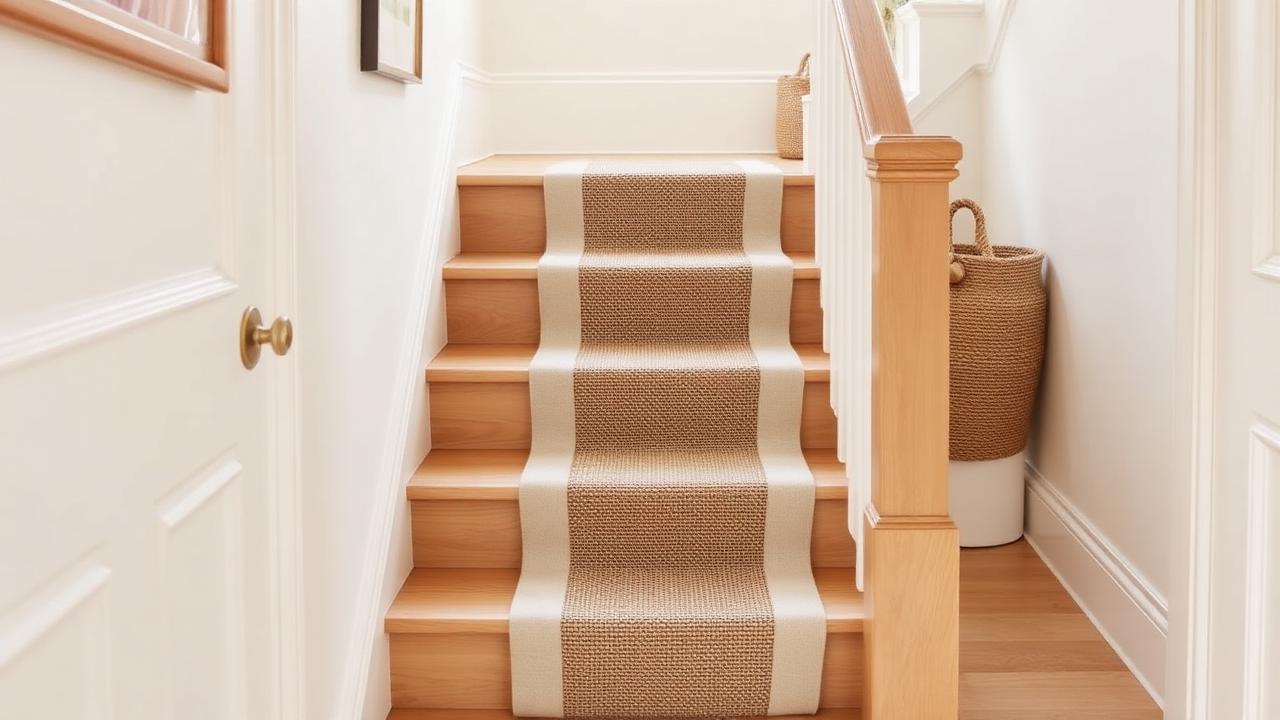
Pricing: GBP and USD
| Product type | UK price (GBP) | US price (USD) |
|---|---|---|
| Washable tread pad, single | £5-£12 each | $7-$16 each |
| 13-piece washable pad set | £60-£140 | $80-$180 |
| Washable runner, per linear metre/yard | £20-£45 | $25-$55 |
| Fitted wool runner, per linear metre/yard, for comparison | £35-£90 | $45-$110 |
Washable ranges sit at the budget-to-mid end of the market. A full 13-step set typically costs £80-£150 (roughly $100-$190) including basic fixing tape, against £400-£900 ($500-$1,100) for a mid-range fitted wool runner professionally installed on the same flight. That gap is the main reason washable runners are so popular in rental properties and family homes with young children: the whole-life cost of replacing a washable set every 3-4 years is often lower than the cost of professionally cleaning a fitted runner repeatedly over the same period.
Where washable falls short of a fitted runner
- Appearance: individual pads show visible gaps and a slightly stepped, budget look compared with a continuous fitted runner, however neatly they are laid.
- Security underfoot: pads and lightly fixed runners can shift or curl at the edges between washes, especially on gloss-painted stairs, which a stapled or gripper-fixed wool runner never does.
- Longevity: low-pile polyester crushes and mats in the high-wear centre of each tread faster than a dense wool pile, typically needing replacement within 3-5 years against 10-15 years for a well-maintained wool runner.
- Sound and warmth: thin washable pile deadens far less noise and adds far less insulation than an 8-12mm wool pile on 8-11mm underlay.
- Design range: washable ranges are almost always plain or simple stripe; you will not find fine Axminster florals or bespoke tartan in a machine-washable line.
Who a washable stair runner suits
Washable runners make most sense for households where hygiene and ease of maintenance genuinely outrank longevity and looks: homes with dogs that come in from muddy gardens, families with toddlers who spill constantly, holiday lets and rental properties where a tenant turnover needs a quick refresh, and anyone fitting a temporary covering while they save for a permanent wool runner. They are a poor choice for a grand or period staircase intended as a design feature, and a poor choice if the stairs see very heavy daily traffic, since the backing and low pile simply do not have the wear reserve of a dense fitted carpet.
If durability under heavy footfall is the priority rather than washability, it is worth reading a straight comparison of fibre durability before committing, because several hard-wearing synthetic and wool-sisal blends outlast washable ranges by years while still being far easier to spot-clean than a delicate wool pile. Work through the numbers for your own flight with the calculator before ordering either a pad set or a fitted runner, since the length and width you actually need often changes which option is better value.
Know your numbers in 30 seconds
Enter your step count, tread depth and riser height — the stair runner calculator gives you the exact length to order, in metres and feet, with waste included.
Open the stair runner calculatorWhatever you decide, get the numbers first: the stair runner calculator doubles as a stair runner length calculator, adding nosing wrap, landings, winders, pattern repeat and waste so you order the right length the first time.
Still deciding on material, width or pattern? Our hub on stair runners compares weaves, widths, backings and fitting styles side by side, then hands the numbers straight to the calculator.
Frequently asked questions
Can you put a stair runner in a normal washing machine?
Only if it is sold as a washable runner or pad in low-pile polyester, chenille or cotton, and it fits inside a domestic drum once folded. Fitted wool runners cannot go in a washing machine: they are far too large, and wool shrinks and felts under machine agitation and heat.
How often should a washable stair runner be washed?
Every 4-8 weeks for normal household traffic, or every 2-3 weeks with dogs or young children, is typical. Washing more often than the backing is rated for accelerates wear, so check the manufacturer's cycle limit rather than washing on a fixed schedule regardless of soiling.
Do washable stair runners need underlay?
Most do not use traditional foam underlay because it would need removing before every wash. Instead they rely on a built-in cushioned backing or a thin non-slip mat placed under each pad, which provides some comfort and grip but noticeably less cushioning than 8-11mm PU underlay under a fitted runner.
Will a washable runner shrink after washing?
A genuine washable range, made from polyester or a stabilised cotton blend, should not shrink noticeably if washed at the recommended temperature. Always check the care label for maximum temperature and tumble-dry advice, since heat rather than water is usually what causes any shrinkage in synthetic fibres.
Is a washable stair runner as safe as a fitted one?
It can be, provided it has a stair-rated non-slip backing and is refitted correctly after every wash. The main added risk is human error: a pad put back slightly loose or a runner refitted without re-tensioning is more likely to slip than a runner that stays permanently stapled or gripper-fixed in place.
How long does a washable stair runner last?
Typically 3-5 years of regular family use before the pile crushes and the backing needs replacing, compared with 10-15 years for a well-maintained fitted wool runner. Repeated washing accelerates wear slightly faster than vacuuming alone, so washable ranges trade some lifespan for the convenience of deep cleaning.
Know your numbers in 30 seconds
Enter your step count, tread depth and riser height — the stair runner calculator gives you the exact length to order, in metres and feet, with waste included.
Work out my runner lengthReady for real prices?
Get quotes from vetted stair runner suppliers and fitters near you. Free, no account, no obligation.
Every guide is written from hands-on measuring and fitting experience, checked against the calculator’s own maths, and re-reviewed whenever prices or methods change. Read our editorial standards.