

Why office stairwells wear differently to home stairs
An office stair runner sees a different kind of wear pattern to a home stair. It's not one household walking up and down in socks or slippers a handful of times a day, it's dozens or hundreds of people in hard-soled shoes, often the same time each morning and evening as staff arrive and leave, concentrating heavy wear into narrow windows rather than spreading it through the day. I've walked plenty of office buildings where the stair runner near the ground floor entrance has visibly worn down years before the upper flights, purely because that's the flight everyone uses to reach reception, while upper floor stairs mostly see occasional use next to a working lift.
This uneven wear pattern is worth planning for. If your building has a heavily used ground-floor flight and quieter upper flights, it's reasonable to specify a heavier-duty fibre on the busiest run and a slightly lighter, cheaper commercial-grade product on upper floors that see far less traffic, as long as both meet your building's fire classification requirements.
Choosing colour and pattern for a professional look
Most offices land on charcoal, mid-grey or navy stair runners because these colours suit corporate branding without looking corporate-beige and, more practically, they hide the grit, dust and occasional coffee spill that come with office traffic far better than a pale colour does. If your building has a branded colour scheme, a subtle tonal fleck in that colour on a grey or charcoal base is a common compromise that nods to the brand without needing a fully bespoke dye run, which most manufacturers will only offer above a fairly large minimum order quantity.
Avoid busy patterns or stripes on office stairs. They photograph well in a lobby brochure shot, but a striped runner across multiple joined flights is genuinely harder for a fitter to keep straight, and any slight misalignment at a landing join is far more visible on a striped runner than a plain loop pile.
How much runner do I need?
For a US-measured office flight of 13 steps, 10 in tread run and 7.5 in riser height, add a 0.75 in nosing wrap allowance per step, giving 18.25 in per step and 237.25 in (19.77 ft) across the flight. Add a 24 in total finishing allowance for tucking at top and bottom, reaching 21.77 ft, then apply a commercial waste margin of 8-10% to land at roughly 23.5-24 ft for a single flight. If your office stair has a half-landing turn between floors, add a further 3-4 ft to wrap that landing without an extra join.
In UK metric measurements, the same flight is 25 cm tread, 19 cm riser and 1.9 cm nosing wrap, giving 45.9 cm per step and 5.97 m across 13 steps. Add 60 cm finishing allowance for 6.57 m, then apply an 8-10% waste margin for roughly 7.1-7.2 m, with an extra 0.9-1.2 m per half-landing turn if your building has one.
| Item | US (in/ft) | UK (cm/m) |
|---|---|---|
| Per-step total | 18.25 in | 45.9 cm |
| 13 steps subtotal | 19.77 ft | 5.97 m |
| Plus finishing allowance | 21.77 ft | 6.57 m |
| With waste margin | 23.5-24 ft | 7.1-7.2 m |
| Per half-landing turn | +3-4 ft | +0.9-1.2 m |
Know your numbers in 30 seconds
Enter your step count, tread depth and riser height — the stair runner calculator gives you the exact length to order, in metres and feet, with waste included.
Open the stair runner calculatorSlip resistance and accessibility rules
Office buildings usually fall under accessibility and workplace safety rules that specify minimum slip resistance for stair coverings, particularly on escape routes. A runner with a low, dense loop pile generally provides more consistent grip for hard-soled shoes than a longer cut pile, which can feel unstable underfoot when compressed unevenly by heavy traffic. Ask your supplier for a pendulum test value or equivalent slip rating and check it against your building's workplace safety documentation before ordering, rather than judging grip by feel in a showroom.
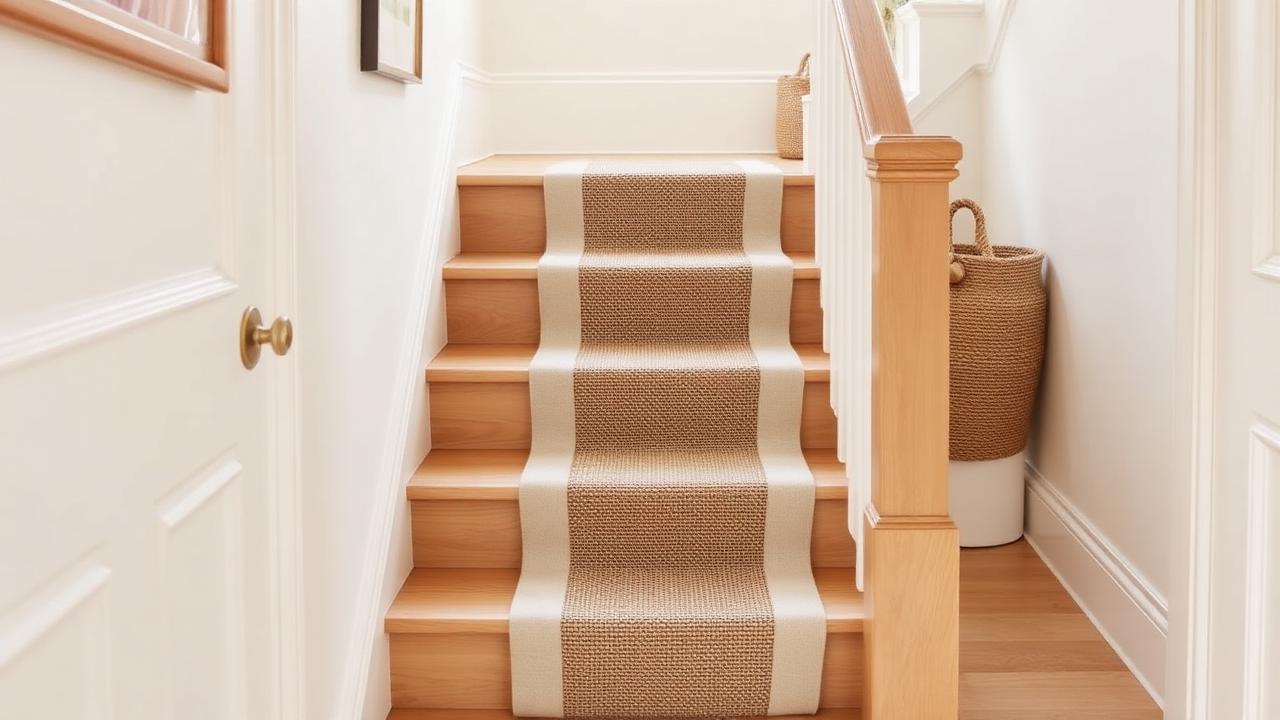
Check nosing visibility for accessibility compliance
Many workplace accessibility rules require a visually contrasting nosing strip on stair edges. If your chosen runner is a similar tone to the tread wood or paint, ask about a contrasting edge trim or nosing tape fitted alongside the runner to meet this requirement.
Ordering and installation logistics
- Measure every flight in the building separately, since office stairwells rarely have identical rise and going on every floor.
- Decide which flights get heavy-duty fibre and which can use a lighter commercial-grade product based on expected footfall.
- Confirm the fire classification required for your building and request written certification from the supplier.
- Schedule fitting outside office hours or over a weekend to avoid disrupting staff access to floors.
- Ask the fitter to plan seam locations at landings rather than mid-flight to reduce visible wear at joins.
Getting an accurate total length before you request quotes saves real time on a multi-flight office job. Running each flight's measurements through a stair runner length calculator and keeping a simple table of totals per floor means you can send one consistent set of numbers to every supplier you're comparing, rather than each supplier measuring on site separately and quoting slightly different totals.
Maintenance in a working office
Office cleaning contracts often include vacuuming as standard, but stairwells get missed more often than open-plan floors simply because they're less visible day to day. Build stair vacuuming into your cleaning schedule explicitly, at least twice a week on a busy entrance flight, and arrange a professional commercial clean of the runner every 6-12 months depending on footfall, since office stair runners installed as part of the wider stair runners fitted through a building tend to be forgotten in routine maintenance schedules compared with open floor carpet tiles.
Whatever you decide, get the numbers first: the stair runner calculator doubles as a stair runner length calculator, adding nosing wrap, landings, winders, pattern repeat and waste so you order the right length the first time.
Frequently asked questions
What colour stair runner works best in an office building?
Mid-grey, charcoal and navy are the most practical because they hide dust, grit and shoe marks far better than pale colours while still looking neutral and professional. A subtle tonal fleck can nod to brand colours without needing a fully custom dye run.
Does an office stair runner need a fire certificate?
Most office buildings open to staff and visitors require flooring on stairwells and escape routes to meet a fire classification set out in the building's fire risk assessment. Always request written certification from your supplier before ordering.
How often should an office stair runner be replaced?
A well-specified commercial loop pile on a busy office flight typically lasts 8-12 years before it needs replacing, though the busiest ground-floor flight in a building often wears out several years before quieter upper floors.
Can different floors have different quality runners in the same building?
Yes, and it's common practice. Specify a heavier-duty fibre on the ground floor and busiest flights, and a lighter commercial-grade product on upper floors with less footfall, as long as every flight still meets the building's required fire and slip standards.
Should office stairs have a cushioned underlay?
Generally no. A thick cushioned underlay can feel spongy underfoot and wear faster under heavy commercial footfall, so most office stair installs use a thinner, denser commercial underlay or a direct-stick fitting method instead.
How do I measure multiple flights in an office building accurately?
Measure each flight separately since rise and going often vary slightly between floors, then run each flight's numbers through a stair runner calculator and keep a simple per-floor table so you can request consistent, comparable quotes from suppliers.
What slip rating should an office stair runner have?
Ask your supplier for a pendulum test value or equivalent slip resistance rating and check it against your building's workplace safety documentation. A dense, low loop pile generally provides more consistent grip for hard-soled office shoes than a longer cut pile.
Is it worth fitting stair runners outside office hours?
Yes. Scheduling fitting over a weekend or evening avoids blocking staff access to floors during the working day and gives the fitter clear space to work without foot traffic disturbing fresh gripper rod and adhesive work.
Know your numbers in 30 seconds
Enter your step count, tread depth and riser height — the stair runner calculator gives you the exact length to order, in metres and feet, with waste included.
Work out your office flight length with the stair runner calculatorReady for real prices?
Get quotes from vetted stair runner suppliers and fitters near you. Free, no account, no obligation.
Every guide is written from hands-on measuring and fitting experience, checked against the calculator’s own maths, and re-reviewed whenever prices or methods change. Read our editorial standards.