
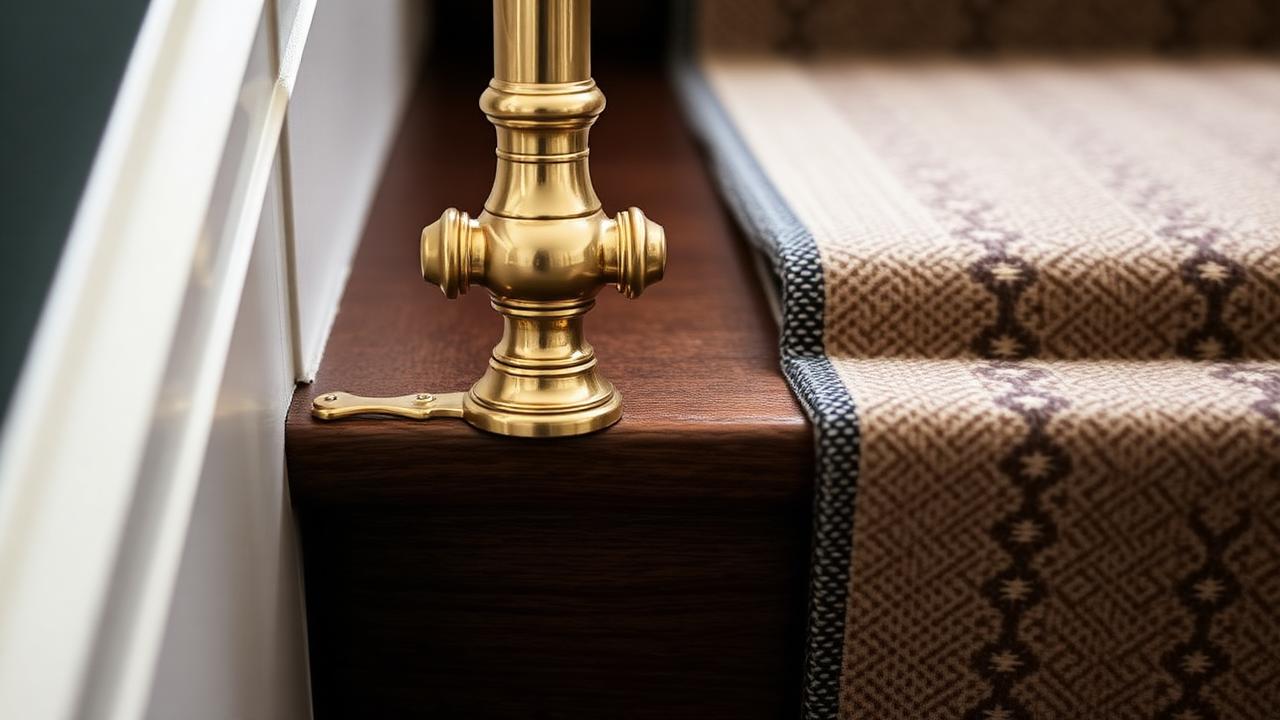
What hold downs actually do
Hold downs sit in the crease where the tread meets the riser and press the runner firmly into that angle, preventing the carpet from bulging or slipping under foot traffic. Without a proper hold-down system, even a well-fitted runner can gradually work loose, creating a tripping hazard. There are two broad categories: decorative stair rods and hidden clip or hook systems.
Traditional stair rods
Stair rods are visible metal bars, typically brass, nickel, or black iron, that lie across the runner at the base of each riser. They are held in place by decorative brackets fixed to the stringer or riser itself. Rods add a classic, tailored look and are especially popular on period staircases and runners with a formal border. When ordering rods, you need the width of your runner (not the full stair width) since the rod should sit just beyond the runner's edges, resting on the exposed timber.
Hidden clip and hook systems
Modern installations often use a hidden clip, sometimes called a stair runner clip or hook rod, which performs the same securing function without a visible metal bar. These are fixed into the crease and simply gripped over by the carpet during fitting. They are a good choice if you want a minimalist look and are especially popular with contemporary striped or solid-colour runners.
How much runner do I need?
For a 13-step flight: 10 in tread + 7.5 in riser + 0.75 in nosing wrap = 18.25 in per step, giving 237.25 in over 13 steps. Add roughly 24 in for top and bottom finishing, for 261.25 in (21.77 ft). Add an 8% waste allowance, bringing the total to about 23.5 ft. Metric: 25 cm + 19 cm + 1.9 cm = 45.9 cm per step, 596.7 cm over 13 steps, plus 60 cm finishing = 656.7 cm, plus 8% waste, roughly 7.1 m. Note that hold downs do not change the length you need; they only affect how the runner sits at each crease.
| Hold-down type | Visibility | Best for |
|---|---|---|
| Brass stair rods | Decorative | Period homes, formal runners |
| Black iron rods | Decorative | Contemporary or industrial style |
| Hidden clips/hooks | Concealed | Minimalist, modern staircases |
| Staple/tack fixing | Concealed | Budget installs, less secure |
Know your numbers in 30 seconds
Enter your step count, tread depth and riser height — the stair runner calculator gives you the exact length to order, in metres and feet, with waste included.
Open the stair runner calculatorMeasure rod width, not stair width
Stair rods should be ordered to match the width of the runner plus a small overhang on each side, not the full width of the staircase. Measure the runner first.
- Decide on rods or clips before your fitter arrives.
- Match rod finish to your other hallway hardware.
- Ask your fitter whether your chosen system suits your tread depth.
- Reorder spare rods early if a fixture goes missing later.
Choosing between the two
If budget allows and you like a traditional aesthetic, stair rods add a polished, finished look that many buyers find increases the perceived value of a home. If you prefer a clean, understated line, hidden hold downs achieve the same functional security without drawing the eye.
Spec checks for rods and brackets
Before ordering stair rods, measure the exact width of your runner, not the full staircase width, then add roughly 1-2 in (2.5-5 cm) so the rod overhangs slightly onto the exposed stringer on each side. For a 30 in (76 cm) wide runner, a 32-34 in (81-86 cm) rod is typical. Check the bracket depth too, since deep-pile runners may need a bracket with more clearance to sit flush without pinching the pile. If you are fitting hidden clips instead, confirm the clip depth matches your tread-to-riser angle, as a standard 90-degree clip will not sit correctly on a bullnose or rounded nosing profile.

Cost bands for hold-down systems
Basic black iron rods with simple brackets typically cost $8-15 per rod ($21-39), while solid brass or nickel-plated rods with decorative end caps run $18-35 per rod ($47-92). Hidden clip or hook systems are usually priced per step rather than per rod, at around $4-8 per step ($10-21), and are often included in a fitter's quoted labour cost rather than itemised separately.
| System | US price (per unit) | UK price (per unit) |
|---|---|---|
| Black iron rod | $8-15 | £21-39 |
| Brass/nickel rod | $18-35 | £47-92 |
| Hidden clip (per step) | $4-8 | £10-21 |
| Bracket set (pair) | $5-12 | £13-31 |
Maintenance of visible hardware
Brass rods will patina over time unless lacquered, which some homeowners prefer for a lived-in look while others opt for a lacquered finish or stainless steel to keep a bright, consistent shine. Wipe rods with a dry or slightly damp cloth during routine vacuuming, and avoid abrasive cleaners on plated finishes, which can wear through to the base metal beneath.
- Measure runner width, not stair width, before ordering rods.
- Check bracket clearance against your runner's pile height.
- Confirm clip depth suits a bullnose or squared nosing profile.
- Choose lacquered brass or stainless steel to avoid patina if you prefer a consistent shine.
Installing rods yourself vs hiring a fitter
Fitting stair rods is one of the more DIY-friendly parts of a runner installation, provided the runner itself is already professionally fitted and securely tacked or gripped in place. Most rod systems use simple bracket sockets screwed into the riser or stringer, with the rod itself simply dropping into place afterwards, so a confident DIYer with a drill and a spirit level can usually manage this stage in an afternoon. The main risk is inconsistent spacing: brackets that are even slightly out of line from step to step are very noticeable on a straight flight, so mark and check every bracket position before drilling any holes.
Hidden clip systems, by contrast, are almost always fitted as part of the original carpet installation rather than added afterwards, since the clips need to be positioned and the carpet tensioned over them in a single continuous process. If you are having a professional fitter install your runner, agree the hold-down system before the appointment, since switching from rods to hidden clips (or vice versa) partway through a job can mean re-cutting or re-tensioning the runner.
Choosing rod diameter and bracket spacing
Stair rods typically come in two common diameters, around 0.5 in (1.3 cm) for a slim, understated look and around 0.75-1 in (1.9-2.5 cm) for a chunkier, more traditional profile that suits wider period staircases. A thicker rod generally needs a sturdier bracket, so check the manufacturer's recommended bracket type rather than mixing and matching between different ranges. Bracket spacing should sit just inside the edges of the runner, roughly 0.5-1 in (1.3-2.5 cm) from each side, so the rod is fully supported without any unsupported overhang that could bow under weight over time.
On stairs with a pronounced bullnose or curved nosing, ask about a curved or sprung rod option rather than a straight rigid one, since a straight rod forced against a curved nosing can leave a visible gap at the centre. Some manufacturers offer a slightly flexible rod specifically designed to follow a gentle curve while remaining rigid enough not to sag.
Whatever you decide, get the numbers first: the stair runner calculator doubles as a stair runner length calculator, adding nosing wrap, landings, winders, pattern repeat and waste so you order the right length the first time.
Still deciding on material, width or pattern? Our hub on stair runners compares weaves, widths, backings and fitting styles side by side, then hands the numbers straight to the calculator.
Frequently asked questions
Do I need hold downs on every step?
Yes, for a secure, safe installation, every crease along the flight should be held down.
Do stair rods affect how much runner I need?
No, rods and clips sit on top of the runner and don't change the total length required.
What is the difference between a hook rod and a stair rod?
Hook rods are a hidden fastening system, while stair rods are decorative and visible across the runner.
Can I add stair rods after installation?
Yes, rods and brackets can usually be retrofitted to an existing runner installation.
What material of stair rod lasts longest?
Solid brass and stainless steel resist tarnishing and wear better than plated finishes.
Are hidden clips as secure as rods?
Yes, when installed correctly, hidden clips hold the runner just as securely as visible rods.
How do I measure for stair rods?
Measure the width of the runner itself, then add a small overhang for the rod to rest on exposed stringer.
Is a stair runner calculator useful when planning hold downs?
Yes, it confirms your total length and width, which helps you order the correct number and size of rods or clips.
Know your numbers in 30 seconds
Enter your step count, tread depth and riser height — the stair runner calculator gives you the exact length to order, in metres and feet, with waste included.
Check your total length with the stair runner calculatorReady for real prices?
Get quotes from vetted stair runner suppliers and fitters near you. Free, no account, no obligation.
Every guide is written from hands-on measuring and fitting experience, checked against the calculator’s own maths, and re-reviewed whenever prices or methods change. Read our editorial standards.