
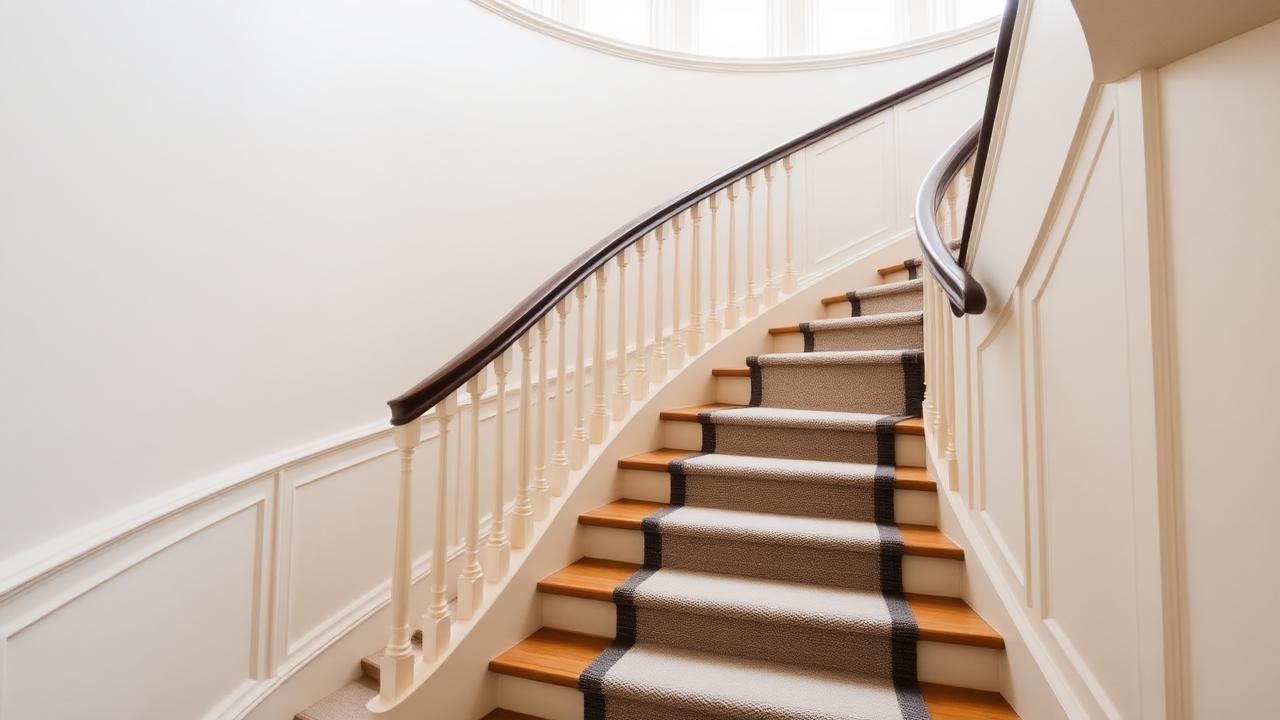
Start from the landing shape, not the pattern
Most people go looking for stair runner ideas for landings by browsing patterns first, then trying to force whatever they like onto their actual landing. I do it the other way round on site: I look at whether the landing is a shallow quarter landing barely deeper than a couple of treads, a half landing where the flight turns through 90 or 180 degrees, or a full gallery-style landing that is really a small room in its own right. That shape decides which of the three workable layouts - unbroken run-through, framed border treatment, or a deliberate break to a different finish - actually looks intentional rather than accidental.
On a shallow quarter landing, almost any attempt to introduce a separate look reads as fussy, because there simply is not enough floor area to establish a new visual idea before the eye moves on to the next flight. On those, I nearly always recommend letting the same stair runner carpet continue straight across at the same width, so the landing is barely noticed as a distinct zone. On a generous half or full landing, the opposite is true: leaving a narrow runner strip marooned in the middle of a wide flat floor looks thin and under-furnished, and it is worth treating the landing as its own design decision.
Idea one: run the same runner straight through
This is the lowest-risk option and the one I fit most often on ordinary domestic landings. The runner keeps its width and pattern uninterrupted as it crosses the flat section, so from a few feet away the landing barely registers as different from the sloped treads either side of it. It works best with a non-directional or subtly patterned runner - a tweed fleck, a narrow stripe, a plain heather-tone wool - because a bold directional chevron or herringbone can look like it has been laid slightly wrong once it hits a flat, walked-in-all-directions surface rather than a single sloped direction.
The practical advantage is that ordering is simple: one continuous roll or one continuous length, with the landing measured as an extra section of length rather than a separate design decision. If you are using a stair runner calculator to plan quantities, add the landing depth into your total length as its own line item rather than trying to fold it into the tread-by-tread count, since a flat landing section does not consume material the way a sloped tread-and-riser wrap does.
Idea two: frame the landing with a border or rug-style layout
On a half landing with a genuine turn, I like treating the landing almost like a small inset rug: the runner still continues in the same material, but a contrasting border - cotton or linen tape in a darker or lighter tone - wraps around just the landing section, visually separating it from the sloped flights either side. This works particularly well where the landing is a natural pause point, such as outside a bedroom door or beside a window, because the border effectively frames that pause the way a doormat frames an entrance.
A variation on this idea, popular with clients who want a period feel, is to use a genuinely separate small rug on the landing floor, chosen to complement rather than exactly match the stair runner, with the runner itself stopping cleanly at the landing's edge on both sides. This needs slightly more planning around where the runner ends and the rug begins, usually with a metal or wood transition strip, but it lets you use a bolder or more delicate rug than would ever survive being walked on constantly by feet coming straight off a flight of stairs.
Decide the border before you order material
If you want a framed or bordered landing look, tell your supplier before cutting, not after. A border added retroactively to an already-fitted runner rarely lines up as cleanly as one planned into the original cut and binding.
Idea three: break to a different finish entirely
Large gallery landings, the kind you find at the top of a grand staircase in an older house, often look better with the runner stopping at the landing edge and the landing itself finished differently - a full wall-to-wall carpet in a coordinating colour, exposed and polished floorboards, or even a patterned encaustic tile if the house calls for it. Trying to carry a narrow 27-30 in (68-76 cm) runner across a landing that is 10 ft (3 m) or more square looks thin and slightly apologetic, like a runner that ran out of confidence. Letting the landing breathe as its own space, with the stair runner treated purely as the flight's finish, usually reads as far more considered.
This idea also suits households where the landing doubles as a small reading nook or a wide hallway junction between two bedrooms, since a full floor covering there is more comfortable underfoot and more forgiving of furniture like a small table or bookcase than a narrow strip of stair runner carpet would be.
How much runner do I need?
Take a real US example: a 13-step lower flight with a 10 in tread run and 7.5 in riser height, turning at a half landing that is 4 ft deep, before a further 6-step upper flight of the same dimensions. Each step on the sloped sections uses roughly 17.5 in of runner once the nosing wrap is included, so the lower flight needs 13 x 17.5 in = 227.5 in, or just under 19 ft. The landing, run straight through at the same width, adds its own 4 ft (48 in) if the pattern continues unbroken, or closer to 10-15% more than that if the runner is mitred round a turn. The upper 6 steps add another 6 x 17.5 in = 105 in, roughly 8.75 ft. Add those together - about 19 ft plus 4 ft plus 8.75 ft - for a subtotal of roughly 31.75 ft, then apply a 5-10% waste allowance across the whole run for cutting and pattern matching, landing you at around 33-35 ft of finished runner to order.

In UK metric terms, the same staircase uses a 25 cm going and 19 cm riser, giving about 44.5 cm per step on the sloped sections. Thirteen steps below the landing use roughly 5.8 m, a 1.2 m deep landing run straight through adds about 1.2-1.4 m depending on whether it is mitred at a turn, and the upper 6 steps add a further 2.7 m. That totals roughly 9.7-9.9 m before waste, and with a 5-10% allowance the practical order comes to about 10.2-10.9 m. If your landing is a genuinely wide gallery rather than a standard half landing, measure its depth and width separately rather than assuming it matches the flight width, since a wide landing intended to take full carpet or a separate rug needs its own quantity calculated on its own terms.
| Section | US length | UK length |
|---|---|---|
| Lower flight (13 steps) | ≈19 ft | ≈5.8 m |
| Landing (straight through) | ≈4 ft | ≈1.2 m |
| Upper flight (6 steps) | ≈8.75 ft | ≈2.7 m |
| Total before waste | ≈31.75 ft | ≈9.7 m |
| With 5-10% waste allowance | ≈33-35 ft | ≈10.2-10.9 m |
Know your numbers in 30 seconds
Enter your step count, tread depth and riser height — the stair runner calculator gives you the exact length to order, in metres and feet, with waste included.
Open the stair runner calculatorMatching versus contrasting the landing
A question I get asked constantly is whether the landing has to match the stairs exactly. It does not, and in period houses it very often did not originally - many Victorian and Edwardian landings were finished in a plainer wall-to-wall carpet while the stair runner itself carried the more decorative pattern, purely because the landing saw different, more even foot traffic than the centre-worn tread line of a flight. If you want a genuinely coordinated look rather than an identical one, pick a landing carpet or rug in a tone lifted from the runner's palette rather than an exact colour match, which tends to look more deliberate than a perfect swatch-matched pairing.
- Unbroken run-through: simplest to order and fit, best for shallow quarter landings and subtle patterns.
- Bordered or framed landing: adds definition at a natural pause point, needs planning before the cut.
- Separate rug on the landing: allows a bolder or more delicate piece than constant stair traffic would tolerate.
- Full break to another finish: suits large gallery landings where a narrow runner strip would look under-scaled.
Fitting and fixing across a landing
Whichever layout idea you choose, the landing itself is fixed differently to the sloped treads, since there is no tread-riser crease for a rod or gripper to sit into. Most fitters use double-sided tape or a tackless gripper strip run around the landing's perimeter, sometimes with a continuous underlay pad beneath for cushioning. If the runner continues straight through from the flight, pay particular attention to the transition point at the top or bottom step, since that is the spot most likely to see a runner lift or curl first, simply because it takes the change from a fixed sloped tension to a flatter, more freely walked surface.
On a mitred or turned corner, the join needs to be cut and finished by someone experienced with directional pattern work, because a poorly aligned mitre is one of the most visible mistakes you can make on an otherwise well-planned staircase. If you are set on a bold directional pattern - a chevron, a strong stripe, a herringbone weave - budget for a fitter who has done turned landings before, rather than treating it as a standard straight-flight job.
Practical ordering advice
Whatever landing idea you settle on, give your supplier the landing's depth and width as a separate figure alongside your tread count, riser height and going, rather than folding it into a single combined length and hoping it works out. Most experienced fitters will re-measure on site anyway, but arriving with your own considered numbers from a stair runner calculator means you can sanity-check the quote before any material is cut, and it makes comparing two different suppliers' quotes far more straightforward, since you are comparing like-for-like lengths rather than guessing at what each one has actually allowed for the landing.
It is also worth deciding your landing idea before you commit to a specific stair runner colour or pattern, not after, particularly if you are leaning towards a bordered or framed treatment. Binding tape, contrasting border fabric and any separate landing rug all need to be sourced and available at the same time as the main runner material to avoid a dye-lot mismatch showing up months later when you try to add the border as an afterthought.
Whatever you decide, get the numbers first: the stair runner calculator doubles as a stair runner length calculator, adding nosing wrap, landings, winders, pattern repeat and waste so you order the right length the first time.
Frequently asked questions
Does a stair runner have to continue across the landing in the same pattern?
No. A shallow quarter landing usually looks best with the pattern running straight through, but a wider half or full landing can just as easily take a contrasting border, a separate rug, or a completely different floor finish, especially if the landing functions more like its own small room.
What is the simplest landing layout to order and fit?
An unbroken run-through, where the same stair runner carpet continues at the same width across the flat landing area. It is the lowest-risk option, needs no mitred joins, and suits shallow quarter landings and non-directional patterns particularly well.
How much extra runner does a landing typically add?
For an average landing 3-4 ft (0.9-1.2 m) deep at the same width as the stairs, expect to add roughly that depth again in length, plus an extra 10-15% on that section if the corner is mitred, to allow for the angled cut and pattern matching.
Can I use a separate rug on the landing instead of continuing the runner?
Yes, and it is a popular choice on wider landings. The runner stops cleanly at the landing edge, usually with a transition strip, and a coordinating rug finishes the flat area, which lets you use a bolder or more delicate piece than constant stair traffic would otherwise tolerate.
Does a bordered landing cost more than a plain run-through?
Generally yes, since a contrasting border needs extra binding labour and careful planning before the material is cut. It is worth deciding on a bordered look before ordering rather than trying to add it retroactively to an already-fitted runner.
How do I calculate the total runner length including a landing?
Measure the lower flight, the landing depth and width, and the upper flight separately, then add them together and apply a 5-10% waste allowance across the total. A stair runner calculator handles the tread-by-tread arithmetic for the sloped sections; add the landing figure to that result.
Is it hard to fit a runner around a landing turn myself?
It is one of the more difficult DIY stair jobs, particularly with a directional or patterned runner, since a mitred corner needs an accurate angled cut and careful pattern alignment. Many people who fit a straight flight themselves still bring in a professional specifically for the landing turn.
What holds a stair runner in place on a flat landing?
Most fitters use double-sided carpet tape or a tackless gripper strip around the landing's perimeter, sometimes with a continuous underlay pad beneath, since there is no tread-riser crease to anchor the runner into as there is on the sloped sections either side.
Know your numbers in 30 seconds
Enter your step count, tread depth and riser height — the stair runner calculator gives you the exact length to order, in metres and feet, with waste included.
Work out runner length for your landing layoutReady for real prices?
Get quotes from vetted stair runner suppliers and fitters near you. Free, no account, no obligation.
Every guide is written from hands-on measuring and fitting experience, checked against the calculator’s own maths, and re-reviewed whenever prices or methods change. Read our editorial standards.