

What's usually in a stair runner kit
A typical stair runner kit includes a pre-cut roll of carpet or runner material, a set of gripper rods or hold-down bars, and the fixings needed to attach them, such as screws or adhesive strips. Some kits go further and include a matching stair rod set for a more decorative finish, while budget kits are often just the carpet itself with basic gripper strips for a no-frills DIY fit. Always read the product listing carefully, since 'kit' can mean very different things between suppliers.
Kits are popular with DIY installers because they remove some of the guesswork around sourcing compatible hardware, and they are often priced as a bundle at a small discount compared to buying each component separately. The trade-off is flexibility: you are locked into whatever length, width and finish the kit manufacturer has chosen, which may not perfectly match your staircase.
Matching kit length to your stairs
This is where most kit buyers go wrong. Kits are sold in round, standard lengths, but staircases rarely measure out to a neat number. For our 13-step example flight, the calculation is: 10 in tread + 7.5 in riser + 0.75 in nosing wrap = 18.25 in per step. Across 13 steps that is 237.25 in, plus a 24 in finishing allowance, giving 261.25 in, or 21.77 ft. Adding a 10% waste margin for trimming and fitting brings the working total to roughly 24 ft. In metric: 25 cm + 19 cm + 1.9 cm = 45.9 cm per step, 596.7 cm across 13 steps, plus 60 cm finishing, totalling 656.7 cm, plus 10% waste, giving about 7.3 m.
| Kit Size | US (ft) | UK (m) | Fits our example flight? |
|---|---|---|---|
| Small kit | 15 ft | 4.6 m | No, too short |
| Medium kit | 20 ft | 6.1 m | No, too short |
| Large kit | 25 ft | 7.6 m | Yes, with margin |
| Custom length | 24 ft (exact) | 7.3 m (exact) | Yes, best fit |
Know your numbers in 30 seconds
Enter your step count, tread depth and riser height — the stair runner calculator gives you the exact length to order, in metres and feet, with waste included.
Open the stair runner calculatorWhen a kit falls short
If your flight is longer than the kits your preferred supplier stocks, or your staircase has a landing or a turn, a fixed-length kit often will not work cleanly. In these situations it is usually better to buy the runner material off the roll to your exact length, and source rods or grippers separately, giving you full control over quantity and finish. Many suppliers who sell kits will also sell the same runner by the linear foot or metre if you ask.
Always round up, never down
If you're between two kit sizes, always choose the longer option. A runner that's slightly too long can be trimmed by your fitter; one that's too short cannot be extended without a visible seam.
Installation hardware in a kit
Most kits include either gripper rods, which are hidden fixings that hold the carpet taut at the back of each tread, or visible stair rods, which sit in the crease between tread and riser and are more decorative. Gripper systems tend to be faster and cheaper for a DIY installer, while stair rods add a traditional, finished look but require careful spacing, usually one rod per step, positioned about 1-2 in (2.5-5 cm) from the riser base.
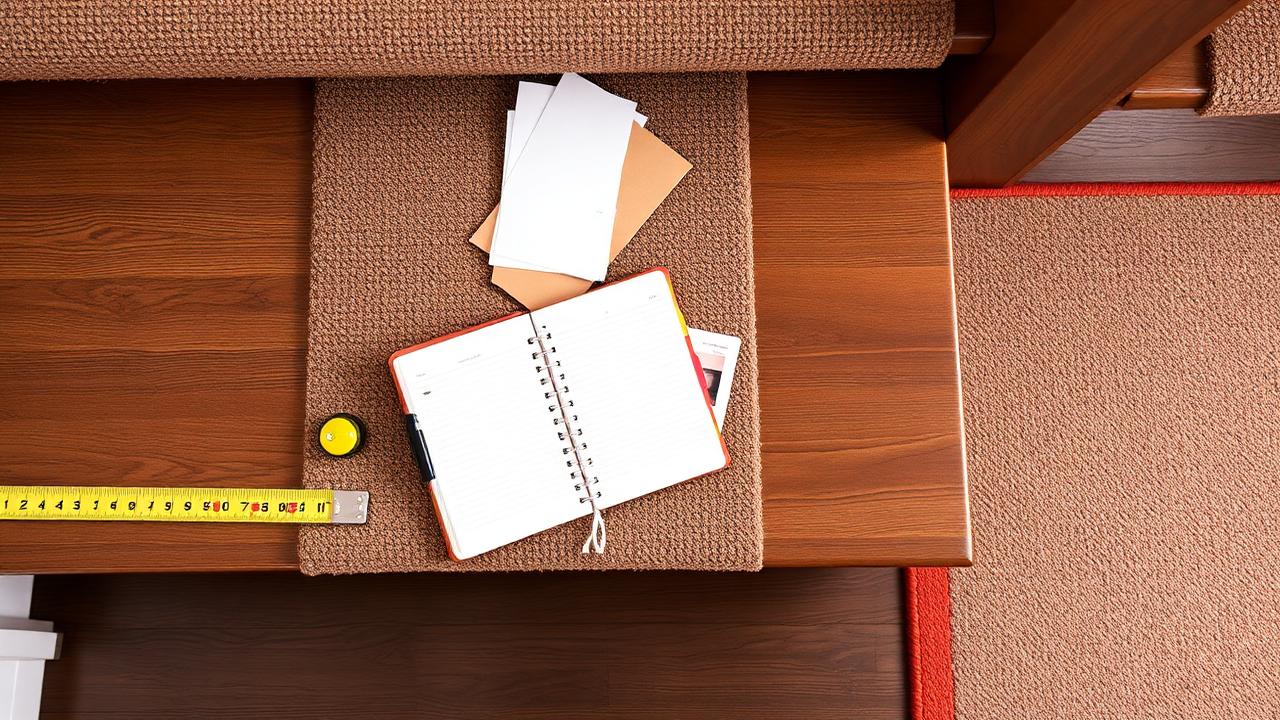
Check whether the kit's hardware is compatible with your subfloor. Gripper rods generally need to be nailed or stapled into timber, which can be difficult on stairs with a concrete or tiled substrate, in which case an adhesive-backed gripper strip is a better fit.
- Confirm the exact kit length against your calculated runner length, not just an estimate.
- Always round up to the next available kit size.
- Check whether hardware suits your subfloor material.
- Consider buying off the roll if your flight has a landing or turn.
- Ask your supplier if custom lengths are available even for 'kit' products.
Final word on kits
Stair runner kits are a convenient shortcut for straightforward, standard-sized flights, but they are not a substitute for measuring your own stairs. Run your numbers through the stair runner length calculator first, then choose the kit size, or custom order, that comfortably covers your total with margin to spare.
Typical kit pricing by size
Kit pricing in the US usually scales with both length and material quality. A basic 15 ft synthetic kit with grippers runs roughly $90-160, a 20 ft mid-range kit $180-320, and a 25 ft premium wool-blend kit with stair rods included can reach $450-700. In the UK, a 4.6 m budget kit typically costs £70-130, a 6.1 m mid-range kit £150-260, and a 7.6 m premium kit with rods £350-550. Kits bundled with decorative stair rods generally cost 25-40% more than an equivalent gripper-only kit of the same carpet.
| Kit size | US price range | UK price range |
|---|---|---|
| Small (15 ft / 4.6 m), gripper-only | $90-160 | £70-130 |
| Medium (20 ft / 6.1 m), mid-range | $180-320 | £150-260 |
| Large (25 ft / 7.6 m), premium with rods | $450-700 | £350-550 |
DIY fitting steps for a standard kit
Most kits are designed to be fitted in a repeatable sequence: starting at the top of the flight, secure the gripper rod or first fixing point at the back of the tread, pull the runner down tight over the nosing, staple or clip it into the crease where the tread meets the riser below, then repeat step by step down to the bottom. Working top to bottom keeps tension even and avoids the sagging that can happen if you start from the bottom and work up on a long flight.
Leave the runner slightly proud of the finished width on your first dry-lay, then trim to the final width only once you have confirmed it sits centred and square on every step, since even a well-measured kit can need small on-site adjustments to look right on an individual staircase.
- Work from the top of the flight down to keep tension consistent.
- Dry-lay the full kit before cutting or fixing anything permanently.
- Centre and square the runner on each step before final fixing.
- Check gripper spacing matches your tread depth before nailing in.
- Keep offcuts in case a step needs a small patch repair later.
Whatever you decide, get the numbers first: the stair runner calculator doubles as a stair runner length calculator, adding nosing wrap, landings, winders, pattern repeat and waste so you order the right length the first time.
Still deciding on material, width or pattern? Our hub on stair runners compares weaves, widths, backings and fitting styles side by side, then hands the numbers straight to the calculator.
Frequently asked questions
What does a stair runner kit usually include?
Typically a pre-cut length of carpet plus grippers or rods and the fixings needed to install them.
Are stair runner kits cheaper than buying separately?
Often slightly, though you lose flexibility on length and finish compared to buying components individually.
What if no kit size matches my exact stair length?
Round up to the next available size, or ask the supplier about custom lengths sold off the roll.
Do kits work on staircases with a landing?
Not always cleanly, since kits are designed for straight flights. Consider buying off the roll for turned or landing staircases.
Can I install a stair runner kit myself?
Many are designed for DIY installation, though staircases with winders or landings are best left to a professional fitter.
Do kits include underlay?
Rarely. Most kits assume you will source underlay separately, so budget for it in addition to the kit price.
How do I know if a kit's hardware suits my subfloor?
Check whether it uses nail-in grippers, which need timber, or adhesive strips, which work on concrete or tile.
Is it better to buy a kit or order custom length?
For standard straight flights a kit is convenient; for anything unusual, custom length off the roll gives a better fit.
Know your numbers in 30 seconds
Enter your step count, tread depth and riser height — the stair runner calculator gives you the exact length to order, in metres and feet, with waste included.
Check your exact length with the stair runner calculatorReady for real prices?
Get quotes from vetted stair runner suppliers and fitters near you. Free, no account, no obligation.
Every guide is written from hands-on measuring and fitting experience, checked against the calculator’s own maths, and re-reviewed whenever prices or methods change. Read our editorial standards.