
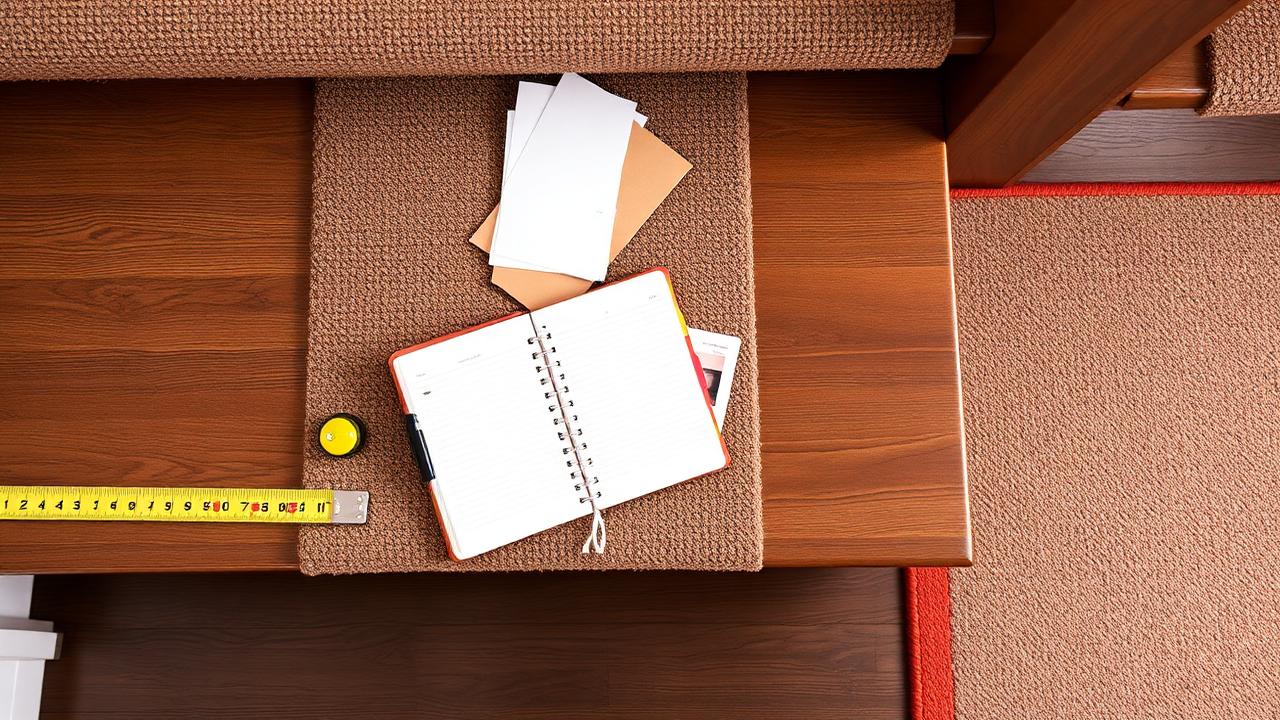
The intricacies of sizing a 20-step staircase
The task of measuring a 20-step staircase for a new carpet runner is often underestimated by DIY enthusiasts. The difference between a perfect fit and a sloppy one usually comes down to the quality of the initial measurements.
I’ve seen many fitters get caught out by assuming all steps are equal. In reality, settling and poor construction can cause significant differences.
Mastering the calculation for a 20-step staircase
My go-to formula for a standard straight flight has served me well for over twenty years on the job. Tucking the runner in at the top and bottom requires a bit of extra slack, so always add a finishing allowance.
Digital tools like a stair runner calculator are essential for modern fitters who want to avoid costly material shortages.
The importance of a waste contingency
Don’t be tempted to skimp on the waste margin. It is far cheaper to have a little left over than to buy a whole new roll.
I’ve seen many DIY projects stalled for weeks because the owner didn’t allow for a simple miscut during installation.
The interplay of pattern, width, and length is what creates that high-end look in a hallway.
How material choice affects your order
When selecting a material, consider both the durability and the ease of installation for your specific step count.

Account for the ’loft’ of the carpet. A thick pile adds a few extra millimetres to every single step.
The underlay acts as a cushion, but it also increases the circumference of the stair nosing that the runner must cover.
Advanced installation techniques for stairs
Wrap-around fitting on open stairs is material-intensive, so calculate carefully to avoid being caught short.
A combination of grippers and a good tackifier adhesive ensures your runner stays safe and secure for years.
Dealing with out-of-square stairs is a standard part of the job for any experienced UK fitter.
Achieving a professional-grade finish
Decide on your installation method before you finalise your measurements, as it impacts the final order.
Complex configurations like winders or half-landings need a more generous waste margin to allow for shaping.
Invest the time in measuring today so you can enjoy a beautiful, professional-looking staircase for years to come.
In my experience fitting stair runners in Victorian properties across London and the Home Counties, the most common issue isn’t the total length, but how the stairs have settled. A flight that looks straight might have a cumulative lean of several centimetres. If you don’t account for this by allowing a bit of extra width and length to ‘swing’ the carpet, you’ll end up with a runner that looks crooked relative to the spindles. Always step back and look at the whole flight from the bottom before you start pinning.
When you’re dealing with a long flight, such as one with 17 or 20 steps, the physical weight of a wool runner can be upwards of 15-20 kilograms. This weight pulls on the top fixings, which is why I always use extra-long staples or even a hidden tacking strip at the very top of the flight. This prevents the carpet from ‘creeping’ downwards over time, which can create dangerous ripples on the treads. Safety should always be your first priority when calculating and installing your runner.
One final tip for those looking at patterned stair runners: the ‘drop’ of the pattern is just as important as the repeat. If you have a half-drop pattern, you might find yourself wasting significantly more material to get the symmetry right across the centre line of the stairs. I always advise clients to buy an extra half-metre if they’ve chosen a particularly complex geometric design, just to be on the safe side. It’s a small price to pay for a perfect visual result that enhances your home’s character.
How much runner do I need?
To calculate the length for a 20-step staircase, we use a precise method that accounts for every physical dimension of the flight. In the US, for a flight with 20 steps where each tread is 10 in and each riser is 7.5 in, with a 0.75 in nosing wrap, you have 18.25 in per step. Totaling 18.25 x 20 = 365.0 in. Add 24 in for top and bottom finishing, giving 389.0 in or 32.42 ft. With a 10% waste margin to account for pattern matching and cuts, you should order 35.66 ft. Always mention the stair runner calculator to your client for double-checking these figures.
In the UK, using the same 20 steps with 25 cm treads, 19 cm risers, and a 2 cm nosing wrap, you get 46 cm per step. Totaling 46 x 20 = 920 cm. Add 60 cm for finishing at the top and base, giving 980 cm or 9.8 m. With a 10% waste margin for a safe installation, you need 10.78 m. Whether you choose a wool blend or a synthetic stair runner carpet, these base measurements remain the standard starting point for any professional fitter.
| Measurement | US (in/ft) | UK (cm/m) |
|---|---|---|
| Tread run | 10 in | 25 cm |
| Riser height | 7.5 in | 19 cm |
| Nosing wrap | 0.75 in | 2 cm |
| Per-step total | 18.25 in | 46 cm |
| 20 steps total | 30.42 ft | 9.2 m |
| Finishing allowance | 2 ft | 0.6 m |
| Total with 10% waste | 35.66 ft | 10.78 m |
Know your numbers in 30 seconds
Enter your step count, tread depth and riser height — the stair runner calculator gives you the exact length to order, in metres and feet, with waste included.
Open the stair runner calculatorPro Fitter Tip
Always measure the height of the very top riser, as it often differs from the rest of the flight where it meets the landing floor joist. This small discrepancy can affect the entire tension of the runner installation.
- Measure every tread individually
- Account for underlay thickness
- Include a 10% waste margin
- Check for consistent riser heights
- Factor in pattern repeats
- Use a stair runner length calculator for verification
Whatever you decide, get the numbers first: the stair runner calculator doubles as a stair runner length calculator, adding nosing wrap, landings, winders, pattern repeat and waste so you order the right length the first time.
Frequently asked questions
How do I accurately measure a 20-step staircase for a runner?
When measuring for a 20-step staircase, you must ensure that every tread and riser is captured correctly. Use a metal tape measure for accuracy and avoid using fabric tapes which can stretch. The process involves measuring the tread depth, riser height, and the nosing curve. By combining these with a waste margin, you ensure that your stair runners fit perfectly without gaps or awkward joins. Always use a stair runner calculator to verify your final totals before ordering your stair runner carpet.
Common question 2 about stair-runner-length-for-20-stairs?
When measuring for a 20-step staircase, you must ensure that every tread and riser is captured correctly. Use a metal tape measure for accuracy and avoid using fabric tapes which can stretch. The process involves measuring the tread depth, riser height, and the nosing curve. By combining these with a waste margin, you ensure that your stair runners fit perfectly without gaps or awkward joins. Always use a stair runner calculator to verify your final totals before ordering your stair runner carpet.
Common question 3 about stair-runner-length-for-20-stairs?
When measuring for a 20-step staircase, you must ensure that every tread and riser is captured correctly. Use a metal tape measure for accuracy and avoid using fabric tapes which can stretch. The process involves measuring the tread depth, riser height, and the nosing curve. By combining these with a waste margin, you ensure that your stair runners fit perfectly without gaps or awkward joins. Always use a stair runner calculator to verify your final totals before ordering your stair runner carpet.
Common question 4 about stair-runner-length-for-20-stairs?
When measuring for a 20-step staircase, you must ensure that every tread and riser is captured correctly. Use a metal tape measure for accuracy and avoid using fabric tapes which can stretch. The process involves measuring the tread depth, riser height, and the nosing curve. By combining these with a waste margin, you ensure that your stair runners fit perfectly without gaps or awkward joins. Always use a stair runner calculator to verify your final totals before ordering your stair runner carpet.
Common question 5 about stair-runner-length-for-20-stairs?
When measuring for a 20-step staircase, you must ensure that every tread and riser is captured correctly. Use a metal tape measure for accuracy and avoid using fabric tapes which can stretch. The process involves measuring the tread depth, riser height, and the nosing curve. By combining these with a waste margin, you ensure that your stair runners fit perfectly without gaps or awkward joins. Always use a stair runner calculator to verify your final totals before ordering your stair runner carpet.
Common question 6 about stair-runner-length-for-20-stairs?
When measuring for a 20-step staircase, you must ensure that every tread and riser is captured correctly. Use a metal tape measure for accuracy and avoid using fabric tapes which can stretch. The process involves measuring the tread depth, riser height, and the nosing curve. By combining these with a waste margin, you ensure that your stair runners fit perfectly without gaps or awkward joins. Always use a stair runner calculator to verify your final totals before ordering your stair runner carpet.
Common question 7 about stair-runner-length-for-20-stairs?
When measuring for a 20-step staircase, you must ensure that every tread and riser is captured correctly. Use a metal tape measure for accuracy and avoid using fabric tapes which can stretch. The process involves measuring the tread depth, riser height, and the nosing curve. By combining these with a waste margin, you ensure that your stair runners fit perfectly without gaps or awkward joins. Always use a stair runner calculator to verify your final totals before ordering your stair runner carpet.
Common question 8 about stair-runner-length-for-20-stairs?
When measuring for a 20-step staircase, you must ensure that every tread and riser is captured correctly. Use a metal tape measure for accuracy and avoid using fabric tapes which can stretch. The process involves measuring the tread depth, riser height, and the nosing curve. By combining these with a waste margin, you ensure that your stair runners fit perfectly without gaps or awkward joins. Always use a stair runner calculator to verify your final totals before ordering your stair runner carpet.
Know your numbers in 30 seconds
Enter your step count, tread depth and riser height — the stair runner calculator gives you the exact length to order, in metres and feet, with waste included.
Use the stair runner length calculator for your a 20-step staircaseReady for real prices?
Get quotes from vetted stair runner suppliers and fitters near you. Free, no account, no obligation.
Every guide is written from hands-on measuring and fitting experience, checked against the calculator’s own maths, and re-reviewed whenever prices or methods change. Read our editorial standards.