
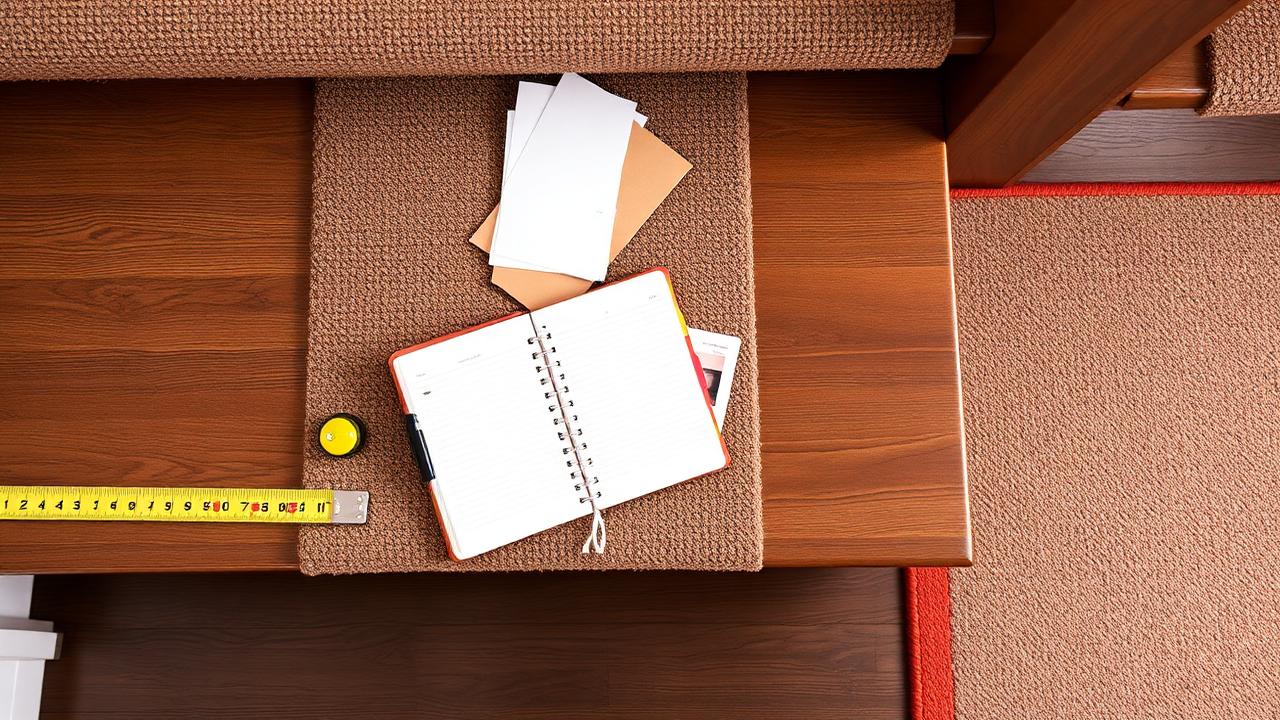
Tools you need
You will need a steel tape measure (a fabric tape can stretch and give inaccurate readings), a notepad or phone to record each measurement, and ideally a helper to hold the tape at awkward angles. If your staircase has winders or curves, a flexible tape or a piece of string can help you trace the actual path the runner will follow.
Step 1: measure the tread depth
The tread depth is the horizontal surface you step on, measured from the front edge (the nosing) to the point where it meets the riser above. A typical residential tread is about 10 in (25 cm), though older homes can vary from 9-11 in (23-28 cm). Measure at least three treads and use the average, since minor construction variances are common, especially in older properties.
Step 2: measure the riser height
The riser is the vertical face between two treads. Measure from the top of one tread down to the top of the next. Standard risers run 7-7.75 in (18-20 cm) in most homes, with building codes typically capping maximum riser height for safety. Again, measure a few risers and average them if there is variation.
Step 3: account for the nosing wrap
The nosing is the rounded or overhanging front lip of the tread. Runners wrap slightly around this edge before continuing down to the next riser, and this wrap typically adds about 0.75 in (1.9 cm) per step. Skipping this allowance is one of the most common reasons DIY orders come up short.
Step 4: total the calculation
For a 13-step flight: 10 in tread + 7.5 in riser + 0.75 in wrap = 18.25 in per step. Across 13 steps, that totals 237.25 in. Add a finishing allowance of about 24 in for tucking under the top landing and finishing cleanly at the bottom, giving 261.25 in, or 21.77 ft. With a 10% waste margin for cutting and pattern matching, order approximately 24 ft. Metric: 25 + 19 + 1.9 cm = 45.9 cm per step, times 13 is 596.7 cm, plus 60 cm finishing is 656.7 cm, plus 10% waste is roughly 7.3 m.

| Measurement | US (in) | UK (cm) |
|---|---|---|
| Tread depth | 10 | 25 |
| Riser height | 7.5 | 19 |
| Nosing wrap | 0.75 | 1.9 |
| Per-step total | 18.25 | 45.9 |
Know your numbers in 30 seconds
Enter your step count, tread depth and riser height — the stair runner calculator gives you the exact length to order, in metres and feet, with waste included.
Open the stair runner calculatorStep 5: measure width and any winders
Measure the full width of your staircase at several points, since older stairs can taper slightly. Decide on your desired runner width, leaving an even gap on each side. If you have winders, measure each winder tread individually along both the narrow and wide edges, since a single average measurement will not capture the pie-shaped geometry accurately.
Measure twice, order once
Because carpet is expensive and often non-returnable once cut, take every measurement twice on different days if possible. A staircase settles and shifts slightly over decades, so double-checking avoids costly surprises.
- Use a steel tape measure, not fabric, for accuracy.
- Average tread and riser measurements across several steps.
- Always include the nosing wrap allowance per step.
- Measure winders individually rather than estimating.
- Add a 10% waste margin to your final total.
Recording measurements so nothing gets lost
It is easy to take careful measurements and then lose track of which figure applied to which step, especially on a staircase with winders or a mid-flight landing. Number each step on your notepad or phone from the bottom up, and record tread depth, riser height, and width for every single step rather than assuming uniformity. This level of detail feels excessive on a straightforward flight, but it is exactly the record a fitter or supplier will want if any discrepancy comes up later.
| Step number | Tread depth | Riser height |
|---|---|---|
| 1 | 10 in / 25 cm | 7.5 in / 19 cm |
| 2-12 | Record individually | Record individually |
| 13 (top) | 10 in / 25 cm | 7.5 in / 19 cm |
Common measuring mistakes to avoid
The most frequent error is forgetting the nosing wrap allowance entirely, which alone can leave an order roughly 10 in (25 cm) short across a 13-step flight. The second most common mistake is measuring only the bottom few steps and assuming the rest match, when older homes in particular can have tread depths that vary by half an inch (about 1 cm) or more between the top and bottom of a flight. The third is forgetting to add a finishing allowance for tucking the runner under the top landing and finishing cleanly at the base.
- Number and record every individual step rather than assuming uniformity.
- Never skip the nosing wrap allowance in your total.
- Check top and bottom treads separately, since older homes can vary.
- Keep a written record in case a fitter or supplier needs to verify your figures.
- Re-check your total against a calculator before placing a final order.
When to call a professional
If your staircase includes a curve, a spiral section, or significant winders, it is worth having a professional fitter take the final measurements, since the margin for error narrows considerably on non-standard geometry. For a straightforward straight flight, careful DIY measuring with the steps above is usually sufficient.
Whatever you decide, get the numbers first: the stair runner calculator doubles as a stair runner length calculator, adding nosing wrap, landings, winders, pattern repeat and waste so you order the right length the first time.
Still deciding on material, width or pattern? Our hub on stair runners compares weaves, widths, backings and fitting styles side by side, then hands the numbers straight to the calculator.
Frequently asked questions
What is the average tread depth?
Around 10 in (25 cm) in most homes, though it can range from 9-11 in (23-28 cm) depending on the property's age and design.
Why do I need to add nosing wrap?
The runner wraps slightly around the front lip of each tread, adding roughly 0.75 in (1.9 cm) per step that is easy to forget.
How much runner do I need for 13 steps?
Approximately 23-24 ft (7-7.3 m) including nosing wrap, finishing allowance, and a 10% waste margin.
Should I measure every step or just a few?
Measure several and average them, since minor construction variances are common, especially in older homes.
How do I measure winders?
Measure each winder tread individually along both its narrow and wide edges, since a single average will not reflect the pie shape.
What tape measure should I use?
A steel tape measure is best, since fabric tapes can stretch and introduce inaccuracies.
How much finishing allowance should I add?
Around 24 in (60 cm) total to tuck under the top landing and finish cleanly at the base of the stairs.
Should I hire a professional to measure?
For curved, spiral, or heavily winding staircases, yes; for a standard straight flight, careful DIY measuring is usually enough.
Know your numbers in 30 seconds
Enter your step count, tread depth and riser height — the stair runner calculator gives you the exact length to order, in metres and feet, with waste included.
Enter your measurements into the stair runner calculatorReady for real prices?
Get quotes from vetted stair runner suppliers and fitters near you. Free, no account, no obligation.
Every guide is written from hands-on measuring and fitting experience, checked against the calculator’s own maths, and re-reviewed whenever prices or methods change. Read our editorial standards.