
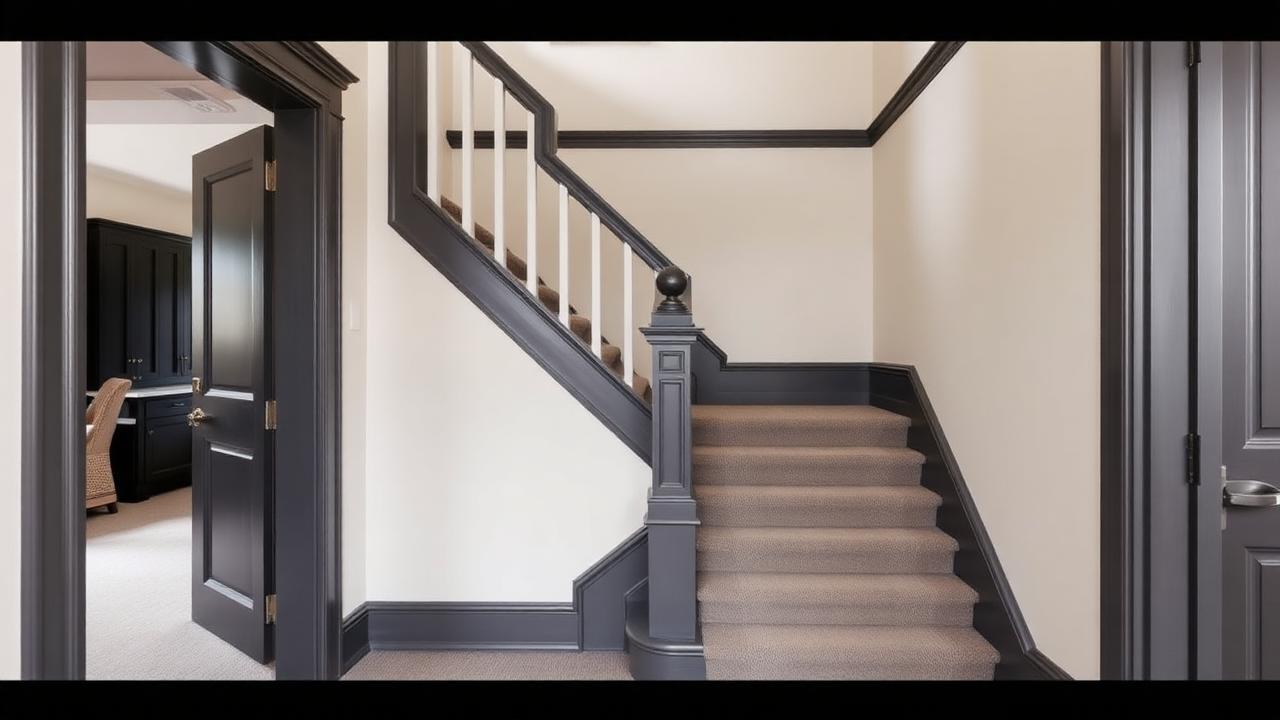
The art of the mitred corner
When a stair runner turns a corner - whether on a quarter-landing or a winder step - the border needs to turn with it. If you simply fold the binding, you end up with a bulky, triple-layered mess that is both ugly and a trip hazard. A mitred corner solves this by cutting the binding tape at a precise angle and sewing it together so the border remains flat and continuous. This is most commonly seen on cotton-bound or leather-bound runners where the border is a distinct decorative element. In the trade, a clean mitre is what separates a DIY job from a master fitter’s work.
Mitring is particularly important on 'Hollywood' style stairs where the runner wraps tightly around every contour. Because the binding has no 'stretch' in its longitudinal direction, the only way to make it turn a sharp corner is to cut and join it. This requires a very steady hand and an industrial sewing machine. When I'm working on a bespoke project, I often pre-fabricate the mitres in the workshop based on a template of the stairs, ensuring the angles are mathematically perfect before the runner even arrives at the house.
Templates are critical
For winders and landings, never rely on measurements alone. Use template paper (or cheap lining paper) to trace the exact shape of the step and the desired path of the runner. This ensures your mitred corners end up in the right place.
Mitring on Winders and Landings
Landings are the most common place for mitred corners. Often, a runner will travel up a flight, turn 90 degrees across a landing, and then continue up a second flight. To maintain the border's continuity, the fitter must create a mitre at the corner of the landing. This is done by 'double-mitring' if the runner is turning back on itself. On winder steps (the triangular steps that turn a corner), the inner edge of the runner is much shorter than the outer edge. This means the binding on the outside needs to be mitred to accommodate the extra length without puckering.
From an aesthetic standpoint, a mitred corner creates a beautiful geometric frame that emphasizes the architecture of the staircase. It works particularly well with striped runners, where the mitre can be used to change the direction of the stripes to follow the turn of the stairs. However, this is advanced work; if the stripes don't line up perfectly at the mitre, it will be very obvious. This is why using a stair runner length calculator is so important - you need that extra bit of 'play' in the material to align the patterns and mitres exactly.
How much runner do I need?
Calculating for a runner with mitred corners requires more material than a straight run. For a UK flight of 13 steps with a 25 cm going and 19 cm rise, the base length is 572 cm. Add 5 cm per nosing (65 cm) and 15 cm for the ends. Total: 652 cm. However, for every 90-degree mitre on a landing, you should add at least 30 cm (1 foot) to allow for the 'turn' and the waste created by the angle cuts. A 10-15% waste margin is standard for these complex jobs, bringing the order to around 7.5 metres.

In US units for 13 steps (10 inch treads, 7.5 inch risers): (10 + 7.5) x 13 = 227.5 inches. Add 13 inches for nosings and 12 inches for ends. Total: 252.5 inches. For a landing with two mitred corners, add another 12-18 inches to the total. With a 15% waste margin to account for pattern matching and mitre cuts, you'd need approximately 305 inches, or 25.4 feet. Using a stair runner calculator helps you visualize these additions and ensures you don't run out of material mid-corner, which is a disaster on a custom-bound job.
| Feature | Mitred Corner | Overlapped Corner | Whipped Corner |
|---|---|---|---|
| Visual Profile | Flat, seamless 45° join | Bulky, layered | Soft, rounded (no join) |
| Suitability | Taped borders (Cotton/Leather) | Low-budget DIY only | Minimalist serged runners |
| Trip Hazard | Very Low | Moderate | Low |
| Difficulty | High (Professional) | Low | Low |
| Aesthetic | Bespoke / Formal | Unfinished | Modern / Casual |
Know your numbers in 30 seconds
Enter your step count, tread depth and riser height — the stair runner calculator gives you the exact length to order, in metres and feet, with waste included.
Open the stair runner calculatorFitting Tips and Durability
When fitting a mitred runner, the tension is everything. If the runner is pulled too tight in one direction, the mitre will 'gape' and show the carpet backing. I use a specialized heat-bond tape under the mitre join to reinforce the stitching, ensuring that foot traffic doesn't pull the seam apart over time. The mitre should be positioned so that it doesn't sit directly on the 'swing' area where people's heels strike the floor, which helps maintain the integrity of the join for 10-20 years.
Maintenance is the same as any bound runner, but pay extra attention to the mitre seam when vacuuming. Avoid using the beater bar directly over the join to prevent the threads from being pulled. If a thread does come loose, it's vital to have it repaired quickly before the seam opens up. A well-made mitre is incredibly durable, but like any precision joint, it is only as strong as the stitching and the installation behind it. When you choose a stair runner carpet with a bold border, the mitre is what makes it look like a piece of high-end design.
Frequently asked questions
What is a mitred corner on a stair runner?
It is a 45-degree angled join in the runner's border (binding) that allows the runner to turn a 90-degree corner on a landing or winder step while remaining flat and seamless.
Can I mitre the corners of a runner myself?
Unless you have an industrial sewing machine and experience with heavy fabrics, it is very difficult. It involves cutting the carpet and binding precisely and then re-sewing them together, which is a job for a professional workshop.
Do all stair runners need mitred corners?
No. Straight flights don't need them. Only runners that turn a corner on a landing or winder steps require mitres if they have a flat-tape border (like cotton or leather).
Is a mitred corner a trip hazard?
Actually, it's the opposite. By keeping the border flat and preventing the 'bulk' of an overlapped join, a mitred corner is safer than an unfinished or poorly folded corner.
Does mitring cost more?
Yes, most workshops charge per mitre because it is a time-consuming manual process that requires high precision.
Can you mitre a striped stair runner?
Yes, and it looks spectacular when done correctly, as the stripes change direction to follow the stairs. However, it requires significantly more material for pattern matching.
Why is my mitre seam opening up?
This usually happens if the runner wasn't secured properly to the floor, allowing it to shift and pull on the seam. It can also be caused by poor-quality stitching or failing to use reinforcing tape.
How much extra carpet do I need for mitres?
As a rule of thumb, add at least 30 cm (1 foot) per 90-degree turn, plus a higher overall waste margin (15% instead of 10%) to allow for the angled cuts.
Know your numbers in 30 seconds
Enter your step count, tread depth and riser height — the stair runner calculator gives you the exact length to order, in metres and feet, with waste included.
Calculate runner length for complex mitred installationsReady for real prices?
Get quotes from vetted stair runner suppliers and fitters near you. Free, no account, no obligation.
Every guide is written from hands-on measuring and fitting experience, checked against the calculator’s own maths, and re-reviewed whenever prices or methods change. Read our editorial standards.