

Material options
Your material choice sets the tone for everything else. Wool stair runners are the traditional premium choice, offering a soft, warm feel and excellent resilience. Nylon runners are more budget-friendly and highly stain resistant, making them a practical option for busy households. Sisal, seagrass, and other natural fibre runners bring texture and a relaxed, coastal aesthetic, though they can feel rougher underfoot and are less forgiving of spills. Wool-blend runners, often 80% wool and 20% nylon, try to combine the best of both worlds.
| Material | Feel | Durability | Best for |
|---|---|---|---|
| Wool | Soft, warm | Very good | Traditional homes |
| Nylon | Firm, springy | Excellent | Busy families |
| Wool-blend | Soft, resilient | Excellent | Most households |
| Sisal/seagrass | Textured, coarse | Good if dry | Coastal, rustic looks |
Width and gap options
Stair runners commonly come in widths from 24 in to 42 in (60 cm to 107 cm), though 27-36 in (68-91 cm) is most typical for a residential staircase. Choosing a narrower runner leaves more exposed timber or stone on either side, which suits a period property, while a wider runner that nearly fills the staircase gives a fuller, more contemporary look. Always measure your total stair width and decide on your desired gap before selecting a width option.
How much stair runner do I need?
Regardless of which option you choose, the calculation stays the same. For a 13-step flight: 10 in tread + 7.5 in riser + 0.75 in nosing wrap = 18.25 in per step. Across 13 steps this totals 237.25 in, plus a 24 in finishing allowance gives 261.25 in, or 21.77 ft. With an 8-10% waste margin, order around 23.5-24 ft. In metric: 25 cm + 19 cm + 1.9 cm = 45.9 cm per step, 13 steps totals 596.7 cm, plus 60 cm finishing is 656.7 cm, and with waste, roughly 7.1-7.3 m.
Know your numbers in 30 seconds
Enter your step count, tread depth and riser height — the stair runner calculator gives you the exact length to order, in metres and feet, with waste included.
Open the stair runner calculatorPattern versus plain
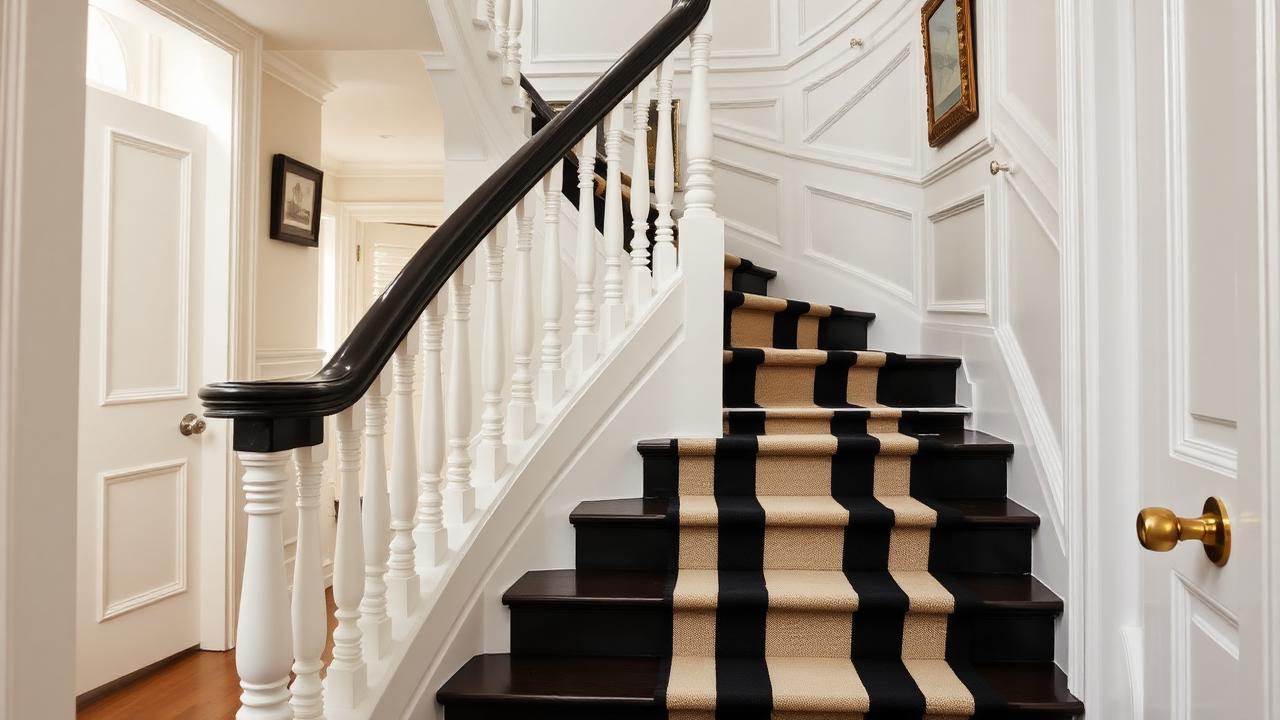
Plain runners are the safest, most versatile choice and suit almost any decor style, while patterned runners such as stripes, florals, or geometrics can add real character but require more careful measuring to ensure the pattern lines up neatly on each tread and at any landings. If you choose a bold pattern stair runner, a stair runner length calculator becomes even more valuable, as accurate lengths reduce the risk of an awkward partial repeat at the top or bottom of the flight.
- Decide on material first based on lifestyle and budget.
- Choose a width that suits your staircase style and desired gap.
- Consider pattern only once material and width are settled.
- Confirm fitting method: tackless strip, rods, or a hybrid installation.
Fitting method options
The two most common fitting methods are the waterfall method, where the runner falls straight down each riser, and the Hollywood or French cap method, which wraps the fabric under and around the nosing for a more tailored look. Stair rods can be added to either method purely for decorative effect, or used as the actual fixing method on open or antique staircases.
Don't decide on looks alone
Always weigh your household's lifestyle against the aesthetic. A beautiful pale wool runner will show stains quickly in a home with young children or pets, no matter how attractive it looks in the showroom.
Worked example for a different flight size
Not every staircase has 13 steps, so it helps to see the formula applied to a shorter run too. For a 10-step flight with the same 10 in (25 cm) tread and 7.5 in (19 cm) riser: 18.25 in per step multiplied by 10 steps gives 182.5 in, plus a 24 in finishing allowance is 206.5 in, or 17.2 ft. With an 8-10% waste margin, order roughly 18.5-19 ft. In metric: 45.9 cm per step across 10 steps is 459 cm, plus 60 cm finishing equals 519 cm, and with waste, around 5.6-5.7 m.
| Flight length | US total (with waste) | UK total (with waste) |
|---|---|---|
| 10 steps | 18.5-19 ft | 5.6-5.7 m |
| 13 steps | 23.5-24 ft | 7.1-7.3 m |
| 16 steps | 28-29 ft | 8.5-8.8 m |
Checking specification sheets before you buy
When comparing stair runner options side by side, ask each supplier for the same core specification details so you are comparing like with like: fibre content and blend ratio, pile weight in ounces per square yard or grams per square metre, backing type, and any stain or fade warranty terms. A lower headline price on a thin, lightweight pile is not necessarily better value than a slightly pricier option with a denser, heavier construction that will outlast it on a high-traffic staircase.
Styling rules worth following
As a general styling rule, keep the runner width consistent with the proportions of your staircase rather than defaulting to the same width used elsewhere in the house. A narrow, steep staircase generally suits a narrower runner that keeps sightlines clean, while a broad, shallow staircase can carry a wider runner without looking heavy. Keep any pattern scale in proportion to the runner width too; a large motif on a narrow runner tends to look cramped.
- Request pile weight and backing type from each supplier, not just price per foot.
- Match runner width to staircase proportions rather than to other rooms in the house.
- Ask about stain and fade warranty terms in writing before ordering.
- Re-run the length calculation for your actual step count rather than assuming 13 steps.
Typical cost bands
As a rough guide, budget nylon options tend to sit at the lower end of the price range, wool-blends in the middle, and premium wool or natural fibre runners at the top, before fitting. Fitting labour, underlay, and any binding or edge finishing are usually quoted separately, so always ask for a full installed price rather than comparing material costs alone.
Ultimately, the right stair runner option balances your budget, your household's daily wear and tear, and the style of your staircase. Take time comparing swatches side by side, and always verify your total length with a calculator before placing a final order.
Whatever you decide, get the numbers first: the stair runner calculator doubles as a stair runner length calculator, adding nosing wrap, landings, winders, pattern repeat and waste so you order the right length the first time.
Frequently asked questions
What is the most durable stair runner material?
Nylon and wool-nylon blends are generally the most durable, resisting wear, staining, and crushing better than pure wool or natural fibres.
What width should I choose?
Most homes use 27-36 in (68-91 cm) runners, leaving a few inches of exposed stair on each side, though this depends on personal taste.
Is a patterned runner harder to fit?
Yes, slightly. Patterns need careful measuring so the repeat lines up neatly on each step and at the top and bottom of the flight.
How much runner do I need for 13 steps?
Around 23-24 ft (7-7.3 m) including nosing wrap, finishing allowance, and waste margin.
Are natural fibre runners a good option?
They look great and add texture, but sisal and seagrass are less forgiving of spills and can feel rougher underfoot than wool or nylon.
Should I choose rods or a waterfall fit?
This is largely aesthetic; rods add a traditional, decorative touch, while a plain waterfall fit gives a cleaner, more contemporary look.
Can I mix materials on one staircase?
It's unusual and generally not recommended, as inconsistent thickness and wear rates can create an uneven, unbalanced result.
Do wider runners cost more?
Yes, wider runners use more material per linear foot, so they typically cost more than a narrower option of the same design.
Know your numbers in 30 seconds
Enter your step count, tread depth and riser height — the stair runner calculator gives you the exact length to order, in metres and feet, with waste included.
Compare lengths with the stair runner calculatorReady for real prices?
Get quotes from vetted stair runner suppliers and fitters near you. Free, no account, no obligation.
Every guide is written from hands-on measuring and fitting experience, checked against the calculator’s own maths, and re-reviewed whenever prices or methods change. Read our editorial standards.