

Why pattern changes the maths
With a plain stair runner, you simply need the total length. With a pattern stair runner, you also need to know the pattern repeat—the distance before the design starts again—so the motif lands consistently on each tread and, ideally, centres neatly at the top and bottom of the flight. Ordering slightly extra length gives your fitter room to shift the cut point and avoid an awkward half-motif at a highly visible step.
Popular pattern styles
Stripes are the most forgiving pattern for stairs because they usually run across the width rather than the length, so there is no repeat to match along the run. Geometric patterns such as diamonds, checkerboards, and trellis designs need more careful planning, since their repeat runs down the length of the runner. Floral and ikat patterns fall somewhere in between, often with a longer repeat that is more forgiving over a typical flight of stairs.
| Pattern type | Matching difficulty | Best for |
|---|---|---|
| Stripes | Low | Most staircases |
| Checkerboard | Medium-high | Modern, graphic interiors |
| Diamond/trellis | Medium-high | Traditional and transitional |
| Floral/ikat | Medium | Period and eclectic interiors |
How much runner do I need?
Start with the standard calculation, then add extra for pattern matching. For a 13-step flight: 10 in tread + 7.5 in riser + 0.75 in nosing wrap = 18.25 in per step. Across 13 steps this totals 237.25 in, plus 24 in finishing allowance gives 261.25 in, or 21.77 ft. For most patterns, add a 10-12% waste and matching margin, bringing the order to around 24-24.5 ft. In metric: 25 cm + 19 cm + 1.9 cm = 45.9 cm per step, totalling 596.7 cm across 13 steps, plus 60 cm finishing is 656.7 cm, and with the pattern-matching margin, roughly 7.3-7.5 m.
Know your numbers in 30 seconds
Enter your step count, tread depth and riser height — the stair runner calculator gives you the exact length to order, in metres and feet, with waste included.
Open the stair runner calculatorWorking with your fitter on repeat placement
Before cutting, a good fitter will lay the runner out and decide where to start the pattern so that the most visually prominent steps—typically the bottom two or three, which are seen most often—display a full, uncut motif. Any partial repeat is usually hidden near the top of the flight or tucked under the landing nosing where it is least noticeable.
- Ask your supplier for the exact pattern repeat measurement in inches or centimetres.
- Order 10-12% extra length for geometric or directional patterns.
- Discuss repeat placement with your fitter before the final cut.
- Choose stripes if you want the simplest, most forgiving pattern option.
Winders need extra care
If your staircase includes winders or a curve, pattern matching becomes significantly more complex. Always consult an experienced fitter for a pattern runner on anything other than a straight flight.
Colour and scale considerations
A bold, large-scale pattern can overwhelm a narrow staircase, while a small, tight pattern can look busy and lost from a distance on a wide staircase. As a rule of thumb, larger repeats generally suit wider runners and grander staircases, while smaller, tighter patterns work well on narrower, more traditional stairs.
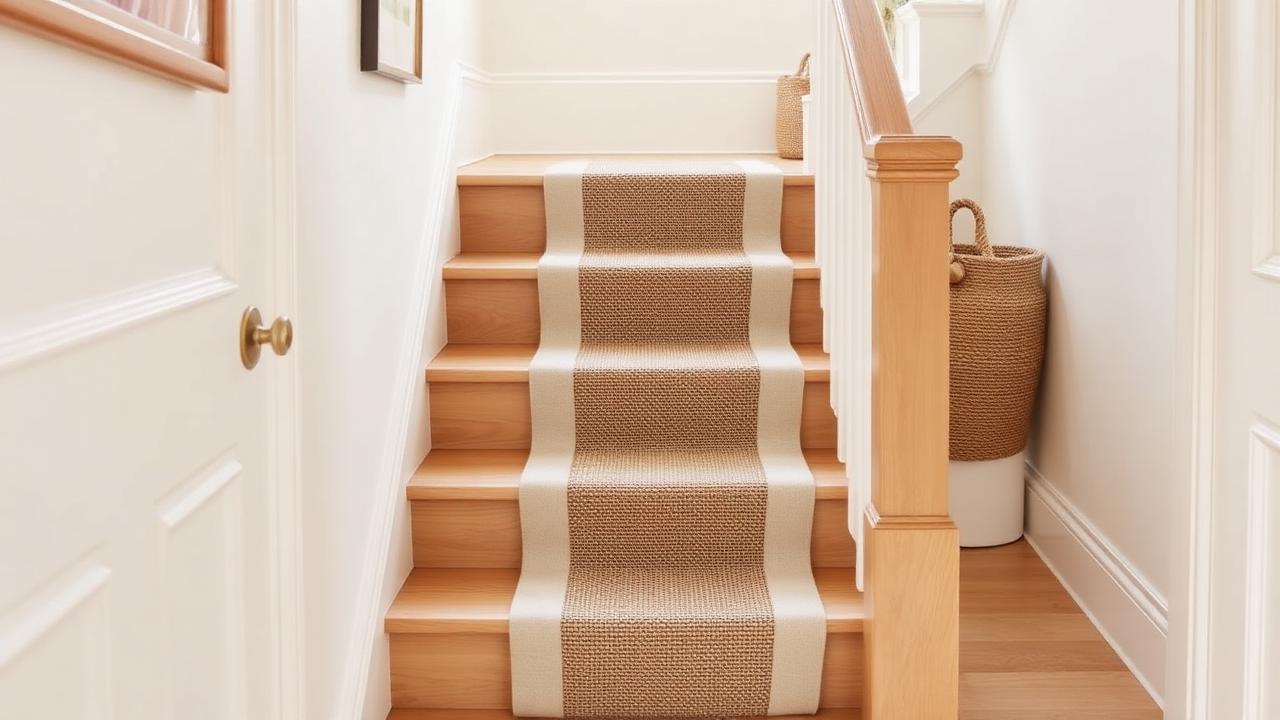
Worked example: matching a checkerboard repeat
A checkerboard pattern with 4 in (10 cm) squares typically has an effective repeat of 8 in (20 cm) for a matched pair of light and dark squares. Across a 13-step flight of roughly 261.25 in (663.6 cm) before waste, this repeat divides cleanly, but real-world weaving tolerances mean it is still worth adding a 10% margin, around 26 in (66 cm), so your fitter has room to align the squares precisely with each nosing edge rather than the pattern drifting slightly by the bottom step.
Style rules for pairing pattern with hardware
A busy geometric or floral pattern generally looks best with simpler, less ornate stair rods, letting the runner carry the visual interest. Conversely, a plain or subtly textured pattern can support more decorative rod finials and finishes without the overall look becoming too busy. As a rule, choose one strong visual element per staircase—either the pattern or the hardware—and keep the other understated.
| Pattern repeat size | Suggested waste margin | Fitter planning need |
|---|---|---|
| Under 6 in (15 cm) | 8-10% | Low |
| 6-10 in (15-25 cm) | 10-12% | Medium |
| Over 10 in (25 cm) | 12-15% | High, plan cut point carefully |
Cost implications of pattern
Patterned runners are often priced similarly to plain runners of the same fibre and quality, but the additional length required for pattern matching, plus more careful (and sometimes slower) fitting labour, both add to the total project cost. Ask your fitter for a separate estimate of any extra labour time required for pattern alignment so you are not surprised by the final invoice.
- Add a larger waste margin for repeats over 10 in (25 cm).
- Choose either a bold pattern or ornate hardware, not both, for a balanced look.
- Ask your fitter for a specific quote covering pattern-matching labour time.
- Confirm the repeat size in writing before your final length order.
Living with a pattern runner day to day
Busy patterns are genuinely practical for households with children, pets, or heavy foot traffic, since they hide everyday soiling, pet hair, and minor stains far better than a plain, pale runner. Regular vacuuming remains important regardless of pattern, since dirt trapped in the pile base still causes long-term wear even if it is not immediately visible on a patterned surface.
In summary, a pattern stair runner adds real character to a staircase but requires more careful measuring and planning than a plain design. Get the exact repeat from your supplier, order extra length, and discuss placement with your fitter before cutting.
Whatever you decide, get the numbers first: the stair runner calculator doubles as a stair runner length calculator, adding nosing wrap, landings, winders, pattern repeat and waste so you order the right length the first time.
Still deciding on material, width or pattern? Our hub on stair runners compares weaves, widths, backings and fitting styles side by side, then hands the numbers straight to the calculator.
Frequently asked questions
What is a pattern repeat?
It is the length of runner before the design pattern begins to repeat itself, an important measurement for planning placement on stairs.
Do I need extra runner for a pattern design?
Yes, typically a 10-12% margin above the standard length calculation to allow for centring the pattern neatly.
Which pattern is easiest to fit on stairs?
Stripes running across the width of the runner are generally the easiest, as there is no lengthwise repeat to match.
Can I use a pattern runner on a staircase with winders?
It's possible but considerably more complex; consult an experienced fitter for pattern matching around curves and winders.
How much runner do I need for 13 steps?
Roughly 24-24.5 ft (7.3-7.5 m) once pattern matching allowances are included.
Where should the pattern start?
Most fitters position a full, uncut motif on the most visible bottom steps, hiding any partial repeat near the top of the flight.
Does pattern scale matter for narrow stairs?
Yes, a large-scale pattern can overwhelm a narrow staircase, so smaller repeats generally suit tighter spaces better.
Should I see the full pattern repeat before ordering?
Yes, always request a sample or photo showing a complete repeat so you know exactly how the design will look on your stairs.
Know your numbers in 30 seconds
Enter your step count, tread depth and riser height — the stair runner calculator gives you the exact length to order, in metres and feet, with waste included.
Calculate length with the stair runner calculatorReady for real prices?
Get quotes from vetted stair runner suppliers and fitters near you. Free, no account, no obligation.
Every guide is written from hands-on measuring and fitting experience, checked against the calculator’s own maths, and re-reviewed whenever prices or methods change. Read our editorial standards.