
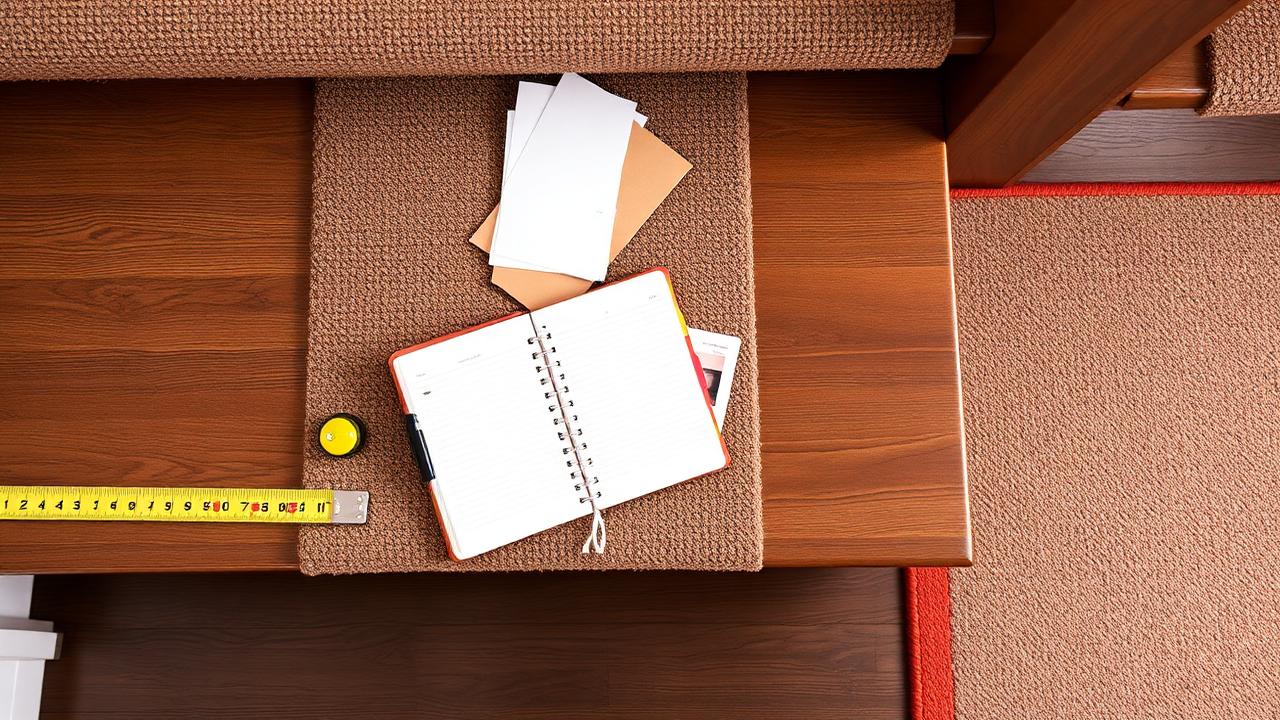
What a fitter is actually looking for on the visit
A good survey isn't just a tape measure exercise. When I go into a house to survey a stair for a runner, I'm checking three separate things at once: the geometry (how many steps, whether they're all the same size, whether there's a winder or a landing that breaks the run), the substrate condition (loose treads, squeaks, old carpet tack strip left behind, uneven paint build-up on painted stairs), and the practical access (how tight the stairwell is for carrying a roll of carpet up, whether there's a turn a roll can't get round in one piece). Missing any of these three at survey stage is how a job ends up with an unexpected delay or extra cost on fitting day.
I always measure every single step individually rather than assuming they're identical, because on older houses, especially anything built before around 1920, it's common to find risers that vary by 5-10 mm from step to step, sometimes more on a stair that's been altered over the decades. That variation matters because a runner cut to one average measurement can end up slightly short or with an odd pucker on the step that's out of tolerance, so a proper survey measures the extremes as well as a representative middle step.
The checklist a thorough survey works through
| Check | Why it matters |
|---|---|
| Number of steps, tread run, riser height per step | Confirms exact metreage and flags any irregular steps |
| Winders or angled treads | Needs extra fabric and careful pattern matching, priced differently to straight flights |
| Landing or half-landing | Requires a separate piece or careful continuation, affects total metreage |
| Existing carpet or gripper condition | Determines whether old gripper can be reused or must be replaced |
| Tread and riser surface (bare wood, painted, existing carpet) | Changes fixing method - staples, tackless strip or glue |
| Squeaks or movement in treads | Best fixed before carpet goes down, not after |
| Stairwell width and turns | Confirms whether a full-width roll can be carried up in one piece |
| Natural light at different times of day | Helps confirm colour choice before ordering |
Ask to see the survey notes, not just the final quote
A written survey sheet with your actual step-by-step measurements is worth asking for. If a supplier only gives you a single total metreage figure with no supporting detail, you have no way to check it against your own measurements or a second quote.
How much runner do I need?
A survey confirms the number a rough estimate can only guess at. Take a US flight of 13 steps with a 10 in tread run and 7.5 in riser height, plus a 0.75 in nosing wrap per step, giving 18.25 in per step. Across 13 steps that's 237.25 in (19.77 ft), plus a 24 in finishing allowance for 261.25 in (21.77 ft), and with a 7% waste margin for straight cuts you land around 23.3 ft. A survey would check whether all 13 risers are genuinely 7.5 in or whether, say, the bottom two are 7.75 in, a small difference that a desk-based estimate would miss entirely.
In UK metric terms, 25 cm tread run and 19 cm riser height with a 1.9 cm nosing wrap gives 45.9 cm per step, or 596.7 cm across 13 steps, plus a 60 cm finishing allowance for 656.7 cm, and a 7% waste margin brings the order to roughly 7.03 m. Use the stair runner calculator to sketch your own numbers before the survey visit, so you can compare the fitter's measured figure against your own and ask questions if there's a big gap between the two.
Know your numbers in 30 seconds
Enter your step count, tread depth and riser height — the stair runner calculator gives you the exact length to order, in metres and feet, with waste included.
Open the stair runner calculatorPreparing your staircase before the surveyor arrives
- Clear the staircase of ornaments, plants and anything hanging on the wall alongside the stringer.
- Remove any existing runner or rugs so bare treads and risers are visible.
- Note any squeaks or movement you've noticed, even if they seem minor, and mention them during the visit.
- Have a rough idea of your preferred width and colour direction so the surveyor can advise realistically.
- Check daylight at the time of the appointment isn't unusually dim or unusually bright compared with normal.
What happens with winders and landings during a survey
Winders, the pie-shaped treads on a turning staircase, get measured individually on both the wide and narrow edge, because a runner has to be trimmed and turned carefully at each one, often using a waterfall or a cap-and-band method depending on the width available. A survey should note exactly how many winders there are and roughly how wide each is at the point the runner will sit, since a very narrow winder can limit how wide a runner you can realistically fit through that section, even if the straight flight above and below is wider.

A half-landing changes the metreage calculation meaningfully, since the runner either continues across the landing as one continuous piece with a turn, or is cut as two separate lengths that meet at the landing, and a survey should tell you which approach they recommend and why, since the two methods have different amounts of waste and slightly different visual results.
Comparing more than one quote after a survey
If you're getting quotes from more than one fitter, it's fair to ask each to leave you with their measured step-by-step figures, not just a final price, so you can sanity-check that both surveys measured the same staircase in roughly the same way. A big gap between two total metreage figures for the same flight usually means one surveyor missed a winder, miscounted a step, or applied a different waste margin, and it's worth asking directly rather than just picking the cheaper number.
What a survey should tell you about fixing method
The condition of your treads decides how the runner gets fixed down, staples directly into wood, a tackless strip and pad combination, or a no-nail rod system for a period stair that shouldn't be pierced. A survey should flag which method suits your stair and why, since this affects both the price and how easy the runner will be to lift and refit later if you ever need to.
Whatever you decide, get the numbers first: the stair runner calculator doubles as a stair runner length calculator, adding nosing wrap, landings, winders, pattern repeat and waste so you order the right length the first time.
Still deciding on material, width or pattern? Our hub on stair runners compares weaves, widths, backings and fitting styles side by side, then hands the numbers straight to the calculator.
Frequently asked questions
How long does a stair runner site survey take?
Around 20-40 minutes for a straight flight, up to an hour if there's a turn, winders or a landing to measure carefully. Most fitters combine the survey with a verbal quote on the day, followed by a written confirmation afterwards.
Do I need to pay for a stair runner survey?
Many suppliers and independent fitters offer a free survey as part of the quoting process, especially if you're likely to order through them. Some charge a small fee that's deducted from the final job cost if you go ahead, so ask upfront.
What should I have ready before a stair runner surveyor visits?
Clear the staircase of rugs, plants and ornaments so treads and risers are fully visible, and have a rough idea of your preferred colour and width. Mention any squeaks or loose treads you've noticed so they can be checked during the visit.
Can I survey my own stairs instead of hiring someone?
You can get a workable estimate yourself using the stair runner calculator with your own tread and riser measurements, but a professional survey will catch irregular steps, winders and substrate issues that a self-measured estimate typically misses.
Why did two fitters give me different metreage figures for the same stairs?
This usually comes down to a missed winder, a different waste margin, or a different assumption about landing treatment. Ask both fitters for their step-by-step measurements rather than just the final total, so you can compare like for like.
Does a survey check for squeaky treads?
A thorough survey should, since a squeak is much easier and cheaper to fix before the runner goes down than after. Mention any noise or movement you've noticed even if it seems minor, so it can be assessed and quoted for if needed.
What's different about surveying a staircase with a landing?
A landing adds a decision point: whether the runner continues as one piece with a turn or is split into two lengths joined at the landing. A survey should measure the landing area separately and tell you which approach suits your stair and why.
Will a survey tell me how the runner will be fixed down?
Yes, a good survey checks your tread surface and condition and recommends staples, tackless strip, or a no-nail rod system accordingly. This affects both price and how easily the runner can be lifted and refitted in future.
Know your numbers in 30 seconds
Enter your step count, tread depth and riser height — the stair runner calculator gives you the exact length to order, in metres and feet, with waste included.
Get a rough metreage estimate first with the stair runner calculatorReady for real prices?
Get quotes from vetted stair runner suppliers and fitters near you. Free, no account, no obligation.
Every guide is written from hands-on measuring and fitting experience, checked against the calculator’s own maths, and re-reviewed whenever prices or methods change. Read our editorial standards.