
Head to head
| Factor | Runner | Full carpet |
|---|---|---|
| Material cost | Lower — narrower width | Higher |
| Warmth | Good | Better |
| Noise reduction | Good | Better |
| Shows off timber | Yes | No |
| Cleaning | Easier — bare edges wipe | Harder |
| Hides poor treads | No | Yes |
| Fitting complexity | Higher precision | More forgiving |
Know your numbers in 30 seconds
Enter your step count, tread depth and riser height — the stair runner calculator gives you the exact length to order, in metres and feet, with waste included.
Open the stair runner calculatorChoose a runner if…
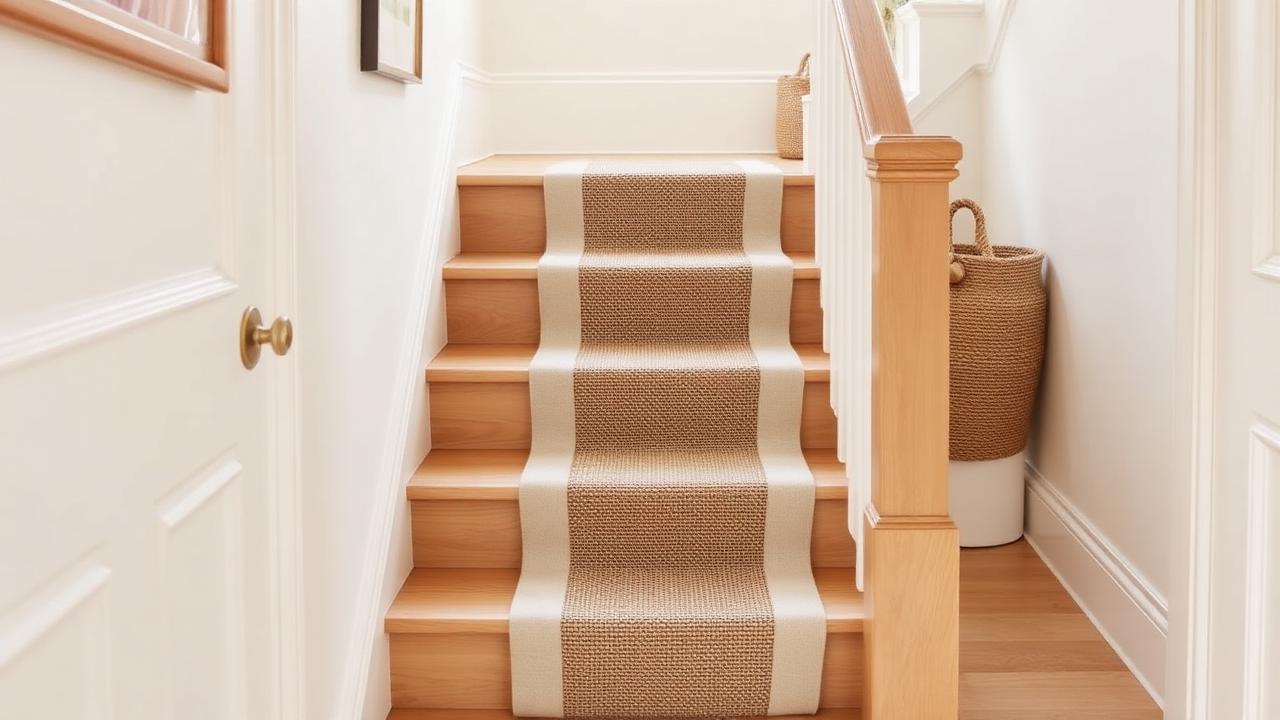
- Your treads are sound timber or stone worth seeing.
- You want the hallway to read as designed rather than as covered.
- You like the option of stair rods.
- You want a lower material spend on a wide staircase.
Choose full carpet if…
- The treads are damaged, mismatched or made of MDF.
- Noise carrying up the house is a real problem.
- You have young children and want the maximum soft surface.
- The staircase is enclosed and the timber is not on show anyway.
The reveal is the whole point
A runner only looks right when there is a clean, even strip of tread on each side. If your staircase is too narrow to leave 3 inches each side, full carpet is the better answer.
Long-term cost comparison
Over a 15-year horizon, a quality runner on well-maintained timber treads often works out cheaper overall than full carpet, because the exposed timber either side needs no ongoing carpet care and the runner itself can be shifted or partially replaced rather than redone in full. Full carpet, once worn, generally has to be replaced wall to wall in one go, since there is no spare fibre to draw on for a partial repair the way a runner's stored offcut allows.
A decision checklist
- Look at the treads with the existing covering lifted or imagine it removed — are they attractive, damaged, or an unremarkable material like MDF?
- Measure the staircase width and check whether at least 3 inches of reveal per side is realistic for a runner.
- Decide how much noise reduction and warmth genuinely matters in your household, since full carpet still outperforms a runner here.
- Get quotes for both options on your actual staircase rather than assuming the cost gap from generic averages, since your specific width and step count change the comparison.
You can change your mind later
A runner can be replaced with full carpet, or vice versa, without structural work to the staircase itself. If you are unsure, choosing the option that suits your current treads and budget is a reasonable low-risk decision.
Cost per step, worked out in full
On a typical 13-step flight, a mid-range wool-blend runner at $35-55 per linear foot comes to roughly $700-1100 in material once fitting is added, against $1400-2200 for the same quality of fibre laid wall to wall across the same flight, because full carpet uses close to double the width of material per step. The gap narrows on very wide staircases, where a runner's reveal takes up a smaller share of the total width, and widens on narrow stairs, where a runner is a much smaller cut of an already modest total area.
| Flight width | Runner cost, 13 steps | Full carpet cost, 13 steps |
|---|---|---|
| 30 in staircase | $650–$1000 | $1200–$1900 |
| 36 in staircase | $750–$1150 | $1550–$2400 |
| 42 in staircase | $850–$1300 | $1900–$2900 |
Noise and warmth in practice
Full carpet's extra warmth and noise reduction come from the fact that every inch of tread and riser is cushioned, not just the central strip. On a staircase directly above a living room or bedroom, that difference is genuinely audible — footfall on a runner still produces a faint knock as feet land on the bare timber either side, while full carpet absorbs the whole footstep. If noise transfer between floors is a real complaint in the household, this is often the deciding factor over looks alone.

Resale value and buyer perception
Estate agents and interior designers generally treat a well-fitted stair runner over attractive original treads as a value-adding feature, since it signals the timber underneath is worth preserving. Full carpet reads as more neutral to buyers — safe and inoffensive, but rarely a talking point — and is the sensible default when the treads themselves are unremarkable softwood or MDF that would not show well if exposed. Neither choice actively harms resale value; the difference is more about first impressions during a viewing.
Maintenance over the years
- A runner's exposed timber edges need occasional cleaning or re-oiling/polishing, an extra task full carpet does not have.
- Full carpet traps more dust and allergens across its wider surface area, meaning more frequent vacuuming for the same air quality.
- A runner can be lifted and rotated to spread wear; full carpet on stairs cannot be shifted the same way once fitted.
- Spot repairs are easier on a runner, since a stored offcut can patch a damaged section without redoing the whole flight.
Safety comparison in more detail
Full carpet has a slight edge on pure slip resistance because there is no bare timber or stone edge on either side for a foot to land on if someone drifts sideways on the stairs. A runner closes most of that gap if it is fitted with at least a 24 to 27 inch width and firmly fixed at every step, leaving a comfortable margin either side without shrinking the usable tread width. The genuine safety risk with a runner is not the concept itself but a poorly sized or loosely fitted one, which is a fitting problem rather than an inherent downside of the format.
Mixing the two approaches in one home
Plenty of houses use a runner on the visible main staircase and full carpet on a secondary or basement flight where the treads are not worth showing, rather than treating the decision as an all-or-nothing choice for the whole property. This mixed approach lets the budget go toward the staircase that gets seen by guests, while the practical second stairs gets the warmth and forgiveness of full carpet without needing to match the main flight's finish.
A final way to decide
If you are still undecided after weighing cost, looks and practicality, lift a small corner of any existing covering and look at the tread underneath. A genuinely attractive, sound timber or stone tread is the single strongest argument for a runner; anything patched, stained or made of a utility material like MDF tips the decision toward full carpet almost every time, regardless of budget.
Getting quotes for both to compare fairly
When comparing prices, ask suppliers to quote both options against your actual staircase measurements rather than relying on generic online averages, since your specific width, step count and any winders change the material quantities and labour time for each approach differently. A like-for-like quote on the same fibre and quality tier for both a runner and full carpet gives the clearest picture of the real cost gap on your particular stairs.
Whatever you decide, get the numbers first: the stair runner calculator doubles as a stair runner length calculator, adding nosing wrap, landings, winders, pattern repeat and waste so you order the right length the first time.
Still deciding on material, width or pattern? Our hub on stair runners compares weaves, widths, backings and fitting styles side by side, then hands the numbers straight to the calculator.
Frequently asked questions
Is a stair runner cheaper than carpeting the whole staircase?
Usually on material, because you buy a narrower width. Labour costs are broadly similar, and runners can need more precise fitting.
Which is safer, a runner or full carpet?
Both are safer than bare stairs. Full carpet covers the whole tread; a runner is equally safe provided it is wide enough and firmly fixed.
Do runners look better than full carpet?
On period and characterful staircases, generally yes. On modern enclosed stairs with plain treads, full carpet often looks more resolved.
Know your numbers in 30 seconds
Enter your step count, tread depth and riser height — the stair runner calculator gives you the exact length to order, in metres and feet, with waste included.
Compare both optionsReady for real prices?
Get quotes from vetted stair runner suppliers and fitters near you. Free, no account, no obligation.
Every guide is written from hands-on measuring and fitting experience, checked against the calculator’s own maths, and re-reviewed whenever prices or methods change. Read our editorial standards.