
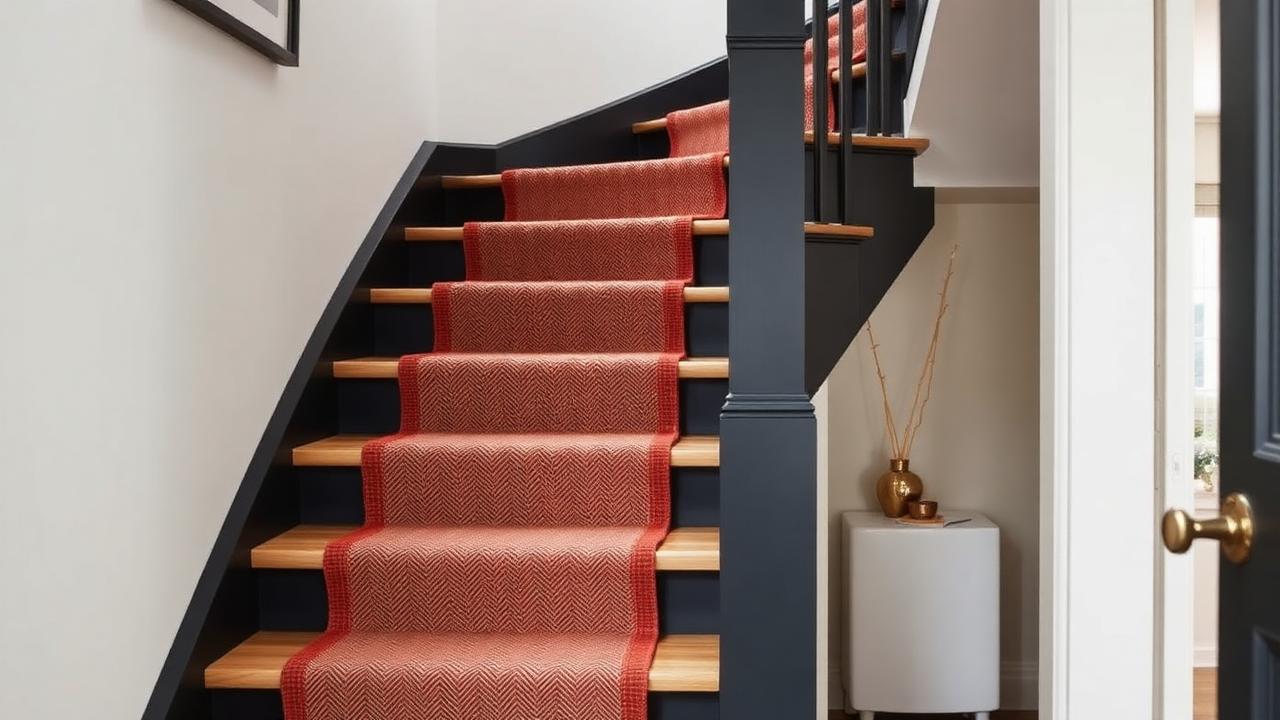
Why the middle ground fails on dark wood
On dark stained or naturally dark hardwood stairs, mid-brown, taupe and dusty rose runners are the colours I get called back to replace most often, not because they're poor quality but because they sit too close in tone to the wood to register as a deliberate choice. From a few steps away a mid-brown runner on dark walnut treads reads almost as a continuation of the wood rather than a considered layer on top of it, which undersells both the runner and the staircase. Go one way or the other: either lean into strong contrast with a pale colour, or lean into depth with a colour darker or richer than the wood itself, and the staircase reads as intentional rather than accidental.
Contrast is the safer, more forgiving route for most households. Cream, oatmeal, pale grey and warm camel all lift dark wood dramatically, making a stairwell that might otherwise feel heavy or dim considerably brighter, particularly useful if the staircase doesn't get much natural light. Tonal depth is the more dramatic, design-led route: a deep charcoal, bottle green or burgundy runner against dark walnut gives a moody, boutique-hotel feel that photographs beautifully but needs a well-lit hallway to avoid the whole space feeling cave-like.
Matching undertone, not just depth
Dark wood carries its own undertone, some walnut leans warm and reddish, some ebony-stained oak leans cool and almost black, and matching your runner's undertone to that base tone matters more than matching the depth of colour. Against warm-toned dark wood, a cool grey or icy cream runner can look slightly at odds, while a warm cream, camel or terracotta plays to the wood's natural warmth. Against cool, near-black stained treads, a cool grey, icy white or true navy tends to sit more harmoniously than a warm beige, which can look slightly dirty by comparison.
Test at both ends of the day
Dark wood shifts noticeably in tone between morning and evening light. Hold your runner sample against a tread at the top and bottom of the flight, in daylight and again under evening lamp light, before ordering.
How much runner do I need?
Take a 13-step US flight with a 10 in tread run, 7.5 in riser height and a 0.75 in nosing wrap allowance per step, for 18.25 in per step. Across 13 steps that's 237.25 in, or 19.77 ft. Add a 24 in combined finishing allowance to reach 261.25 in, or 21.77 ft, then apply a 7% waste margin, landing at around 23.3 ft. Dark wood staircases are often older builds with slightly uneven step depths, so measure every single step individually rather than assuming they're all identical, and add a touch more to the waste allowance, closer to 9-10%, if you find variation of more than about a quarter of an inch between steps.
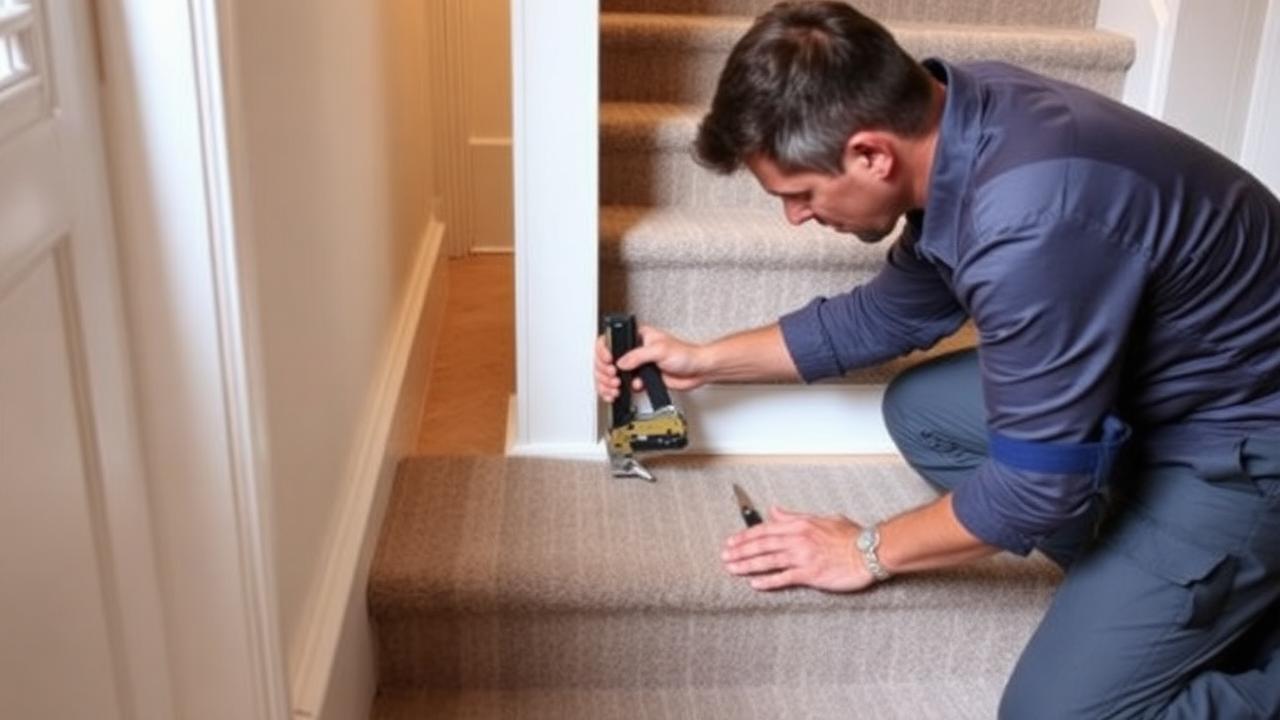
In UK metric terms, the same flight is 25 cm tread run, 19 cm riser height and 1.9 cm nosing wrap, giving 45.9 cm per step. Multiply by 13 for 596.7 cm, add 60 cm finishing allowance for 656.7 cm, then apply a 7% waste margin for roughly 7.03 m, rising to nearer 7.2 m with the extra margin for an uneven older flight. On a shorter 12-step flight of the same proportions, expect around 6.5 m (21.4 ft).
| Step count | Estimated length (US) | Estimated length (UK) |
|---|---|---|
| 12 steps | 21.4 ft | 6.5 m |
| 13 steps | 23.3 ft | 7.0 m |
| 13 steps, uneven older flight (+10%) | 24.1 ft | 7.2 m |
Know your numbers in 30 seconds
Enter your step count, tread depth and riser height — the stair runner calculator gives you the exact length to order, in metres and feet, with waste included.
Open the stair runner calculatorWidth choices that flatter dark wood grain
Dark wood grain is often the most attractive feature of the staircase, so a narrower runner that leaves generous exposed tread either side lets the grain show through as a frame, which is one of the reasons dark stairs often look best with a runner covering roughly 60-70% of the tread width rather than nearly the full width. On a 36 in (91 cm) staircase that's a runner of about 22-25 in (56-64 cm), leaving 5.5-7 in (14-18 cm) exposed per side, enough to show the grain clearly without leaving so much bare wood that the stairs feel unfinished or slippery underfoot at the edges.
- Warm dark wood (walnut, mahogany): pair with cream, camel, terracotta or deep burgundy.
- Cool dark wood (ebony-stained oak, near-black): pair with icy cream, cool grey, navy or true white.
- Avoid mid-brown, taupe or dusty rose, which sit too close in tone to disappear against the wood.
- Leave 5.5-7 in (14-18 cm) of exposed tread per side on a standard 36 in (91 cm) staircase to let the grain show.
- Choose a low-sheen wool or wool-blend fibre, since a shiny synthetic can clash with a matte or satin wood finish.
Ordering with confidence on an older or characterful flight
Dark wood staircases are frequently the original stairs in a period property, which means winders, slightly bowed treads or a step or two that's a different depth to the rest are common, and none of that is a reason to avoid a runner, but it does mean a generic length estimate is riskier than on a modern, uniform new-build staircase. Measuring each tread and riser individually, then running the full set of numbers through a stair runner calculator, gives a far more reliable total than applying one average measurement across the whole flight, and it flags in advance if you'll need a slightly wider waste allowance for pattern matching around any winders.
It's also worth thinking about how the runner will look once fitted rather than just how the sample looks against a single tread, since dark wood staircases often run through more than one lighting condition along their length, a bright window at a half-landing, a dim run of straight steps below it. Stair runners in a mid-depth tone with some texture cope with this shift in light better than a flat, single-tone weave, which can look markedly different in the bright section versus the dim section of the same flight.
Whatever you decide, get the numbers first: the stair runner calculator doubles as a stair runner length calculator, adding nosing wrap, landings, winders, pattern repeat and waste so you order the right length the first time.
Frequently asked questions
What colour runner works best on dark wood stairs?
Either strong contrast (cream, pale grey, warm camel) or a colour as deep or deeper than the wood itself (charcoal, navy, burgundy) works well. Mid-brown or taupe tends to sit too close in tone to dark wood and can look accidental rather than deliberate.
Should I match warm or cool undertones to dark wood?
Match your runner's undertone to the wood's undertone, not just its depth of colour. Warm dark woods like walnut suit cream, camel or terracotta, while cool, near-black stained treads suit icy cream, cool grey or navy.
How wide should a runner be on dark wood stairs?
A runner covering roughly 60-70% of the tread width lets the grain show as a frame either side. On a 36 in (91 cm) staircase that's about 22-25 in (56-64 cm) wide, leaving 5.5-7 in (14-18 cm) exposed per side.
How much runner do I need for a 13-step dark wood staircase?
For a typical 13-step flight with 10 in (25 cm) treads and 7.5 in (19 cm) risers, budget roughly 23-24 ft (7-7.3 m) including nosing wrap and waste, the same as any staircase, though older uneven flights may need a slightly higher waste margin.
Do older dark wood staircases need extra measuring?
Yes, older period staircases often have slightly uneven tread depths or winders, so measure each step individually rather than assuming uniformity, and add a touch more waste allowance, closer to 9-10%, if steps vary by more than a quarter inch.
Will a pale runner look out of place on dark wood?
No, pale runners like cream, oatmeal or pale grey are one of the most reliable pairings for dark wood, since they create clear contrast and brighten a stairwell that might otherwise feel heavy or dim.
Does the sheen of the runner fibre matter against wood?
Yes, a low-sheen wool or wool-blend fibre generally suits dark wood better than a high-shine synthetic, since a glossy runner can clash visually with a matte or satin wood finish rather than complementing it.
What colours should I avoid on dark wood stairs?
Avoid mid-brown, taupe and dusty rose tones close to the wood's own depth, as these tend to blend in rather than stand out. Committing to either clear contrast or a deeper, richer tone gives a more finished result.
Know your numbers in 30 seconds
Enter your step count, tread depth and riser height — the stair runner calculator gives you the exact length to order, in metres and feet, with waste included.
Get your exact length with the stair runner length calculatorReady for real prices?
Get quotes from vetted stair runner suppliers and fitters near you. Free, no account, no obligation.
Every guide is written from hands-on measuring and fitting experience, checked against the calculator’s own maths, and re-reviewed whenever prices or methods change. Read our editorial standards.