
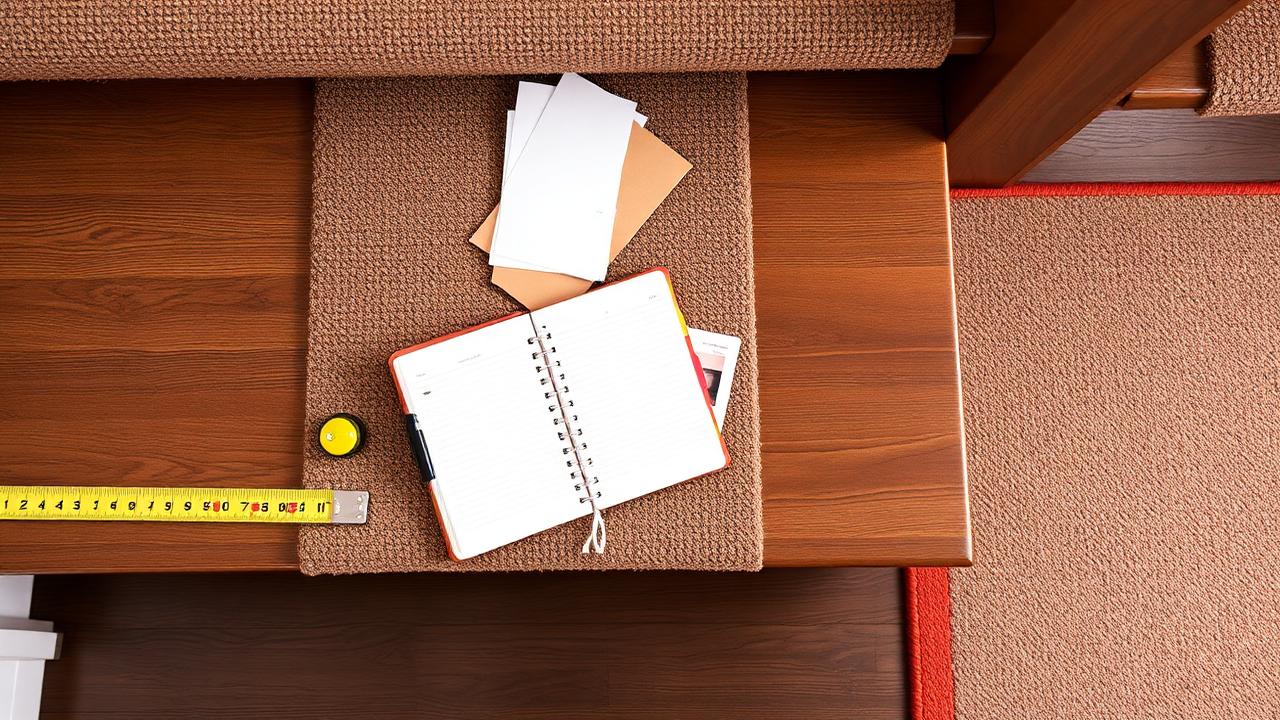
The stair square footage formula
For closed-riser stairs where only the tread top is finished (typical for a full-width carpet or a runner): area per step = width x tread run. For open-riser or fully finished stairs where the riser face is also covered: area per step = width x (tread run + riser height). Total square footage = area per step x number of steps, converted from square inches to square feet by dividing by 144.
Worked example: 13 steps, 36in wide
- Tread-only area per step = 36 x 10 = 360 sq in.
- Tread + riser area per step (both finished) = 36 x (10 + 7.5) = 630 sq in.
- Tread-only total = 360 x 13 = 4,680 sq in = 32.5 sq ft.
- Tread + riser total = 630 x 13 = 8,190 sq in = 56.9 sq ft.
- For a 27in-wide runner (not full width) instead of 36in: 27 x (10 + 7.5) = 472.5 sq in per step x 13 = 42.7 sq ft.
| Scenario | Width | Sq ft per step | 13-step total |
|---|---|---|---|
| Tread only, full width | 36in | 2.5 sq ft | 32.5 sq ft |
| Tread + riser, full width | 36in | 4.38 sq ft | 56.9 sq ft |
| 27in runner, tread + riser | 27in | 3.28 sq ft | 42.7 sq ft |
| 24in runner, tread + riser | 24in | 2.92 sq ft | 37.9 sq ft |
Why square footage and carpet yardage diverge
Flooring materials sold by the square foot (tile, vinyl plank, hardwood) map fairly directly onto the stair square footage number above, with 10-15% waste added for cuts and nosing profiles. Carpet and runners, however, are sold by the linear foot or yard off a fixed-width roll (usually 27in, 30in, or a full 36in broadloom width), so the relevant number for ordering is length, not area — which is why a stair runner calculator reports linear length rather than square footage.
The two numbers are related but not interchangeable: square footage tells you how much surface needs covering, while the stair runner length calculator converts that same flight into the single continuous cut length a mill needs to weave or a fitter needs to order, factoring in waterfall wrap around each nosing. For area-based materials, always compute square footage the direct way above rather than trying to back-convert from a runner length.
| Code requirement affecting area | IRC (US) | UK Part K |
|---|---|---|
| Max riser height | 7.75in | 220mm |
| Min tread run/going | 10in | 220mm |
| Min stair width | 36in | 800-900mm typical |
| Max riser variation | 3/8in | similar tight tolerance |
Landings count separately
A landing's floor area is a simple width x depth rectangle, calculated the same way as any room floor — don't fold it into the per-step tread formula, since a landing has no riser face and often a different width than the flight.
Winder and curved stair area
For winder or curved treads, use the trapezoid area formula (average of the two parallel edges, times the tread depth) per wedge instead of the simple width x run rectangle, since a straight rectangle formula understates a winder's outer edge and overstates its inner edge. Sum each wedge individually rather than averaging one 'typical' tread across the whole turn.
From square footage to a runner order
Once you know total tread-plus-riser square footage, cross-check it against a linear-length estimate before ordering: divide total square footage by your intended runner width (in feet) to get an approximate length, then compare that to the tread-by-tread sum the stair runner length calculator produces. The two should be within a few percent of each other; a bigger gap usually means a miscounted step or an inconsistent riser height somewhere in the flight.

Square footage for painted or stained stairs
Painted or stained stairs use the same tread-plus-riser area formula as a carpet estimate, but the practical waste allowance differs: paint and stain are typically bought by coverage rate per gallon or litre rather than cut to a fixed shape, so round up to the nearest full container size and always buy enough for two coats, since stair treads see enough direct foot contact to need more film build than a wall or ceiling.
| Coverage basis | Typical rate | 13-step (56.9 sq ft) example |
|---|---|---|
| Paint/stain (1 coat) | ~350-400 sq ft per gallon (US) / ~12-14 sq m per litre (UK) | Well under 1 gallon / under 4-5 litres for one coat |
| Paint/stain (2 coats, stairs) | Half the single-coat coverage rate | Budget close to 1 full gallon or 5 litres for both coats with margin |
Skirt board and stringer face area
If the stair also has a finished skirt board or exposed stringer face running the length of the flight, add its area separately: skirt board area equals its height times the diagonal stringer length (the Pythagorean hypotenuse of total rise and total run), not the height times the horizontal floor run, since the board itself runs at the stair's pitch angle. For a flight with a 167in diagonal stringer length and an 8in-tall skirt board, that's 167 x 8 = 1,336 sq in, or about 9.3 sq ft per side — easy to forget when totalling a whole-flight paint or finish order.
- Calculate skirt board area using the diagonal stringer length, not the horizontal run.
- Double the figure if both sides of the stair have a finished skirt board.
- Add skirt board area as a separate line item from tread and riser area, since it's usually a different finish or colour.
- Round paint or stain quantities up to the next full container size after adding all area line items together.
Know your numbers in 30 seconds
Enter your step count, tread depth and riser height — the stair runner calculator gives you the exact length to order, in metres and feet, with waste included.
Open the stair runner calculatorStill deciding on material, width or pattern? Our hub on stair runners compares weaves, widths, backings and fitting styles side by side, then hands the numbers straight to the calculator.
Frequently asked questions
How do I calculate stair square footage?
Multiply tread width by tread run for closed risers, or width by (tread run + riser height) if risers are also finished, then multiply by the number of steps and divide by 144 to convert to square feet.
How many square feet is a 13-step staircase?
For a 36in-wide stair with a 10in tread and 7.5in riser, tread-only area is about 32.5 sq ft; tread-plus-riser area is about 56.9 sq ft.
Is stair square footage the same as carpet yardage?
No — square footage measures surface area, while carpet and runners are ordered by linear length off a fixed-width roll, which is what a stair runner length calculator reports.
Do I include the landing in stair square footage?
Yes, but calculate it separately as a simple width x depth rectangle, since it has no riser face.
How do I calculate square footage for winder treads?
Use a trapezoid area formula per wedge (average of the two parallel edges times depth) instead of a simple rectangle, since winder treads taper.
How much extra should I add for waste when ordering stair flooring?
Typically 10-15% for tile, vinyl or hardwood cuts around nosings; carpet waste is usually calculated as a percentage of linear length instead, often 10%.
Know your numbers in 30 seconds
Enter your step count, tread depth and riser height — the stair runner calculator gives you the exact length to order, in metres and feet, with waste included.
Open the stair calculatorReady for real prices?
Get quotes from vetted stair runner suppliers and fitters near you. Free, no account, no obligation.
Every guide is written from hands-on measuring and fitting experience, checked against the calculator’s own maths, and re-reviewed whenever prices or methods change. Read our editorial standards.