
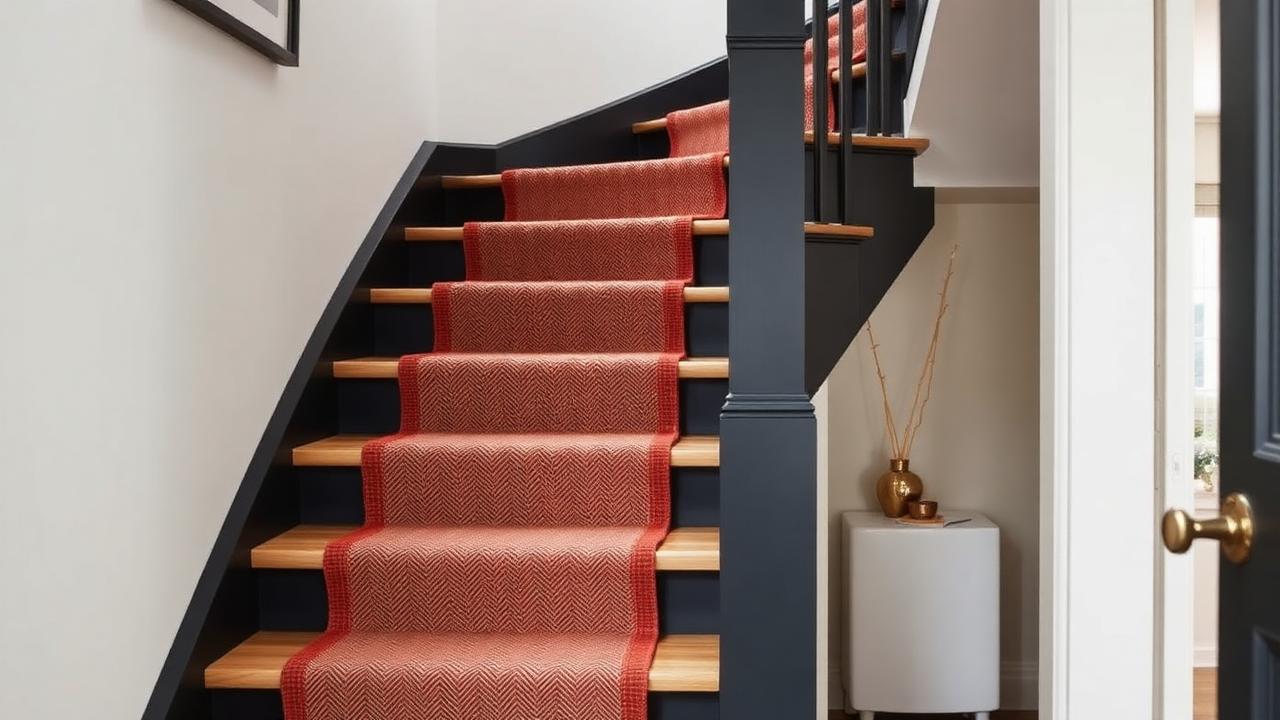
Why tan is such a popular choice
Tan sits in a sweet spot among neutral stair runner colors. It's warmer and more forgiving than gray, less stark than beige, and far more practical for everyday dirt and dust than white or cream. Tan works particularly well with warm wood tones, oak, pine, and honey-toned floors, since it complements rather than competes with the natural grain and color of the treads it sits between.
Pairing tan with your home's existing palette
If your home has warm-toned wood floors, tan is often a near-automatic match. It also pairs beautifully with earthy accent colors, terracotta, olive, and warm browns, making it a strong choice for traditional, farmhouse, or transitional interior styles. For homes with cooler-toned gray or white-washed wood, a tan runner can still work but is worth testing with a sample first, since the warmth can occasionally clash with very cool, modern palettes.
Practical benefits of a tan runner
Beyond aesthetics, tan is a genuinely practical choice for busy stairways. Mid-tone neutrals like tan disguise everyday soiling, pet hair, and light staining far better than very pale or very dark colors. This makes tan a favorite for families, pet owners, and anyone who wants their stairs to look clean between deep cleanings rather than showing every speck of dust.
| Wood tone | Tan runner pairing | Notes |
|---|---|---|
| Warm oak/honey | Excellent | Natural, cohesive match |
| Cherry/mahogany | Good | Adds warmth without clashing |
| Gray-washed | Fair | Test a sample first |
| White-painted | Good | Creates warm contrast |
How much runner do you need?
The length formula is unaffected by color. For a 13-step flight: 10 in tread + 7.5 in riser + 0.75 in nosing wrap = 18.25 in per step, times 13 = 237.25 in. Add a 24 in finishing allowance, giving 261.25 in (21.77 ft). With an 8-10% waste margin, order 23.5-24 ft. Metric: 25 + 19 + 1.9 cm = 45.9 cm per step, times 13 = 596.7 cm, plus 60 cm finishing = 656.7 cm, plus waste, roughly 7-7.3 m.

Know your numbers in 30 seconds
Enter your step count, tread depth and riser height — the stair runner calculator gives you the exact length to order, in metres and feet, with waste included.
Open the stair runner calculatorTest your tan sample under real light
Tan can shift dramatically between warm incandescent lighting and cool daylight or LED bulbs. Always view your sample on the actual staircase at different times of day before committing to a full order.
Choosing fiber and pattern in tan
Tan is available across nearly every fiber type, from budget-friendly synthetics to premium wool. A tan wool or wool-blend runner offers a particularly rich, warm look with excellent durability. If you want to further disguise everyday wear, consider a subtly patterned tan runner, such as a herringbone weave or a fine geometric print, which hides soiling even more effectively than a solid tan.
- Test your tan sample in both natural and artificial light before ordering.
- Pair with warm wood tones for the most cohesive traditional look.
- Consider a subtle pattern in tan for extra dirt-hiding performance.
- Choose wool or wool-blend for the richest, warmest tan finish.
- Confirm color consistency across your full order using dye lot matching.
Long-term maintenance of a tan runner
Tan holds up well to regular vacuuming and occasional spot cleaning, though like any mid-tone neutral, it benefits from a proactive stain treatment applied at installation, particularly in households with children or pets. Routine care will keep a quality tan runner looking fresh for many years.
Cost expectations for a tan runner
Tan is a mainstream, widely-stocked color across almost every fiber and price tier, so it rarely carries a premium over other neutral shades. Budget synthetic tan runners start around 18 to 28 USD (14 to 22 GBP) per linear foot, mid-range nylon or wool-blend options run 35 to 60 USD (28 to 48 GBP) per linear foot, and premium wool tan runners sit at 60 to 100 USD (48 to 80 GBP) per linear foot. For a 13-step flight needing 23-24 ft (7-7.3 m), total material cost typically ranges from about 420 USD (335 GBP) at the budget end to 2,300 USD (1,850 GBP) for premium wool.
Because tan is such a common stock color, it's often easier to find remnant or clearance rolls in this shade than in more unusual colors, which can be a good way to save on a smaller project or a narrower runner width.
Matching tan across dye lots
If your project needs more than one roll, always request matching dye lot numbers from your supplier. Tan, like any dyed neutral, can show subtle batch-to-batch variation that becomes obvious in daylight, particularly along a long flight where two lengths might be joined. Ask for all your yardage cut from the same dye lot wherever possible, and if a second lot is unavoidable, request a sample from each to compare side by side before installation.
| Tier | Cost per ft (US / UK) | 13-step material total |
|---|---|---|
| Budget synthetic | $18-28 / £14-22 | $420-670 / £335-535 |
| Mid-range nylon/blend | $35-60 / £28-48 | $820-1,440 / £655-1,150 |
| Premium wool | $60-100 / £48-80 | $1,400-2,300 / £1,120-1,850 |
- Request matching dye lot numbers whenever your order spans more than one roll.
- Look for remnant or clearance tan stock to save on smaller or narrower projects.
- Budget 420-2,300 USD in material cost depending on fiber tier for a 13-step flight.
- Compare side-by-side samples from different dye lots before installation if a match can't be guaranteed.
- Ask your supplier about stain-resist treatments, often applied as standard on tan synthetic ranges.
Whatever you decide, get the numbers first: the stair runner calculator doubles as a stair runner length calculator, adding nosing wrap, landings, winders, pattern repeat and waste so you order the right length the first time.
Still deciding on material, width or pattern? Our hub on stair runners compares weaves, widths, backings and fitting styles side by side, then hands the numbers straight to the calculator.
Frequently asked questions
Does tan work with gray-toned wood floors?
It can, but test a sample first, since tan's warmth doesn't always suit very cool, gray-washed wood.
Is tan a good choice for hiding dirt?
Yes, mid-tone neutrals like tan disguise everyday soiling and pet hair much better than very pale or very dark colors.
What fiber options come in tan?
Nearly all fiber types, including nylon, wool, and wool blends, are widely available in tan shades.
Does color affect how much runner I need?
No, the length formula depends only on your stair's rise, run, and step count, not the color chosen.
Should I choose a solid or patterned tan runner?
A subtle pattern in tan hides wear and soiling slightly better than a solid, though both are excellent practical choices.
How does tan look under artificial lighting?
It can appear warmer or cooler depending on your bulb type, so always check a sample under your actual hallway lighting.
Is tan a timeless choice?
Yes, tan is a classic, versatile neutral that tends to remain stylish far longer than trend-driven colors.
Does tan pair well with stair rods?
Yes, both brass and black stair rods complement tan nicely, depending on whether you want a warm or contrasting accent.
Know your numbers in 30 seconds
Enter your step count, tread depth and riser height — the stair runner calculator gives you the exact length to order, in metres and feet, with waste included.
Calculate your tan runner's length with the stair runner calculatorReady for real prices?
Get quotes from vetted stair runner suppliers and fitters near you. Free, no account, no obligation.
Every guide is written from hands-on measuring and fitting experience, checked against the calculator’s own maths, and re-reviewed whenever prices or methods change. Read our editorial standards.