
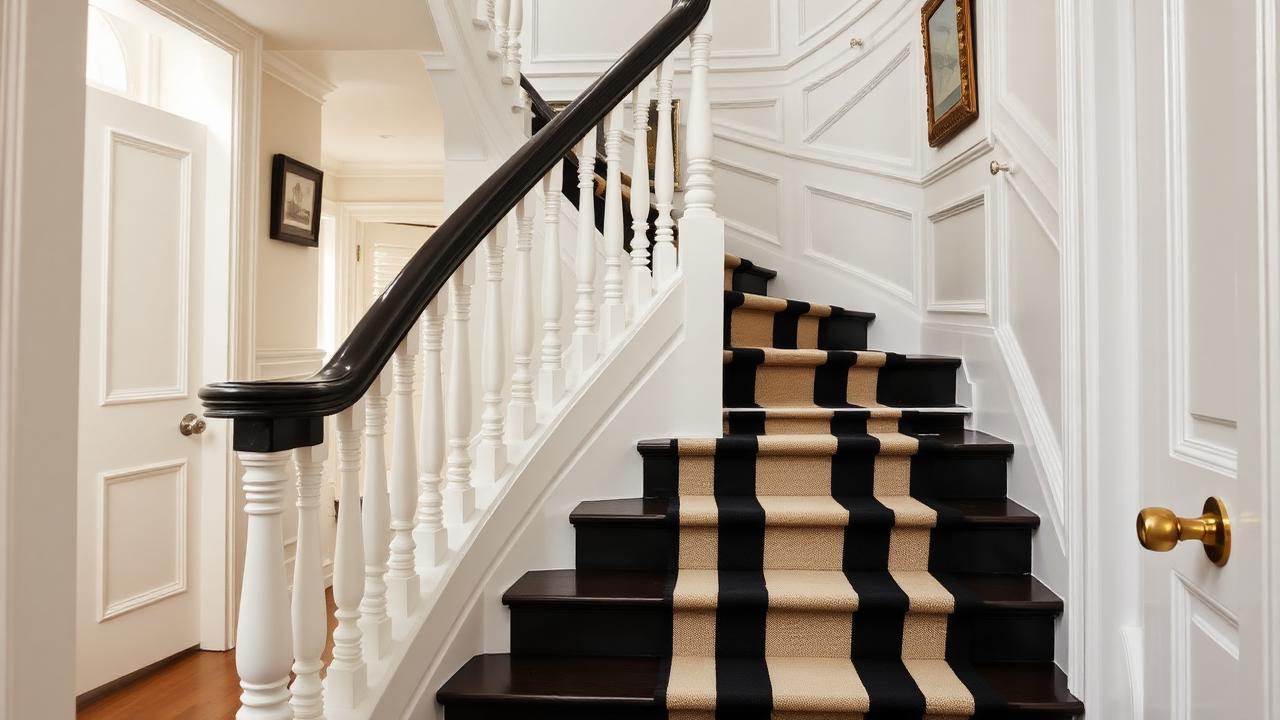
Why tartan needs more care than most patterns
Tartan is instantly recognisable and that's exactly the problem when it's fitted badly, because everyone notices a wonky line in a way they wouldn't notice a slightly misaligned floral motif. The pattern is built from horizontal and vertical bands of colour crossing at right angles, and both directions have to stay true as the runner travels up the stairs, wraps each nosing, and turns any corner in the flight. I've seen tartan fitted where the horizontal bands drift visibly off-level by the top of the stairs because the fitter tensioned the runner unevenly step by step rather than checking level against a spirit line every few treads.
This is a pattern where it genuinely pays to use an experienced fitter rather than attempt it as a first DIY carpet job, particularly if your staircase has any winders, a turn, or steps of slightly inconsistent height, which is common on older houses. A tartan stair runner on a genuinely straight, uniform flight is a manageable job for a confident DIYer with the right tools; the same pattern on an uneven period staircase is a job I'd hand to someone who fits carpet for a living.
Matching the check across nosings and turns
The main technical challenge with tartan is that the pattern has to remain visually level even though it's wrapping around a three-dimensional nosing on every step. As the runner bends over the front edge of the tread and down the riser, the horizontal bands can appear to kink slightly at the fold unless the fitter accounts for this when positioning and tensioning the material. A good fitter will dry-lay the length first, check where each horizontal band falls relative to the nosing line on every step, and adjust the starting position at the top of the flight if needed so the pattern falls as evenly as possible across the whole run.
On a staircase with a turn or a winder section, tartan is one of the more demanding patterns to keep looking deliberate, because the checked lines on a winder tread have to either continue at an angle that still reads as 'level' to the eye, or be deliberately broken with a plain capping strip. Ask your fitter for their honest opinion before ordering if your stairs have any winders; sometimes the better answer is fitting tartan only on the straight run and a complementary solid or striped runner on the winder section.
Insist on a dry-lay before any cutting
Ask your fitter to lay the entire runner length out flat on the stairs, unfixed, and check the horizontal bands against a level line before a single cut is made. This single step catches most tartan fitting problems before they become permanent.
How much runner do I need?
Start with a US flight of 13 steps, 10 in tread run, 7.5 in riser height and a 0.75 in nosing wrap, giving 18.25 in per step and 237.25 in (19.77 ft) across the flight. Add a 24 in finishing allowance top and bottom for 261.25 in, or 21.77 ft. Because tartan's checked lines need careful matching across every nosing and any turn, apply a 10% waste margin rather than the usual 5-7%, bringing the order length to roughly 23.9 ft, so round up to 24 ft to give your fitter room to re-position the starting point if the first dry-lay doesn't sit level.
In UK metric terms, that's a 25 cm tread run, 19 cm riser height and a 1.9 cm nosing wrap, giving 45.9 cm per step and 596.7 cm across 13 steps. Add 60 cm finishing allowance for 656.7 cm, then apply the 10% line-matching waste margin to reach about 7.22 m, so order 7.3-7.4 m to be safe. If the staircase has a winder section, measure and order that portion separately, since the checked pattern behaves quite differently on a tapering tread than on a uniform straight one.
| Measurement | US (in/ft) | UK (cm/m) |
|---|---|---|
| Tread run | 10 in | 25 cm |
| Riser height | 7.5 in | 19 cm |
| Nosing wrap per step | 0.75 in | 1.9 cm |
| Per-step total | 18.25 in | 45.9 cm |
| 13 steps subtotal | 19.77 ft | 5.97 m |
| Plus finishing allowance | 21.77 ft | 6.57 m |
| With 10% line-matching waste | 23.9 ft | 7.22 m |
Know your numbers in 30 seconds
Enter your step count, tread depth and riser height — the stair runner calculator gives you the exact length to order, in metres and feet, with waste included.
Open the stair runner calculatorPicking a tartan that suits your staircase width
A large-scale tartan with wide bands can look impressive on a broad staircase, 32 in (81 cm) or wider, where there's enough runner width to show a full repeat of the check on each step. On a narrower stair, closer to 27 in (68 cm), a large tartan repeat can look cropped, showing only part of the pattern on each tread, so a finer, tighter tartan check tends to suit narrower runners better. Traditional Scottish tartans in particular vary hugely in scale, so it's worth asking your supplier which specific tartan repeats work best at your chosen runner width rather than assuming any tartan pattern will scale down cleanly.

- Confirm your staircase is straight and reasonably uniform before choosing tartan, or plan for a separate treatment on any winder.
- Choose a tighter check scale for narrower runners, a bolder one only on wider flights.
- Order with a 10% line-matching waste margin rather than the standard 5-7%.
- Insist on a full dry-lay and level check before any fixing begins.
- Decide how any turn or landing will be handled before the runner is cut.
Fibre choice and where tartan works in a home
Wool is by far the most common fibre for a genuine tartan weave, since the pattern originates from woven wool cloth and wool holds the crisp checked lines better than most synthetic alternatives. A wool-nylon blend adds durability for a busy household stair without significantly softening the line definition, which matters more with tartan than with almost any other pattern precisely because the lines are the whole point of the design. Tartan suits country houses, Scottish and Scandinavian-influenced interiors, and any home where the staircase already has some traditional character, dark wood banisters, a runner rod set, panelled walls, since the pattern reinforces rather than clashes with that kind of setting.
It's a bolder choice than a plain runner or even a striped one, so it's worth living with a full sample pinned to the wall at the top of the stairs for a week or two before committing, checking it against your actual wall colour and stair rods or hardware if you're using them. Some of the stair runner carpet suppliers who specialise in tartan can also produce a custom colourway matching an existing family or clan tartan, which is worth asking about if that matters to you, though be aware this usually adds cost and lead time compared with a stock design.
Living with and maintaining a tartan runner
Tartan hides general wear reasonably well because the multiple colours and crossing lines already break up the surface visually, so flattening at the nosing is less obvious than on a plain solid colour. Vacuum along the length of the runner rather than diagonally, and if you notice one area of the check fading faster than the rest, typically a step that catches direct sun near a stairwell window, a blind or curtain to reduce UV exposure will do more to protect a tartan runner's colour than almost any cleaning product, since strong sunlight fades the dye in checked wool noticeably faster than it does a plain neutral colour of the same fibre.
Whatever you decide, get the numbers first: the stair runner calculator doubles as a stair runner length calculator, adding nosing wrap, landings, winders, pattern repeat and waste so you order the right length the first time.
Frequently asked questions
Why does a tartan stair runner need more careful fitting than other patterns?
Because the horizontal and vertical checked lines have to stay visibly level and evenly spaced up the whole flight. Any drift is far more noticeable than it would be with a subtle pattern like damask, since the eye immediately picks up on lines that aren't straight.
How much extra runner should I order for tartan?
Order with a 10% waste margin rather than the standard 5-7%, to allow for line-matching across nosings and any turns. On a typical 13-step flight this usually means ordering around 24 ft (7.3-7.4 m) rather than the 23 ft you might use for a plain runner.
Can tartan be fitted around a winder or turn in the staircase?
It can, but it's genuinely more demanding than on a straight flight. Some fitters recommend fitting tartan only on the straight run and using a complementary plain or striped runner on the winder section rather than forcing the check around a tapering tread.
Should I fit a tartan stair runner myself?
On a perfectly straight, uniform staircase, a confident DIYer with the right tools can manage it. On an older or uneven staircase, or one with winders, it's worth using an experienced fitter, since a misaligned check is one of the most visible fitting mistakes on any stair pattern.
What fibre is best for a genuine tartan stair runner?
Wool is the traditional and most common choice, since tartan originates from woven wool cloth and wool holds the checked lines crisply. A wool-nylon blend adds durability for a busy household while keeping the line definition sharp.
What width of runner suits a tartan pattern?
Wider staircases, 32 in (81 cm) or more, suit a large-scale tartan with wide bands, since there's enough width to show a full repeat per step. Narrower runners around 27 in (68 cm) look better with a finer, tighter check scale.
Will a tartan stair runner fade in direct sunlight?
Yes, checked wool patterns can fade noticeably faster than a plain neutral colour of the same fibre if a section of the staircase catches direct sun near a window. Fitting a blind or curtain to reduce UV exposure protects the colour better than most cleaning routines.
Can I get a custom tartan colourway matching a specific clan or family tartan?
Some specialist stair runner suppliers can weave a custom colourway to match a specific tartan, though this typically costs more and takes longer to produce than a stock design. It's worth asking directly if this matters to you before ordering.
Know your numbers in 30 seconds
Enter your step count, tread depth and riser height — the stair runner calculator gives you the exact length to order, in metres and feet, with waste included.
Work out your exact length with the stair runner calculatorReady for real prices?
Get quotes from vetted stair runner suppliers and fitters near you. Free, no account, no obligation.
Every guide is written from hands-on measuring and fitting experience, checked against the calculator’s own maths, and re-reviewed whenever prices or methods change. Read our editorial standards.