

Stripe orientation matters more here than in any other animal print
Tiger stripes are long, bold and directional, unlike the scattered spots of a leopard or cheetah print, so the orientation of the weave relative to the stair matters a great deal. Most manufacturers print or weave tiger-pattern runners with the stripes running across the width — perpendicular to the direction of travel — which is what you want on a staircase, because it means each tread shows a clear, undistorted band of stripes rather than a stretched or foreshortened one. If you're custom-ordering broadloom carpet cut down to a runner width, confirm the roll's stripe direction before cutting, since carpet cut the wrong way will show the stripes running the length of the stair instead, which reads as an obvious mistake rather than a design choice.
Colourways
| Colourway | Character | Best pairing |
|---|---|---|
| Bright orange/black | Bold, high-energy, classic tiger | Dark walnut or black-painted stairs |
| Rust/charcoal | Warm but more restrained | Mid-tone oak, traditional trim |
| Tawny/deep brown | Muted, sophisticated, almost tortoiseshell-like | Any staircase, most versatile |
| Cream/soft grey (white tiger) | Pale, striking, high contrast with dark treads | Contemporary, gallery-style hallways |
Repeat and matching on the stairs
Because tiger stripes are bold and irregular but still directional, a repeat that drifts even slightly off-centre from one tread to the next is more visible than on a cheetah or leopard spot print. Printed tiger runners typically repeat every 20-32in along the length; plan on 12-15% extra yardage over the flat flight length to allow the installer to centre the pattern and avoid an obviously truncated stripe at the top landing.
- Measure the full flight length and width with the stair runner length calculator.
- Confirm the roll's stripe orientation with the supplier before cutting.
- Centre the pattern on the bottom step first, since that is the most visible tread from the hallway.
- Check the repeat lands consistently at the midpoint and top step before the installer fixes the runner permanently.
Fibre choices
- Wool-blend printed tiger: deepest orange and blackest black, best colour saturation, $30-58 per step (US) / £24-46 (UK).
- Solution-dyed nylon: holds bright orange without fading under UV from stair windows, $16-30 per step / £13-24.
- Wool Axminster woven tiger pattern: premium, colour goes through the pile, $48-90 per step / £39-72.
Bright orange needs a confident room
A bright orange-and-black tiger runner is one of the boldest choices in this whole category. It works best as the single statement element in an otherwise neutral hallway — pale walls, plain treads, minimal art — rather than layered with other strong colours or patterns.
Fitting and cost
Hollywood fitting with visible stair rods in black or antique bronze complements a tiger print particularly well, since the rod line adds a horizontal break that helps the eye read each stripe band as belonging to its own tread. Waterfall fitting also works and keeps costs slightly lower by using less carpet per step.
| Item | US price range | UK price range |
|---|---|---|
| Wool-blend runner, 13 steps | $400-780 | £320-625 |
| Nylon print runner, 13 steps | $215-400 | £170-320 |
| Stair rods (black or bronze, per set) | $60-140 | £48-115 |
| Professional fitting | $235-455 | £195-365 |
Tiger print on a landing or half-turn
Because tiger stripes are bold and directional, a half-landing or 90-degree turn is one of the trickiest transitions to get right: the stripe direction that reads correctly on the lower flight can look wrong once the runner turns onto the landing and continues up the second flight. Ask your installer to plan the landing section as its own piece, matching the stripe orientation to each flight independently rather than trying to carry one continuous stripe direction around the corner, which usually distorts the pattern at the pivot point.
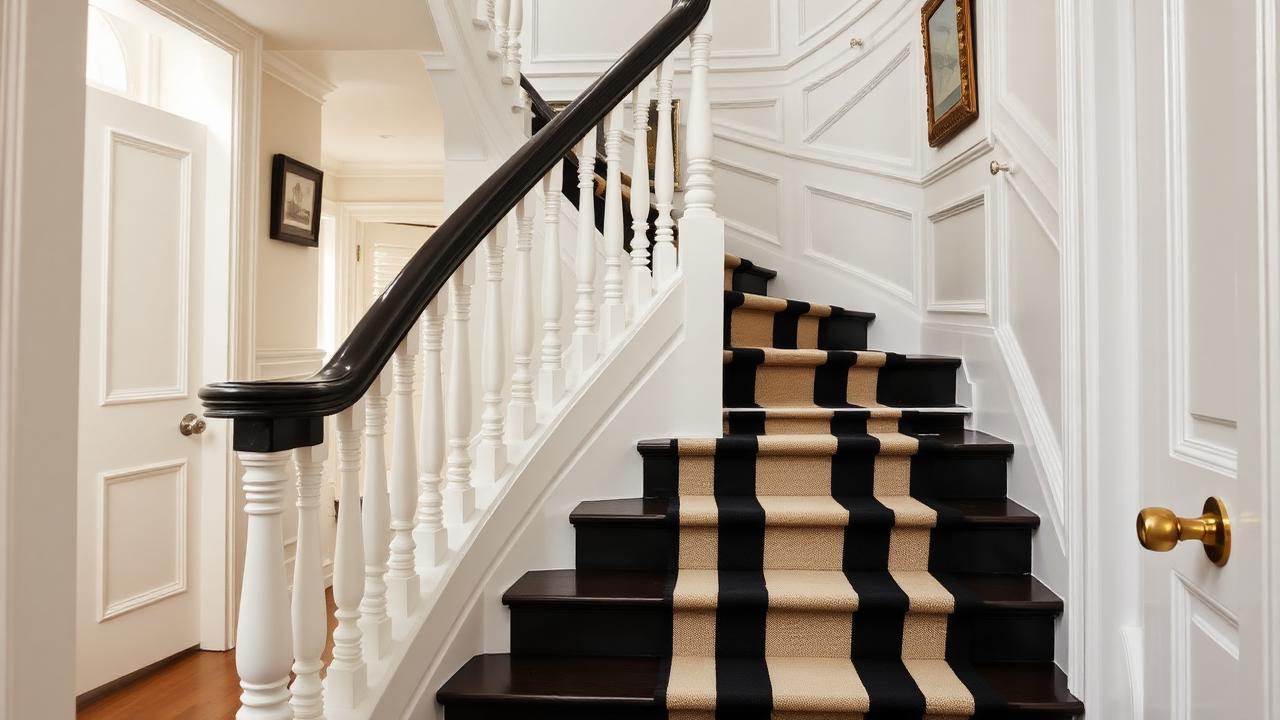
Nursery, playroom-adjacent and family staircases
A tiger stair runner is a popular choice leading up to a child's bedroom or playroom floor, and in that context the tawny/deep brown colourway is usually the more durable long-term pick over bright orange, since crayon marks, juice spills and general scuffing show less against a muted ground than against a saturated orange one. If young children use the stairs unsupervised, pair the runner with a firm 9-10mm underlay and full-width stair rods at every riser rather than every other riser, for extra grip definition on each step edge.
Comparing tiger print to solid-colour orange or rust runners
| Option | Pattern maintenance | Typical cost difference |
|---|---|---|
| Tiger print (patterned) | Repeat must be matched at each tread | Baseline |
| Solid rust or burnt-orange runner | No pattern matching needed, faster install | 10-20% cheaper installed |
| Tonal tiger (subtle stripe, low contrast) | Easier matching than bold print, still textured | 5-10% cheaper than bold tiger print |
If the bold graphic stripe feels like too much commitment for the whole flight, a tonal tiger print in low-contrast tawny-on-rust delivers similar warmth and texture with an easier, cheaper installation, since the reduced contrast makes small repeat mismatches far less noticeable tread to tread.
Know your numbers in 30 seconds
Enter your step count, tread depth and riser height — the stair runner calculator gives you the exact length to order, in metres and feet, with waste included.
Open the stair runner calculatorStyling a tiger stair runner with stair runners elsewhere
A bold orange-and-black tiger runner works best as the single statement stair runner carpet in the house, so keep any other visible stair runners or rugs elsewhere in a plain, complementary neutral rather than another bold pattern. A tawny or rust colourway is more forgiving here, since its muted warmth can sit alongside a modestly patterned runner on a secondary staircase without the two competing for attention the way two bold prints would.
Pairing tiger print with wall art and accent colours
Because tiger stripes carry so much visual energy on their own, the safest styling approach is to let the runner be the loudest element in the hallway and keep wall art, mirrors and furniture in quieter, complementary tones – warm neutrals, deep browns, soft creams – rather than introducing a second bold colour or pattern into the same sightline. A single well-chosen piece of art that picks out either the orange or the black from the runner can tie the space together without competing with it.
Pattern repeat maths and stripe orientation
Tiger stripes are directional as well as repeating, which makes the maths slightly more demanding than a scattered spot print. On a 13-step flight with a 10in (25cm) going and 7.5in (19cm) rise, the flat length before waste is roughly 13ft 6in (4.1m); with a typical printed repeat of 20-32in, allow 12-15% extra yardage so the stripe pattern can be centred correctly on the bottom step and checked again at the midpoint and top of the flight, since a directional stripe that drifts off-centre is more visible than an irregular spot pattern would be.
Wear on a bold, high-contrast pattern versus a muted one
High-contrast bright orange-and-black tiger print shows dirt, dust and minor wear more readily than the muted tawny/deep brown colourway, simply because the strong contrast makes any change in surface texture more visible. On a busy family staircase, the tawny colourway typically looks presentable for longer between deep cleans than the bright classic version, even though both wear at a similar physical rate underneath.
Confirming your flight with the stair runner calculator before a landing turn
Because tiger print is one of the trickier patterns to carry cleanly around a half-landing or turn, measure your full flight including the landing with the stair runner calculator before ordering, and ask your installer specifically how they plan to treat the stripe direction on each separate flight either side of the turn.
| Colourway | Visible wear/dirt tolerance | Best household fit |
|---|---|---|
| Bright orange/black | Lower – shows marks readily | Lower-traffic, more formal staircases |
| Rust/charcoal | Medium | Everyday family use, moderate traffic |
| Tawny/deep brown | Higher – disguises marks well | Busy households, children, pets |
Whatever you decide, get the numbers first: the stair runner calculator doubles as a stair runner length calculator, adding nosing wrap, landings, winders, pattern repeat and waste so you order the right length the first time.
Frequently asked questions
Which way should tiger stripes run on a stair runner?
Stripes should run across the width of the runner, perpendicular to the direction of travel, so each tread shows an undistorted band. Confirm this with your supplier before cutting broadloom.
What colour tiger stair runner is easiest to live with?
A tawny or deep brown colourway is the most versatile and least visually demanding day to day, compared with the bolder bright orange-and-black classic combination.
How much extra yardage do I need for a tiger print repeat?
Budget 12-15% extra yardage over the flat flight length, since the repeat (typically 20-32in) needs to be centred to avoid a truncated stripe at the top landing.
Should I use stair rods with a tiger print runner?
Stair rods in black or antique bronze work well because the horizontal rod line helps separate each stripe band tread by tread, though a waterfall fit without rods also works and costs less.
How much does a tiger stair runner cost?
For a standard 13-step, 36in staircase, wool-blend printed material typically runs $400-780 (£320-625); solution-dyed nylon runs $215-400 (£170-320).
Does a tiger print fade near windows?
Solution-dyed nylon resists UV fading far better than a standard printed wool pattern, which matters most on stairs that get direct sun through a landing or stairwell window.
Know your numbers in 30 seconds
Enter your step count, tread depth and riser height — the stair runner calculator gives you the exact length to order, in metres and feet, with waste included.
Measure my stairsReady for real prices?
Get quotes from vetted stair runner suppliers and fitters near you. Free, no account, no obligation.
Every guide is written from hands-on measuring and fitting experience, checked against the calculator’s own maths, and re-reviewed whenever prices or methods change. Read our editorial standards.