

Why tribal blue is a striking staircase choice
Tribal and kilim-inspired patterns bring movement and personality to a staircase in a way solid colors simply can't. A blue colorway in particular strikes a balance between boldness and versatility, pairing well with both warm and cool wood tones, and working equally well in modern, bohemian, or transitional interiors. The geometric repeats found in tribal patterns are also exceptionally good at disguising everyday dirt, pet hair, and light wear, since the eye is drawn to the pattern rather than any single imperfection.
Understanding pattern repeat with tribal designs
Tribal patterns typically have a defined repeat length, the distance before the design pattern starts again. This matters enormously for stair runners because you want the pattern to land attractively on each step, ideally centered or consistently placed, rather than being awkwardly cropped partway through a motif on alternating steps. Before ordering, ask your supplier for the exact repeat length of your chosen tribal blue design, then work with your fitter to plan how the pattern will fall across your specific tread and riser dimensions.
How much extra should you order for pattern matching?
As a rule of thumb, patterned runners with a repeat need an additional 5-10% beyond the standard waste margin to allow the fitter to adjust where each length is cut, ensuring the pattern aligns attractively at each step. For a 13-step flight: 10 in tread + 7.5 in riser + 0.75 in nosing wrap = 18.25 in per step, times 13 = 237.25 in, plus 24 in finishing = 261.25 in (21.77 ft). With a standard 8-10% waste margin plus an additional pattern-matching allowance, order closer to 25-26 ft to be safe. Metric: 45.9 cm per step times 13 = 596.7 cm, plus 60 cm finishing = 656.7 cm; with combined waste and pattern allowance, aim for roughly 7.6-7.9 m.
| Consideration | Standard runner | Tribal patterned runner |
|---|---|---|
| Waste margin | 8-10% | 13-18% (waste + pattern match) |
| Length for 13 steps (US) | 23.5-24 ft | 25-26 ft |
| Length for 13 steps (UK) | 7-7.3 m | 7.6-7.9 m |
Know your numbers in 30 seconds
Enter your step count, tread depth and riser height — the stair runner calculator gives you the exact length to order, in metres and feet, with waste included.
Open the stair runner calculatorOrder a full repeat's worth of extra buffer
When in doubt, round your order up to include at least one full pattern repeat as extra buffer. This gives your fitter room to adjust placement without running short partway through the installation.
Pairing tribal blue with your home's decor
Blue tribal patterns work beautifully against natural wood tones, white or gray walls, and brass or black stair rods alike. If your hallway already features other patterned textiles, keep those in a complementary but not competing scale, letting the stair runner serve as the visual anchor of the space rather than competing with an equally bold rug or wallpaper nearby.
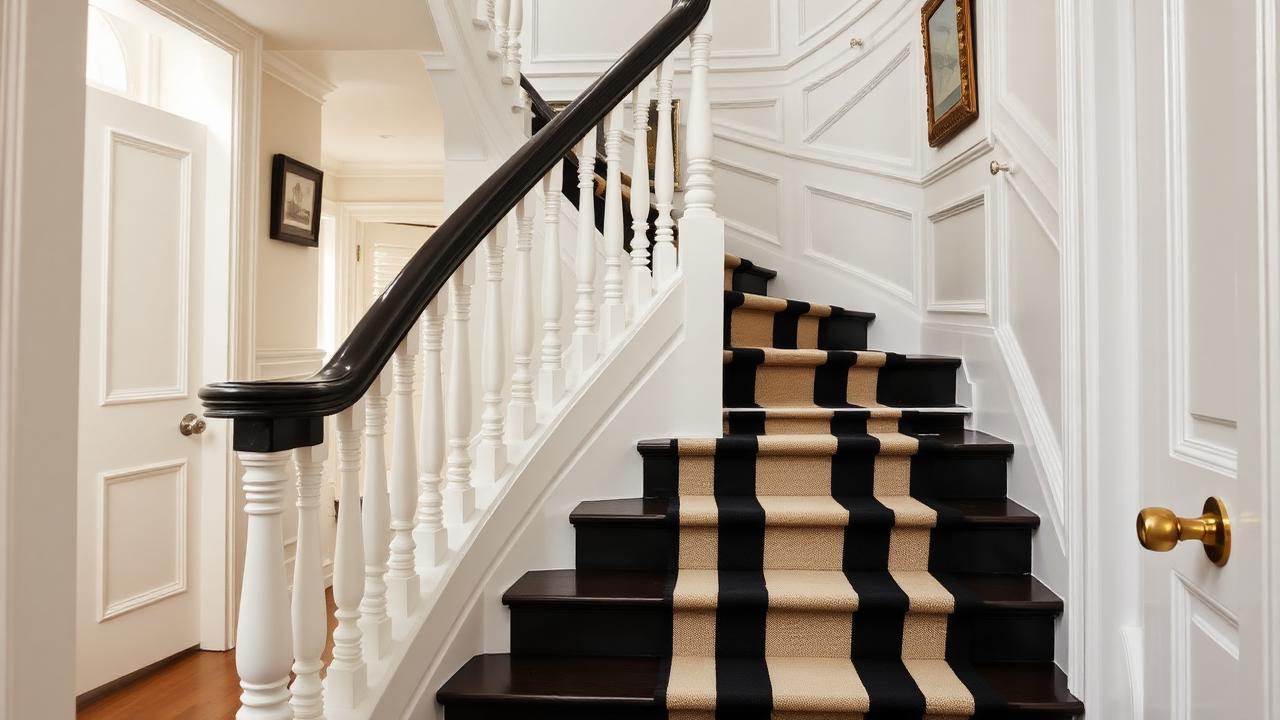
- Confirm the exact pattern repeat length with your supplier before ordering.
- Add a pattern-matching allowance of 5-10% beyond your standard waste margin.
- Discuss pattern placement with your fitter before cutting begins.
- Pair with natural wood tones or neutral walls to let the pattern stand out.
- Choose a durable fiber base, like wool or nylon, since tribal patterns are often loved for years and deserve to last.
Fiber considerations for patterned runners
Tribal blue designs are available in both wool and synthetic constructions. Wool offers rich, saturated color depth that suits the traditional roots of tribal-inspired patterns, while a nylon or wool-blend version delivers the same visual impact with added durability for busy households. Either way, the bold pattern will help mask the earliest signs of everyday wear far longer than a solid color would.
What a tribal blue runner typically costs
Patterned tribal designs generally cost more than solid colors within the same fiber tier, reflecting the more complex weaving or printing process. Budget synthetic tribal prints start around 25 to 38 USD (20 to 30 GBP) per linear foot, mid-range wool-blend woven tribal patterns run 55 to 85 USD (44 to 68 GBP) per linear foot, and premium hand-finished wool tribal designs can reach 90 to 150 USD (72 to 120 GBP) per linear foot. For a 13-step flight needing the pattern-adjusted 25-26 ft (7.6-7.9 m), total material cost ranges from roughly 650 USD (520 GBP) at the budget end to over 3,900 USD (3,120 GBP) for premium hand-finished wool.
Because pattern alignment takes extra fitter time, labor for a tribal or geometric patterned runner typically runs 15 to 25% higher than for a solid color on the same size flight, so budget 350 to 850 USD (280 to 680 GBP) for professional fitting rather than the 300 to 700 USD (240 to 560 GBP) typical of a plain runner.
| Tier | Cost per ft (US / UK) | 13-step material total (25-26 ft) |
|---|---|---|
| Budget synthetic print | $25-38 / £20-30 | $650-990 / £520-790 |
| Mid-range woven wool-blend | $55-85 / £44-68 | $1,430-2,210 / £1,145-1,770 |
| Premium hand-finished wool | $90-150 / £72-120 | $2,340-3,900 / £1,875-3,125 |
- Budget 15-25% more in fitting labor for pattern alignment versus a solid-color runner.
- Request the exact repeat length in writing before finalizing your order quantity.
- Expect material costs from roughly 650 to 3,900 USD depending on fiber and finish quality.
- Choose a woven wool-blend for the best balance of pattern richness and everyday durability.
- Ask for a fitter experienced with patterned stair carpet specifically, since alignment skill varies.
Whatever you decide, get the numbers first: the stair runner calculator doubles as a stair runner length calculator, adding nosing wrap, landings, winders, pattern repeat and waste so you order the right length the first time.
Frequently asked questions
What is a pattern repeat?
It's the distance along the carpet before the design motif starts again, an important measurement for planning how the pattern falls on each step.
Do patterned runners need more material than solid ones?
Yes, typically 5-10% more to allow for pattern matching across each step, on top of the standard waste margin.
Does tribal blue suit modern homes?
Yes, it works well in modern, bohemian, and transitional interiors thanks to its bold but versatile blue colorway.
Should I ask for the pattern repeat before ordering?
Always; knowing the repeat length lets your fitter plan attractive, consistent pattern placement on every step.
Is wool or synthetic better for a tribal design?
Wool offers richer color depth, while nylon or wool-blend options add extra durability for high-traffic staircases.
Does a bold pattern hide dirt better than a solid color?
Yes, geometric patterns are particularly effective at disguising everyday soiling and light wear.
How do I calculate length for a patterned runner?
Use the standard per-step formula, then add both your usual waste margin and an extra pattern-matching allowance.
What stair rod finish pairs well with tribal blue?
Both brass and black stair rods complement blue tribal patterns nicely, depending on whether you want a warm or cool accent.
Know your numbers in 30 seconds
Enter your step count, tread depth and riser height — the stair runner calculator gives you the exact length to order, in metres and feet, with waste included.
Size your patterned runner with the stair runner calculatorReady for real prices?
Get quotes from vetted stair runner suppliers and fitters near you. Free, no account, no obligation.
Every guide is written from hands-on measuring and fitting experience, checked against the calculator’s own maths, and re-reviewed whenever prices or methods change. Read our editorial standards.