
Building a coastal palette without going literal nautical
A coastal stair runner works best when it evokes the feeling of a beach house — light, breezy, sun-faded — rather than depicting literal ocean imagery. Soft blues (powder blue, chambray, faded denim), sandy neutrals (oatmeal, driftwood, bleached linen) and crisp whites are the core palette, often combined in a simple stripe or a subtle two-tone weave rather than a busy pattern. Overtly nautical motifs — anchors, rope trims, sailboats — read as more theme-park than coastal-chic to most contemporary interior schemes, and are worth using sparingly if at all, reserved for accessories rather than the runner itself.
| Palette | Character | Best staircase pairing |
|---|---|---|
| Powder blue and white stripe | Classic, crisp, timeless coastal | Whitewashed or pale oak stairs |
| Sandy oatmeal and driftwood grey | Warm neutral, understated | Any timber tone, especially reclaimed wood |
| Chambray blue solid | Calm, denim-like texture | White-painted staircases |
| Seafoam and cream | Softer, slightly more contemporary coastal | Light, airy hallways |
Texture over pattern
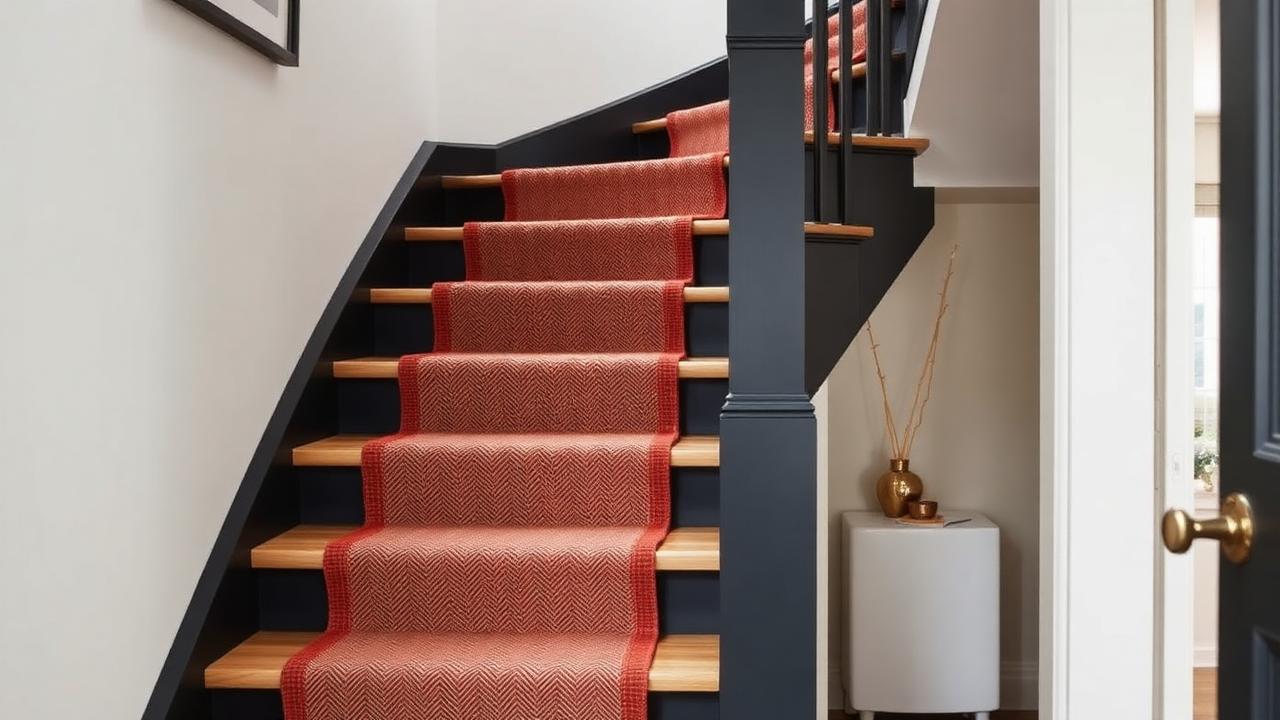
Where a traditional runner leans on decorative pattern, a coastal scheme leans on texture: a flatweave with a visible ribbed or basketweave structure, a wool-sisal blend that mimics the look of natural sisal without its downsides, or a fine herringbone in a two-tone blue-and-white combination. This textural approach keeps the look relaxed and tactile rather than flat and glossy, which suits the casual, sun-worn character coastal interiors are going for.
Fibre: durability against sand and damp
Coastal homes, whether genuinely beachside or just styled that way, tend to see more sand, damp footwear and higher humidity than the average household, all of which are hard on natural fibres. True sisal and jute look the part but perform poorly with moisture — jute in particular can develop mould or mildew if it stays damp, and both fibres show sand as a gritty texture that's hard to fully vacuum out. A wool or wool-blend flatweave with stain protection, or a solution-dyed polypropylene styled to look like sisal, delivers the same visual texture with far better real-world resilience.
| Fibre | Coastal suitability | US cost/step | UK cost/step |
|---|---|---|---|
| True sisal/jute | Authentic look, poor with damp/sand | $18-34 | £15-28 |
| Wool-sisal blend (sisal look) | Best balance of look and durability | $26-48 | £21-39 |
| Solution-dyed polypropylene (sisal-look) | Most damp- and stain-resistant, budget-friendly | $14-26 | £11-21 |
| Wool flatweave (solid or stripe) | Soft underfoot, needs stain protection near entries | $28-52 | £23-42 |
- Choose a stain-treated or solution-dyed fibre if the staircase is within a few steps of a beach-facing entry.
- Avoid true jute in bathrooms-adjacent or humid coastal climates; it holds moisture and can mildew.
- A low, tight pile sheds sand more easily during vacuuming than a deep or looped pile.
- Consider a darker sandy tone rather than pure white if sand tracking is a daily reality, since pale colours show grit fastest.
Stripe direction and width
A simple horizontal-look stripe (perpendicular to the stair's length) reinforces the casual, deckchair-inspired coastal feel; a lengthwise stripe reads more like a traditional runner border. Pair either with a slightly narrower runner width than usual for a breezier, less formal look.
Fitting and cost
Waterfall fitting suits the relaxed coastal aesthetic well, and gripper strip or hidden staples keep the hardware invisible, consistent with the pared-back look. For a standard 13-step, 36in staircase, budget $340-625 (£270-500) for a wool-sisal blend, or $180-340 (£145-275) for solution-dyed polypropylene, plus $235-455 (£195-365) fitting. Run your numbers through the stair runner length calculator to get an exact quote for your own flight.
Coastal runners in humid or high-altitude second homes
Coastal-style stair runners are frequently specified for vacation or second homes that stand empty for weeks at a time, which changes the fibre calculus: a property that isn't climate-controlled year-round is more vulnerable to humidity swings, and a solution-dyed synthetic or treated wool blend resists moisture-related issues (mildew, dye bleeding, backing degradation) far better than an untreated natural fibre left in a closed-up house. If the property is unoccupied for long stretches, ask your fitter about a moisture-resistant underlay and backing as well as the face fibre.

Pairing a coastal runner with painted versus natural stair treads
A whitewashed or fully painted staircase is the classic pairing for a coastal-style runner, since the crisp white base echoes weathered beach-house woodwork, but a natural, lightly oiled timber staircase also works well with the sandy oatmeal and driftwood grey palette, creating a warmer, more organic coastal look than the crisper blue-and-white combination. Avoid pairing a coastal runner with a very dark stained staircase, since the contrast tends to read as more traditional-nautical (think ship's cabin) than the relaxed, sun-bleached coastal look most homeowners are aiming for.
Coastal runner width and stringer reveal
| Runner width | Stringer reveal (each side, approx.) | Look |
|---|---|---|
| 24-27in | 5-6in on a 36in-wide stair | Breezy, pared-back, most classically coastal |
| 31.5in | 2-3in on a 36in-wide stair | Balanced, still shows some painted stringer |
| Full width (custom) | None | Cosier, less of the pared-back coastal look |
Know your numbers in 30 seconds
Enter your step count, tread depth and riser height — the stair runner calculator gives you the exact length to order, in metres and feet, with waste included.
Open the stair runner calculatorStyling a coastal runner alongside other stair runners in the home
A coastal-style stair runner carpet works best as part of a coherent palette carried through from an entryway rug to the stairs and, ideally, onto any visible upstairs landing. Where a home has multiple stair runners – a main flight and a secondary back staircase, say – keeping both in the same coastal palette family, even if one is a plainer solid and the other a stripe, ties the whole house together far more convincingly than treating each staircase as an unrelated decision.
Pairing texture and colour with painted versus natural woodwork
A crisp powder-blue-and-white stripe suits whitewashed or painted stairs particularly well, echoing classic weathered beach-house woodwork, while the sandy oatmeal and driftwood grey palette suits natural, lightly oiled timber, creating a warmer, more organic coastal look. Avoid mixing a very cool blue-and-white runner with warm, honey-toned oak, since the two undertones can pull against each other in a way that reads as unresolved rather than deliberately layered.
Pattern repeat maths for a coastal stripe
A coastal stripe typically runs perpendicular to the stair's length, and the repeat maths follows the same logic as any other striped runner: on a 13-step flight with a 10in (25cm) going and 7.5in (19cm) rise, the flat length before waste is roughly 13ft 6in (4.1m), and a stripe repeat of 1-3in needs 10-15% extra yardage to centre correctly on both the bottom step and the top landing, avoiding a half-stripe at either end of the flight.
Wear and moisture resistance in a genuinely coastal climate
In a property that actually sits near the coast, humidity and salt air accelerate wear on natural fibres more than in an inland home styled the same way, so a treated wool blend or solution-dyed synthetic on the stair runner carpet is a more durable long-term choice than true sisal or jute, even though the natural fibres arguably look more authentic. Expect a genuinely coastal property to need cleaning and inspection slightly more often than the 12-18 month interval typical of an inland home, simply because of the added humidity and grit exposure.
Confirming a narrower coastal runner width with the stair runner calculator
Because coastal schemes often favour a narrower runner with a generous painted stringer reveal either side, use the stair runner calculator with your intended narrower width, not just your stair's full clear width, to get an accurate material estimate, since a 24-27in runner on a 36in-wide stair uses noticeably less carpet than a full-width order and the cost difference is worth confirming before ordering.
| Woodwork | Best coastal palette | Reasoning |
|---|---|---|
| Whitewashed or painted | Powder blue and white stripe | Echoes classic weathered beach-house woodwork |
| Natural, lightly oiled timber | Sandy oatmeal and driftwood grey | Warmer, more organic coastal look |
| Mid-tone honey oak | Chambray blue solid, avoid stark white/blue stripe | Avoids undertone clash between warm wood and cool stripe |
Frequently asked questions
What colours work for a coastal stair runner?
Powder blue and white, sandy oatmeal and driftwood grey, and chambray blue solids are the core coastal palette, usually in a simple stripe or subtle texture rather than a busy pattern.
Is sisal or jute good for a coastal stair runner?
They look authentic but perform poorly with damp and sand; a wool-sisal blend or solution-dyed polypropylene styled to look like sisal offers similar texture with much better durability.
Should a coastal stair runner have nautical motifs?
Generally no. Literal motifs like anchors or rope trims read as theme-park rather than coastal-chic; a pared-back palette and texture achieve the look more convincingly.
What stripe direction suits a coastal stair runner?
A stripe running across the width (perpendicular to the stair's length) reinforces the casual coastal feel more than a lengthwise stripe, which reads closer to a traditional runner border.
How much does a coastal stair runner cost?
For a 13-step, 36in staircase, a wool-sisal blend typically runs $340-625 (£270-500); solution-dyed polypropylene runs $180-340 (£145-275).
Is jute safe to use near a beach entry?
True jute can hold moisture and develop mildew in humid coastal climates, so it's best avoided within a few steps of a beach-facing entry in favour of a treated wool blend or synthetic.
Know your numbers in 30 seconds
Enter your step count, tread depth and riser height — the stair runner calculator gives you the exact length to order, in metres and feet, with waste included.
Measure my stairsReady for real prices?
Get quotes from vetted stair runner suppliers and fitters near you. Free, no account, no obligation.
Every guide is written from hands-on measuring and fitting experience, checked against the calculator’s own maths, and re-reviewed whenever prices or methods change. Read our editorial standards.