

What makes a U shaped stair different
A U shaped staircase, sometimes called a switchback stair, consists of two parallel flights running in opposite directions, connected by a landing that turns the direction of travel 180 degrees. Unlike a straight run, you cannot treat this as one continuous length calculation. Instead, you need to measure the lower flight, the landing crossing, and the upper flight as three distinct sections, then add them together. Many people underestimate the landing portion because it looks like a simple square, but the runner still needs to travel across it in a straight line connecting the two flights, and that distance can be more than you expect once you factor in how the stairs turn.
The other complication with a U shaped stair is that many have winders instead of a flat square landing, especially in older or more compact homes. If your landing has winder treads that taper to a point, the calculation is different again, closer to that of a curved staircase, and you should measure the inside and outside edges of each winder separately. For a true flat landing, though, the calculation is much simpler and is exactly what we cover here.
Measuring each flight
Start with the lower flight. If it has 7 steps at 10 in tread and 7.5 in riser, each step contributes 10 + 7.5 + 0.75 in nosing wrap = 18.25 in. Over 7 steps that is 127.75 in, or 10.65 ft. Do the same for the upper flight; if it also has 7 steps, it is another 127.75 in, or 10.65 ft. Together the two flights total 21.3 ft before you add the landing and finishing allowances.
Adding the landing
The landing crossing typically needs its own piece of runner, sized to the depth of the landing plus a small turn allowance where it meets each flight. For a 4 ft deep landing, allow roughly 4.5 ft of runner to account for the turn and any wrap at the nosing of the top step of each flight. In metric terms, a 1.2 m landing needs about 1.35 m of runner.
| Section | US (in/ft) | UK (cm/m) |
|---|---|---|
| Lower flight (7 steps) | 10.65 ft | 3.25 m |
| Landing crossing | 4.5 ft | 1.35 m |
| Upper flight (7 steps) | 10.65 ft | 3.25 m |
| Subtotal | 25.8 ft | 7.85 m |
| With 5% waste | 27 ft | 8.25 m |
Know your numbers in 30 seconds
Enter your step count, tread depth and riser height — the stair runner calculator gives you the exact length to order, in metres and feet, with waste included.
Open the stair runner calculatorWhy professionals split the order
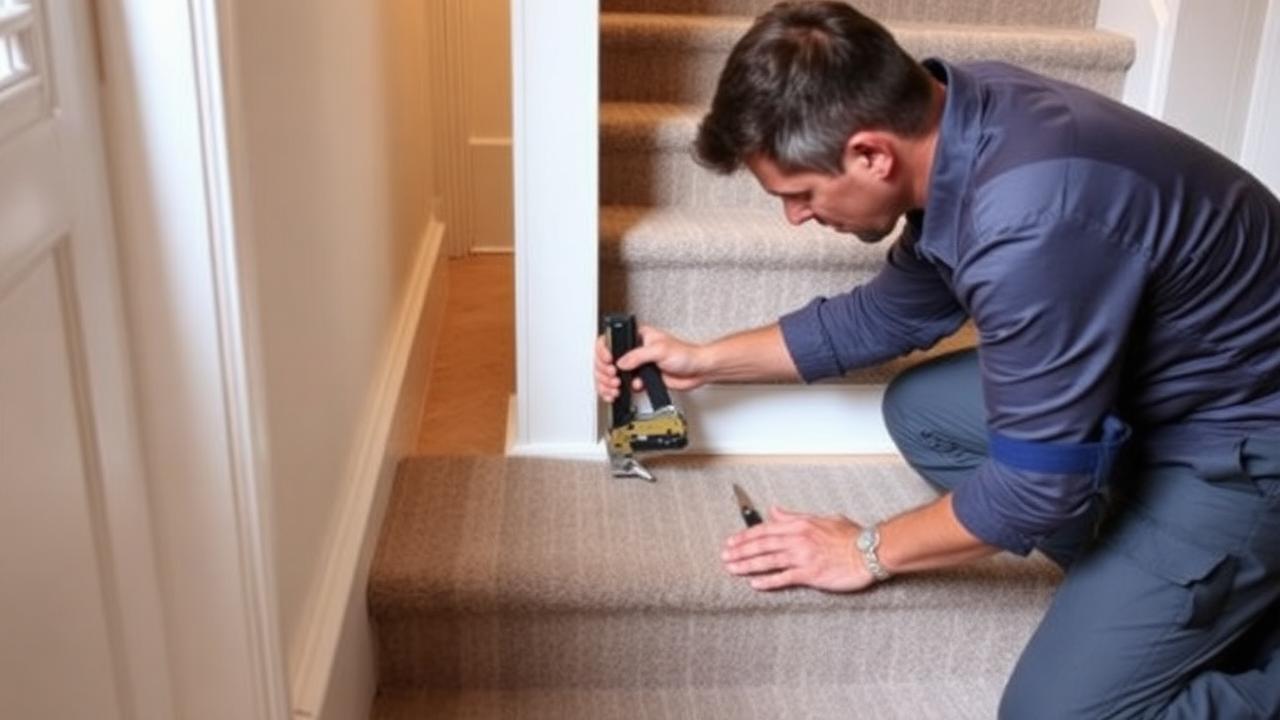
Fitters often order U shaped stair runners as separate lengths rather than one continuous roll, because the landing section needs to be cut and turned to match the direction change. If your runner has a directional pattern, such as a herringbone or a chevron, discuss with your fitter how the pattern will read as it turns the corner. Some designs are cut and pieced so the pattern appears to flow continuously; others are simply turned, which can create a visible break at the landing.
Measure both flights even if they look identical
It's tempting to assume both flights of a U shaped stair are the same length and just double one measurement. In older homes especially, floor levels and tread depths can differ slightly between the two runs, so always measure each flight independently before ordering.
Winders instead of a square landing
If your U shaped stair uses winder treads to turn the corner rather than a flat landing, you'll need to measure the outer edge of each winder (the walking line side) since that's the path the runner follows in most installations. This can add 15-20% more length compared to a flat landing design, so budget accordingly and consult our guide on winder stair measuring for full detail.
Rods, edging and pattern matching
Because a U shaped stair has a highly visible landing, many homeowners choose to install stair rods across the full run to add a decorative, finished look, particularly at the turn. Rods also help hold the runner firmly in place where the direction changes, reducing the risk of the carpet lifting or shifting over time with heavy use.
- Measure the lower flight, landing, and upper flight as three separate sections.
- Add a turn allowance of 3-6 in (8-15 cm) at the landing.
- Check whether your landing is a flat square or has winder treads.
- Consider stair rods at the landing turn for extra grip and style.
- Always add a waste margin of 5-10% to your total.
Spec checks before you order
Before you commit to a total footage, run a few sanity checks against your actual staircase. Most US residential codes call for a minimum landing depth of 36 in (91 cm) in the direction of travel, so if your landing measures less than that, double check your measurement rather than assuming a standard 4 ft (1.2 m) square. UK Building Regulations Part K set a similar minimum of 900 mm. Also confirm your riser height falls within the typical 7-7.75 in (18-19.5 cm) range and tread depth is at least 10 in (25 cm), since runners cut for out-of-spec steps rarely fit off-the-shelf nosing allowances.
It also pays to check whether your landing is a true 180-degree turn or a slightly offset 'dog-leg' layout, since the two require different landing pieces. On a true U shape, the landing runner is usually a simple rectangle; on an offset dog-leg, you may need an angled or trapezoid cut, which is worth flagging to your supplier before they cut from the roll.
Cost bands for a two-flight installation
Because a U shaped stair needs a separate landing piece plus fitting labour at the turn, budget for a bit more than a straight flight of similar total length. A budget synthetic runner typically runs $15-25 per linear ft ($50-80 per linear m) installed, a mid-range wool-blend $30-50 per ft ($100-165 per m), and a premium pure wool with a decorative border $55-90 per ft ($180-300 per m). Fitting labour for the extra landing cut and turn typically adds $75-150 (£60-120) on top of a standard straight-flight quote.
| Quality band | US price per ft installed | UK price per m installed |
|---|---|---|
| Budget synthetic | $15-25 | £40-65 |
| Mid-range wool-blend | $30-50 | £80-135 |
| Premium wool | $55-90 | £145-245 |
Styling rules specific to turned stairs
On a U shaped stair, the landing is the single most visible part of the whole run, since it's what you see first from the entry hall and what you look down on from the upper flight. Keep the pattern orientation consistent between the two flights so the eye reads it as one continuous design, and if you're using a bordered runner, make sure the border wraps the landing corners cleanly rather than being cut short. Ask your fitter for a photo of the mitred corner before installation day if this matters to you.
- Confirm landing depth meets minimum code (36 in / 900 mm) before ordering.
- Check whether your turn is a true U shape or an offset dog-leg.
- Budget extra fitting labour of $75-150 (£60-120) for the landing cut.
- Keep pattern orientation consistent across both flights and the landing.
- Ask for a photo of the mitred landing corner before final sign-off.
In summary, a U shaped stair calculator approach simply means breaking the flight into logical sections and adding them together, rather than trying to force a single measurement. Use the stair runner length calculator for each flight individually, then sum the results with your landing allowance for an accurate total.
Whatever you decide, get the numbers first: the stair runner calculator doubles as a stair runner length calculator, adding nosing wrap, landings, winders, pattern repeat and waste so you order the right length the first time.
Frequently asked questions
How is a U shaped stair different from an L shaped stair?
A U shaped stair turns 180 degrees via a landing, connecting two parallel flights, while an L shaped stair turns only 90 degrees.
Do I need extra runner for the landing?
Yes, the landing needs its own length of runner to cross it and connect visually with both flights.
Can I use one continuous piece of runner?
In many installations the landing piece is cut and seamed separately from the flights, especially with patterned runners.
What if my landing has winders instead of being square?
Measure the outer walking-line edge of each winder tread, which will add roughly 15-20% more length versus a flat landing.
Should I add stair rods at the landing turn?
Many homeowners do, both for a decorative finish and to help secure the runner where direction changes.
How much waste allowance should I include?
Budget 5-10% extra to account for pattern matching, trimming, and any measuring inaccuracies.
Are both flights always the same length?
Not necessarily. Always measure both independently rather than assuming symmetry, especially in older homes.
Can the stair runner calculator handle U shaped stairs?
Yes, run the calculator separately for each flight and add the landing allowance manually for a complete total.
Know your numbers in 30 seconds
Enter your step count, tread depth and riser height — the stair runner calculator gives you the exact length to order, in metres and feet, with waste included.
Work out your total with the stair runner calculatorReady for real prices?
Get quotes from vetted stair runner suppliers and fitters near you. Free, no account, no obligation.
Every guide is written from hands-on measuring and fitting experience, checked against the calculator’s own maths, and re-reviewed whenever prices or methods change. Read our editorial standards.