
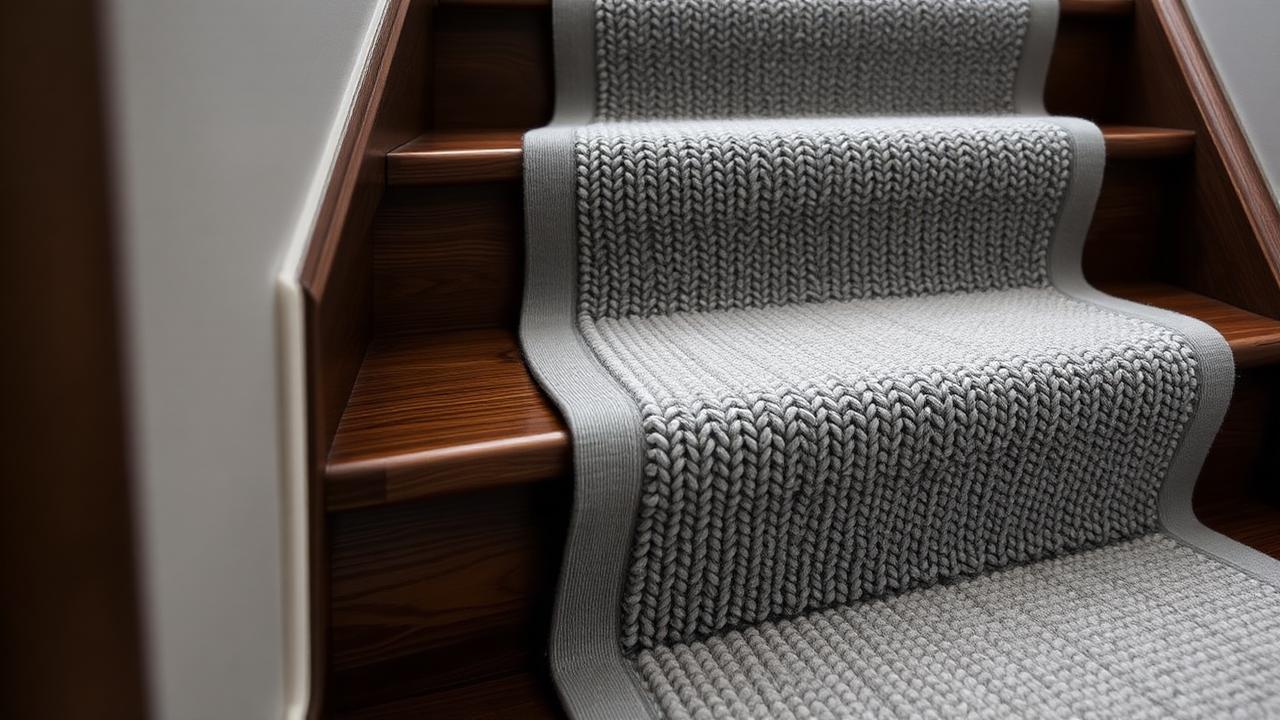
Why wool remains the gold standard
Wool fibre has a natural crimp that gives it excellent resilience, meaning it bounces back from foot traffic rather than crushing flat. It also has a natural resistance to staining, since the fibre's outer layer repels liquid long enough for spills to be blotted before they set. Combined with a soft, springy feel underfoot and excellent noise dampening, wool has earned its reputation as the premium choice for main staircases in both the US and UK.
Pure wool runners typically cost more than wool-blend or synthetic alternatives, but a well-made wool runner on a main staircase routinely lasts 15-20 years with proper care, which changes the cost-per-year calculation significantly compared to cheaper options that need replacing every 5-7 years.
Pure wool versus wool blends
An 80/20 wool-nylon blend is extremely common and for good reason: the nylon adds extra abrasion resistance at the tips of the pile, where wear concentrates most on stairs, while the wool retains its natural softness and stain resistance. Pure 100% wool runners look and feel slightly more luxurious but can be more prone to shedding fibres in the first few months after installation, which is normal and settles down over time.
How much runner do I need?
For a 13-step flight: 10 in tread + 7.5 in riser + 0.75 in wrap = 18.25 in per step, totalling 237.25 in. Add 24 in for finishing to reach 261.25 in, or 21.77 ft. With an 8% waste margin, order roughly 23.5 ft. In metric: 25 cm + 19 cm + 1.9 cm = 45.9 cm per step, 596.7 cm over 13 steps, plus 60 cm finishing gives 656.7 cm, and with 8% waste that comes to approximately 7.1 m. The stair runner calculator will do this instantly using your own measurements if your staircase differs from these figures.
| Fibre | Typical cost per foot (US) | Typical lifespan |
|---|---|---|
| Pure wool | $25-45 | 15-20 years |
| Wool-nylon blend | $18-32 | 12-18 years |
| Nylon | $10-20 | 8-12 years |
| Sisal | $12-22 | 10-15 years |
Know your numbers in 30 seconds
Enter your step count, tread depth and riser height — the stair runner calculator gives you the exact length to order, in metres and feet, with waste included.
Open the stair runner calculatorWool shedding is normal at first
New wool stair runners often shed loose fibres for the first few weeks after fitting. This is a natural part of the manufacturing process, not a defect, and it settles with regular vacuuming.
Fire safety and other advantages
Wool is also naturally flame-resistant compared to many synthetics, self-extinguishing rather than melting or spreading fire. Combined with its sound-dampening qualities, this is one reason wool stair runners remain the default recommendation for period homes and higher-end renovations on both sides of the Atlantic.
Pile weight and how it affects wear
Wool stair runners are sold by pile weight, usually measured in ounces per square yard in the US or grams per square metre in the UK. A heavier pile, above roughly 50 oz/sq yd (1700 g/sqm), holds up noticeably better on a main staircase than a lighter decorative pile intended for lower-traffic areas. If a supplier cannot tell you the pile weight, ask directly, since it is one of the clearest indicators of how a wool runner will perform over years of daily footfall rather than just how it looks on day one.
Twist level also matters. A tightly twisted, low-profile pile resists crushing and matting far better on stair nosings than a loose, high-pile cut, which is why most quality stair-specific wool runners use a denser, tighter construction than a comparable wool area rug.
Spec checklist before buying wool
- Ask for the pile weight in oz/sq yd or g/sqm, not just a vague quality grade
- Check the twist level, tighter constructions wear better on stairs specifically
- Confirm wool content percentage if buying a blend, 80/20 wool-nylon is a solid benchmark
- Ask about stain-treatment options if the household has young children or pets
- Request a certificate of flame rating if fitting in a rental or commercial setting
Cost bands by pile weight
| Pile weight | Typical use | US cost per ft |
|---|---|---|
| 30-40 oz/sq yd | Light-traffic secondary stairs | $15-25 |
| 40-55 oz/sq yd | Main staircase, family use | $25-38 |
| 55+ oz/sq yd | Heavy traffic, premium finish | $38-55 |
Wool on winders and curved staircases
Wool is one of the most forgiving fibres to fit around winders and curves, since it has enough natural flex to bend smoothly without cracking or excessive distortion the way sisal or a stiff jacquard weave can. This is part of why wool remains the default recommendation for staircases with turns, landings, or unusual geometry, in addition to its durability and comfort advantages on straight runs.

Sourcing responsibly and understanding origin
Wool quality and character vary by origin. New Zealand wool is prized for its brightness and durability and is a common benchmark for quality stair runners, while British and Irish wools tend to have a slightly coarser, more rustic character that suits traditional country-style interiors. Ask your supplier about the wool's origin and whether it carries any certification for responsible farming practices, since this is increasingly a factor buyers care about alongside performance and looks.
When wool is not the right choice
Wool is not ideal in consistently damp or poorly ventilated stairwells, since prolonged moisture exposure can lead to mould in the backing over time, nor is it the most budget-friendly option if you are furnishing on a tight timeline before a sale. In these situations, a quality wool-look synthetic or a wool-nylon blend at a lower wool percentage can offer a reasonable middle ground.
Whatever you decide, get the numbers first: the stair runner calculator doubles as a stair runner length calculator, adding nosing wrap, landings, winders, pattern repeat and waste so you order the right length the first time.
Frequently asked questions
Is a wool stair runner worth the extra cost?
Often yes, since wool typically lasts 15-20 years compared to 8-12 years for many synthetics, improving the long-term cost-per-year.
Is pure wool better than a wool blend?
Pure wool feels slightly more luxurious, but a wool-nylon blend often wears better at high-friction points like stair nosings.
Does wool shed after installation?
Yes, mild shedding for the first few weeks is normal and resolves with regular vacuuming.
Is wool naturally stain-resistant?
Yes, wool's fibre structure repels liquid initially, giving you time to blot spills before they set.
How much wool runner do I need for 13 steps?
Around 23.5 ft (7.1 m) including nosing wrap, finishing, and an 8% waste allowance.
Is wool fire-resistant?
Yes, wool is naturally flame-resistant and self-extinguishing, unlike many synthetic fibres.
How long does a wool stair runner last?
A well-maintained wool runner on a main staircase typically lasts 15-20 years.
Does wool need special cleaning?
Regular vacuuming and prompt blotting of spills is usually enough; avoid harsh chemical cleaners that can damage the fibre.
Know your numbers in 30 seconds
Enter your step count, tread depth and riser height — the stair runner calculator gives you the exact length to order, in metres and feet, with waste included.
Work out your exact length with the stair runner calculatorReady for real prices?
Get quotes from vetted stair runner suppliers and fitters near you. Free, no account, no obligation.
Every guide is written from hands-on measuring and fitting experience, checked against the calculator’s own maths, and re-reviewed whenever prices or methods change. Read our editorial standards.