

Why 24 inches exists as a standard width
Most stair runner ranges are cut and bound to a handful of standard widths, and 24 inches sits near the bottom of that list alongside 22 inch and 27 inch options. It is not an arbitrary number. Older properties, particularly Victorian, Edwardian and early 20th century cottages and terraces on both sides of the Atlantic, were frequently built with staircases whose treads measure somewhere between 28 and 34 inches wall to wall. Once you subtract the width of the strings (the timber sides that carry the treads and risers) and leave a sensible margin of exposed wood on each side for the runner to look intentional rather than cramped, you are often left with a usable width of 22 to 26 inches. A 24 inch wide stair runner (61cm) sits right in the middle of that range and is the single most common choice for this category of staircase.
It is also the width fitters reach for on very steep stairs, cottage stairs with a pitch approaching or exceeding 45 degrees, and stairs that turn tightly through winders where a wider runner would be harder to dress cleanly around the tapered treads. A narrower runner is simply easier to lay flat and pull taut on a steep pitch, and it reduces the amount of carpet that has to negotiate the compound angles at a winder.
24 inches in metric: exact conversions
24 inches converts to 60.96cm, which every UK retailer and most US retailers round to 61cm. This is worth knowing because UK broadloom carpet, from which many runners are cut, is typically woven in 68cm or 70cm wide rolls (sometimes quoted as 4ft or 27in narrow rolls, and 12ft/13ft/4m broadloom for full width). A 61cm finished runner cut and bound from a 68cm or 70cm roll leaves 7 to 9cm of waste per linear metre, most of which is trimmed from one edge before binding. US broadloom is more often supplied in 12ft (3.66m) or 15ft (4.57m) wide rolls, from which a 24in (61cm) runner is cut as a single strip with the length running along the roll, not across it, so waste calculations work differently: length efficiency matters more than width efficiency once the roll is wide enough to nest several runner-widths of pattern.
| Unit | Value | Notes |
|---|---|---|
| Inches | 24in | Nominal trade size |
| Centimetres | 61cm | 60.96cm rounded |
| Millimetres | 610mm | For CAD/joinery specs |
| Feet | 2ft | Common alternate naming: 2ft stair runner |
Reveal maths for a 24 inch runner
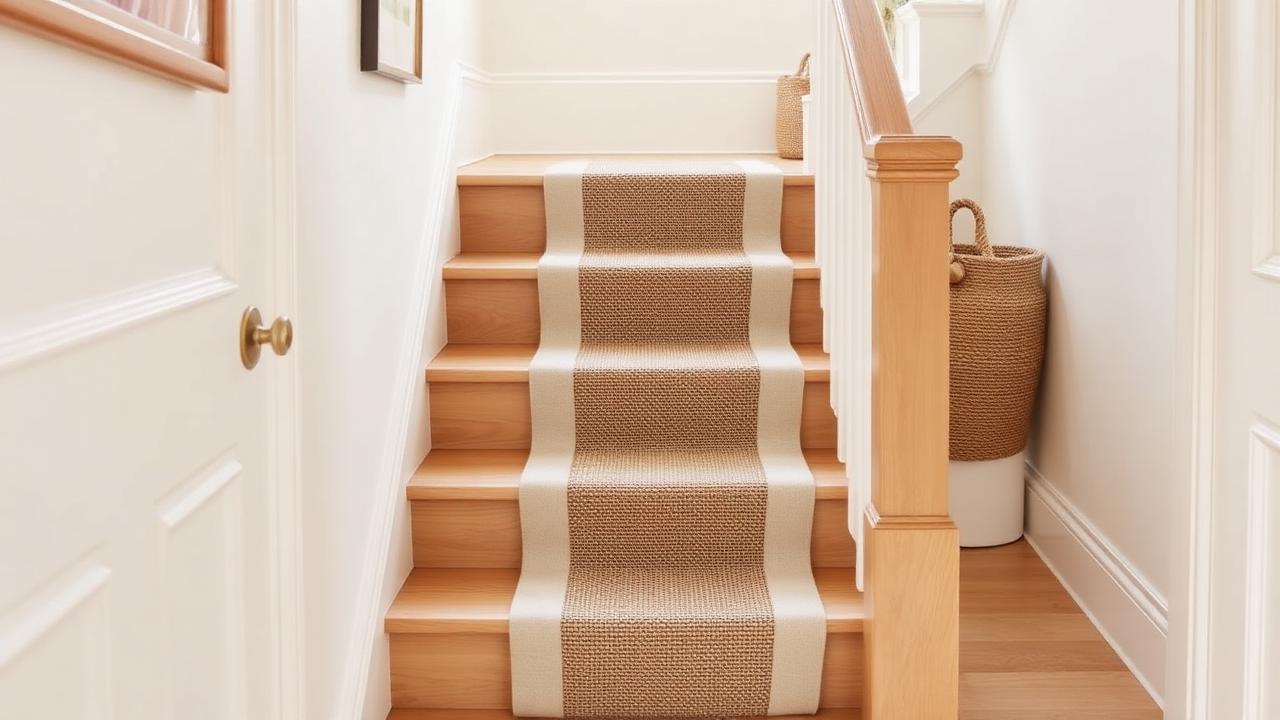
The reveal is the strip of exposed tread visible on either side of the runner, and it is the single most important number for making a narrow runner look deliberate rather than mean. To calculate it, measure the clear tread width between the strings (or between any skirting boards on an open-string stair), subtract 24in (or 61cm), and divide the remainder by two. On a 30in (76cm) wide tread, that gives a reveal of (30-24)/2 = 3in (7.6cm) on each side, which reads as a generous, well-proportioned margin. On a narrower 28in (71cm) tread, the same runner gives a 2in (5cm) reveal each side, which is tighter but still comfortable. Below about 1.5in (3.8cm) of reveal per side, most designers and fitters recommend dropping to a narrower runner still, such as 22in, because the margin starts to look accidental rather than styled.
Quick reveal formula
Reveal per side = (tread width - runner width) / 2. For a 24in runner on a 28in tread: (28-24)/2 = 2in each side. Keep at least 2in (5cm) per side wherever the staircase allows it, and never go below about 1.5in (3.8cm).
Matching 24 inch runners to cottage and steep stairs
Steep and cottage stairs bring two extra considerations beyond width. First, pitch: UK Approved Document K and US IRC R311.7 both set maximum pitch and minimum tread depth for new stairs, but older cottage staircases were frequently built before these rules existed and can run steeper than 42 degrees, sometimes close to 50 degrees on the tightest winders. On these flights, a narrower 24 inch runner is easier to keep flat against the nosing because there is less carpet width fighting the compound curve at each turn. Second, tread depth: many cottage stairs have a going (tread depth) of only 9 to 10in (23-25cm), which is shorter than modern code minimums. Shorter treads mean the runner wraps around a tighter nosing radius, and a narrower runner handles that wrap with less rippling at the edges than a wide one.
Ordering length once width is fixed
Fixing the width is only half the job. Once you know a 24 inch wide stair runner is right for your treads, use the stair runner length calculator to work out total linear length: measure the going (tread depth) and rise of each step, add the depth of the tread plus the height of the riser for every step, add a landing allowance if the flight turns, and then add a waste and pattern-matching margin. For a straight 13-step flight with a typical 10in going and 7.5in rise, that is roughly (10+7.5) x 13 = 227.5in, or about 19ft (5.8m), before waste. Because a 24 inch runner is narrower than average, remember that narrower widths do not need less length — length is driven entirely by the flight geometry, not the runner width.
US and UK buying differences at 24 inches
- US retailers commonly stock 24in, 27in, 32in and 36in as standard runner widths cut to order from broadloom.
- UK retailers more often list 60cm, 65cm, 67cm, 70cm and 80cm, so a 24in request is usually matched to a 61cm or 60cm product rather than an exact 24.00in cut.
- Sisal, seagrass and wool flatweave ranges are the most common natural-fibre options offered at this narrower width because their firm hand makes a slim runner sit flatter.
- Expect US pricing for a 24in runner around $18-32 per linear foot fitted for mid-range wool or wool-blend, and UK pricing around £28-48 per linear metre fitted for equivalent quality.
Common mistakes with narrow runners
The most frequent error is ordering 24 inches simply because a room looks narrow, without actually measuring the clear tread width. A tread that is 34in wide can happily take a 28in or 32in runner with a generous reveal; dropping to 24in there wastes the visual weight of the staircase and can look mean rather than deliberate on a wide flight. The second mistake is forgetting that a runner needs to be centred, not just narrow enough to fit — an off-centre 24in runner on an otherwise symmetrical staircase looks like a fitting error even if the width itself was the right call. Third, on stairs with a handrail or balustrade fixed close to one string, the reveal on that side is effectively unusable for foot traffic, so many fitters bias the centring slightly toward the open side rather than splitting the reveal exactly in half.
24in against UK roll widths and the 91cm broadloom myth
It is a common misconception that a narrow 24in runner is simply trimmed off a full 91cm (36in) UK broadloom roll with the offcut thrown away. In practice, most mills weave dedicated narrow-width broadloom specifically for stair runners at 68cm and 70cm, distinct from the 91cm or 4m wide-format broadloom used for fitted room carpet. A 61cm runner cut from 68cm narrow stock wastes only about 7cm per linear metre, almost all of it trimmed as a clean selvedge strip before binding, whereas cutting the same 61cm runner from a 91cm roll would waste 30cm per linear metre, nearly a third of the roll, which is why narrow-width weaving exists at all rather than everyone simply cutting down from wide broadloom.
US buyers comparing quotes should ask specifically whether a 24in runner is being cut from narrow US stock (commonly 27in or 30in narrow broadloom, itself analogous to the UK's 68/70cm narrow rolls) or trimmed from a 12ft (3.66m) wide roll. Trimming from wide broadloom is common for premium wool ranges that are only woven at wide format, and it is not a quality problem, but it does mean the price per linear foot can be higher than a runner cut from dedicated narrow stock, since more of the roll's width is discarded.
Choosing between 24in and its closest neighbours
Homeowners weighing a 24in runner are usually also considering 22in or 26in, and the decision genuinely does come down to millimetres on a tight staircase. Stepping up from 24in (61cm) to 26in (66cm) adds 5cm of total width, which removes 2.5cm of reveal from each side — on a 28in (71cm) tread already giving a 2in (5cm) reveal at 24in width, moving to 26in would leave almost no margin at all, roughly 1in (2.5cm) per side. Conversely, stepping down from 24in to 22in (56cm) adds about 2.5cm of reveal per side, which can be the difference between a runner that looks pinched against a very narrow tread and one that looks deliberately proportioned. This is exactly the kind of decision the stair runner calculator is built to check numerically rather than by eye, because a couple of centimetres either way is very hard to judge accurately just by looking at a bare staircase.
| Runner width | Metric | Reveal on a 28in (71cm) tread |
|---|---|---|
| 22in | 56cm | 3in (7.5cm) per side |
| 24in | 61cm | 2in (5cm) per side |
| 26in | 66cm | 1in (2.5cm) per side |
Fixings and pile height on a narrow, steep runner
Because 24in runners are so often paired with steep pitches, the fixing method matters more here than on a gentler standard-width stair. Traditional stair rods, whether brass, chrome or bronze finish, are a popular choice on narrow cottage runners because they hold the carpet firmly into the internal angle of each tread and riser, resisting the tendency of a runner to creep or lift at the back of a shallow tread on a steep pitch. Grippers (tackless strip) fixed to both tread and riser give a lower-profile, invisible fixing and are the standard choice for a permanent fitted look, but they demand accurate installation on a steep, narrow flight since there is very little spare carpet width to hide any inaccuracy in the strip's position. Pile height should also be kept moderate, generally under about 8-10mm, on a steep 24in runner: a deep, plush pile is harder to keep flat and secure at a compound-angle winder, and it can make the narrow exposed reveal either side look even more pronounced by contrast.

Cleaning and upkeep for a narrow natural-fibre runner
Sisal and seagrass are especially common choices at the 24in width because their firm construction suits a narrow, steep runner, but both fibres need different care from wool. Never wet-shampoo sisal or seagrass, since both absorb moisture into the fibre core and can stain, discolour, or even shrink slightly if soaked, unlike wool which tolerates a damp clean far better. Vacuum a narrow natural-fibre runner weekly with suction only, avoiding a rotating beater bar that can snag and fray the coarser fibre, and blot any spill immediately with a dry cloth rather than rubbing, since rubbing pushes liquid deeper into the weave.
Because a 24in runner leaves relatively little reveal on either side, dirt and grit tracked in near the edges is more visible than on a wider runner with a generous margin of bare tread to distract the eye. A stiff outdoor mat at the entrance and a habit of removing shoes before climbing a narrow, steep, natural-fibre staircase both meaningfully extend the interval between professional cleans, which is worth doing roughly every 12-18 months on a moderately used stair.
Know your numbers in 30 seconds
Enter your step count, tread depth and riser height — the stair runner calculator gives you the exact length to order, in metres and feet, with waste included.
Open the stair runner calculatorFrequently asked questions
What is 24 inches in cm for a stair runner?
24 inches converts to 61cm (60.96cm rounded). UK retailers typically list this as a 60cm or 61cm runner, cut from 68cm or 70cm wide broadloom rolls, while US retailers list it directly as 24in cut from 12ft or 15ft wide rolls.
Is a 24 inch stair runner too narrow?
It depends on your tread width. On treads of 28-32in, a 24in runner gives a comfortable 2-4in reveal per side and looks proportionate. On treads wider than about 36in, 24in can look too narrow; step up to 28in or 32in instead for better visual balance.
What staircases suit a 24 inch wide runner best?
Narrow cottage stairs, steep flights over about 42 degrees pitch, staircases with tight winders, and older properties with treads between 28 and 32 inches wide all suit a 24in runner because it leaves a workable margin without overwhelming a compact tread.
How much reveal does a 24 inch runner leave on a 30 inch tread?
(30-24)/2 = 3 inches (about 7.6cm) of exposed tread on each side, which is a generous, well-proportioned reveal that most designers consider close to ideal for a traditional-looking staircase. It also leaves enough margin for a stair rod fixing to sit comfortably clear of the runner edge.
Does a narrower runner need less carpet length?
No. Runner length is set entirely by the going and rise of each step, plus any landing allowance and waste margin, not by the runner's width. A 24in runner on a 13-step flight needs the same length as a 32in runner on the identical flight.
Can I fit 24 inch runners on winder or curved stairs?
Yes, and a narrower width is often easier to dress around winders because there is less carpet fighting the tapered tread and compound angle at each turn. You will still need a professional template or careful measuring at each winder tread.
What is the equivalent US broadloom width for a 24 inch runner?
US broadloom is commonly supplied in 12ft or 15ft wide rolls, and a 24in runner is cut as a single length-wise strip from that roll rather than matched to a narrow roll width, unlike UK 68cm/70cm narrow rolls which are close to the finished runner width already.
How do I check if 24 inches fits my stairs before ordering?
Measure the clear width between the strings or skirting at several treads (widths can vary slightly along a flight), then use the stair runner calculator to confirm the resulting reveal on both the narrowest and widest tread before committing to a width.
Know your numbers in 30 seconds
Enter your step count, tread depth and riser height — the stair runner calculator gives you the exact length to order, in metres and feet, with waste included.
Check your stair runner widthReady for real prices?
Get quotes from vetted stair runner suppliers and fitters near you. Free, no account, no obligation.
Every guide is written from hands-on measuring and fitting experience, checked against the calculator’s own maths, and re-reviewed whenever prices or methods change. Read our editorial standards.