

Width on a narrow staircase
| Stair width | Runner width | Reveal each side |
|---|---|---|
| 28 in | 20–22 in | 3–4 in |
| 30 in | 22–24 in | 3–4 in |
| 32 in | 24 in | 4 in |
| 34 in | 24–27 in | 3.5–5 in |
Below 3 inches of reveal, reconsider
A reveal narrower than about 3 inches per side reads as a badly fitted carpet rather than a runner. On very narrow stairs, full-width carpet is often the better-looking choice.
Steep stairs need shallow pile
- Deep pile visually softens the nosing edge, which is exactly what you cannot afford on a steep flight.
- Choose a dense low loop or short cut pile so the step edge stays legible.
- Contrast binding along the edges helps define the tread line.
- Wrap the nosing rather than a waterfall drop — waterfall hides the edge on steep stairs.
Know your numbers in 30 seconds
Enter your step count, tread depth and riser height — the stair runner calculator gives you the exact length to order, in metres and feet, with waste included.
Open the stair runner calculatorExtra material to allow
Steep flights have taller risers, so the length per step is higher than the usual assumption. A staircase with 8.5in risers and 9in treads still needs roughly 18 inches per step once the nosing is wrapped — do not assume shallow treads mean less material.
Winders on cottage stairs
Narrow cottage staircases nearly always turn on winders. Measure each winder at its widest point, treat every winder as a separate cut piece, and add 15% waste rather than 10%.
Handrails matter more on steep, narrow stairs
A steep, narrow staircase concentrates most of the trip risk a house has into one flight, so the runner is only one part of making it safe. Check that a handrail runs the full length of the flight on at least one side, ideally both if the stairs are steeper than about 42 degrees, and that it sits 34 to 38 inches above the nosing line. Fitting a new runner is a natural moment to address a missing or too-short handrail at the same time, since access is already disrupted.
Cost on a narrow cottage staircase
Narrower runners use less material, which partly offsets the extra labour that winders and precise fitting demand. Expect $450-750 in material for a 22-24 inch runner over a 13-step cottage flight with winders, against $600-950 for a wider 27-30 inch runner on a standard straight staircase of the same length, with fitting typically running 10-20% higher on the winder flight due to the extra templating each step needs.
| Flight type | Typical material cost | Typical fitting time |
|---|---|---|
| Narrow straight cottage stairs, 13 steps | $400–$650 | 3–4 hours |
| Narrow stairs with 3–4 winders | $450–$750 | 5–7 hours |
| Standard 30–32 in straight flight | $500–$800 | 2–3 hours |
Choosing pattern and colour on a tight flight
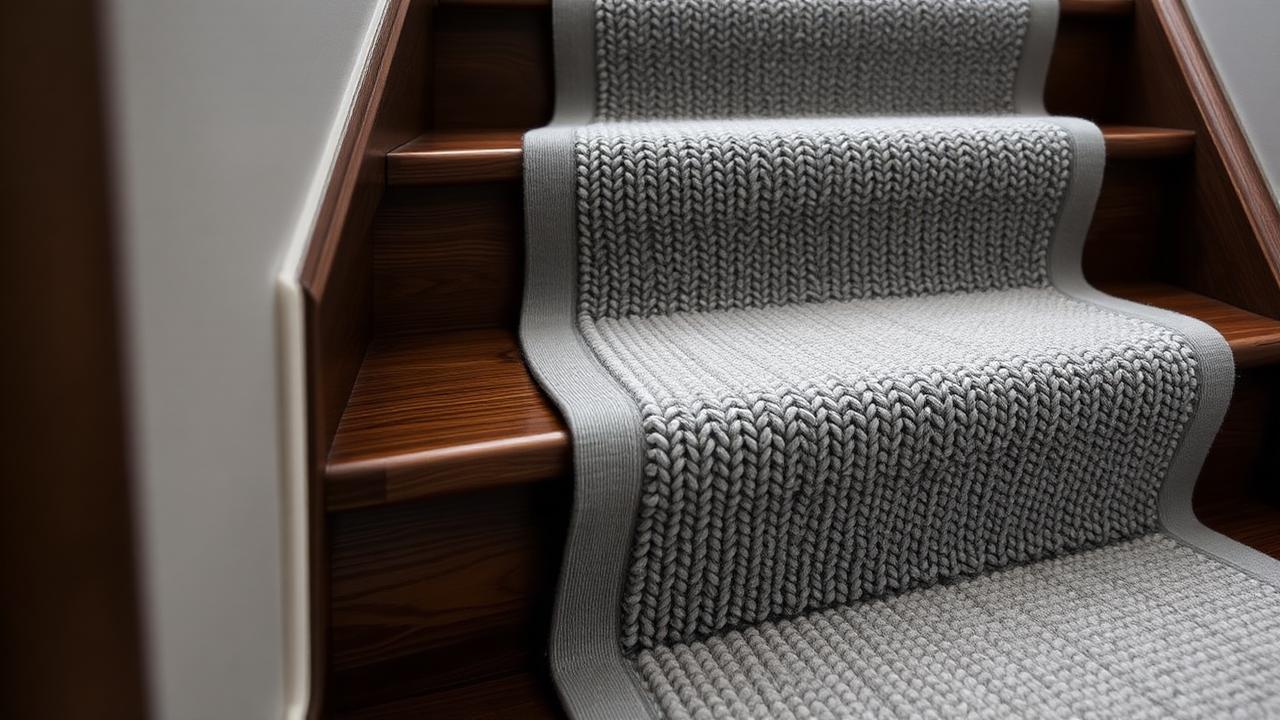
A busy, large-scale pattern can overwhelm a narrow runner and make the staircase feel even more cramped, since there is less width for the eye to read the repeat comfortably. A fine tweed fleck, narrow stripe running the length of the flight, or a plain tone in a mid-shade generally suits a tight cottage staircase better than a bold floral or large geometric design, which tends to look more at home on a wider, more generously proportioned flight.
Handrail and lighting on a steep flight
Steep, narrow staircases are disproportionately represented in household fall statistics, so a runner is only one part of a safe outcome. Make sure a handrail runs the full length of the flight and, ideally, extends slightly past the top and bottom steps rather than stopping exactly at the nosing. A single well-placed light at the top of a steep, enclosed staircase makes a bigger practical difference to safety than almost any change to the runner itself, since poor lighting on a steep pitch is one of the most common contributing factors in a stair fall after dark.
Fitting time and what to expect
Steep and narrow staircases generally take longer to fit than a standard flight of the same length, mainly because of the winders, the reduced working space for a fitter to kneel and manoeuvre, and the extra care needed to keep tension even on a shorter tread depth. Budget roughly 25 to 40% more fitting time than a standard straight flight of comparable step count, and mention the staircase type when getting quotes so the estimate reflects the real complexity rather than a generic straight-flight assumption.
Underlay choice on narrow treads
A thick underlay pad can eat into an already shallow tread depth on a narrow cottage staircase, effectively shortening the usable footing on each step. A thinner, denser pad — typically 6 to 8mm rather than the 10mm-plus sometimes used on standard stairs — keeps cushioning benefits without meaningfully reducing tread depth, which matters more on a steep, narrow flight than almost anywhere else in the house.
Material choice for cottage and loft stairs
Wool blends and dense nylons both work well on steep, narrow flights, but flatweave and low-loop constructions are worth a closer look here specifically because their reduced pile height keeps the tread edge sharply defined. Very plush, saxony-style cut pile, however appealing on a wide gracious staircase, is one of the least suitable choices for a narrow cottage or loft flight, since its softness and height are exactly what obscures a step edge on a steep pitch.
Fixing methods that suit steep flights
On a steep staircase, the runner takes a more direct downward pull with every step than on a shallow flight, so fixing security matters even more than usual. Staples in the crotch of every single step, rather than every other step, are worth the extra time on anything steeper than a standard 42-degree pitch. Stair rods add real mechanical security here too, not just decoration, since the rod itself physically blocks the runner from creeping downward over the tread edge under repeated footfall.
Loft conversion and attic stair considerations
- Loft conversion staircases are very often steeper than standard building regulations would allow for a main staircase, since they are frequently fitted into limited existing floor space.
- Headroom is often tight on these flights, so a very low, dense pile keeps the finished step height as close to the bare tread height as possible.
- Winders are common on loft stairs to save space, and each one should be measured and cut individually rather than assumed identical.
- Check any local building regulations on stair pitch and covering before finalising material, since some loft stair designs are treated differently to a standard staircase for safety purposes.
Whatever you decide, get the numbers first: the stair runner calculator doubles as a stair runner length calculator, adding nosing wrap, landings, winders, pattern repeat and waste so you order the right length the first time.
Still deciding on material, width or pattern? Our hub on stair runners compares weaves, widths, backings and fitting styles side by side, then hands the numbers straight to the calculator.
Frequently asked questions
How wide should a runner be on narrow stairs?
Aim to keep 3 to 4 inches of exposed tread each side. On a 30in staircase that means a 22 to 24 inch runner.
Are runners safe on steep stairs?
Yes, when the pile is short and dense, the nosing is wrapped, and the runner is fixed at every step. Avoid deep pile, which obscures the step edge.
Do steep stairs need more runner material?
Often yes — taller risers add length per step even though the treads are shallower. Measure both dimensions rather than assuming.
How much runner do I need on a steep 13-step US flight?
For a 13-step flight with a 9 in tread and 8.5 in riser, each step uses roughly 18 in of runner including the wrap, giving about 19.5 ft before waste. Add a 10-15% margin for winders if present, landing around 21-22 ft.
What is the UK metric equivalent for a steep narrow flight?
A 23 cm tread and 21.5 cm riser gives roughly 45.5 cm per step, or about 5.9 m across 13 steps before waste. With a 10-15% winder allowance, expect to order roughly 6.5-6.8 m.
Should I use a stair runner calculator for a non-standard staircase?
Yes — a stair runner calculator still gives you an accurate base figure from your tread, riser and step count even on a steep or narrow flight. Just apply a higher waste margin, 10-15% rather than 5-10%, to cover winders and tighter fitting tolerances.
Is a plain stair runner carpet better than a patterned one on narrow stairs?
Usually yes. A fine fleck, narrow stripe or plain mid-tone reads better on a tight cottage or loft staircase than a large-scale pattern, which can make an already narrow flight feel more cramped and is also harder to align across winders.
Know your numbers in 30 seconds
Enter your step count, tread depth and riser height — the stair runner calculator gives you the exact length to order, in metres and feet, with waste included.
Find my runner widthReady for real prices?
Get quotes from vetted stair runner suppliers and fitters near you. Free, no account, no obligation.
Every guide is written from hands-on measuring and fitting experience, checked against the calculator’s own maths, and re-reviewed whenever prices or methods change. Read our editorial standards.