

Why 32 inches is the wide-staircase default
Once a staircase's clear tread width climbs past about 40 inches, which is typical of grand entrance stairs, double-width staircases, and many higher-end new-build homes in the US and larger period properties in the UK, the standard 26 or 28 inch runner starts to look genuinely undersized, leaving 7 inches or more of bare tread on each side and failing to give the staircase the visual weight it needs. 32 inches (81cm) is the width most commonly stepped up to for this category of stair: it restores a proportionate reveal on wide treads and reads as substantial enough to suit an impressive entrance hall or curved feature staircase, without going so wide that it looks like an oversized rug rather than a runner.
32in is also frequently chosen for stairs with an open or curved plan, where a wider runner helps visually anchor the flight and can better follow the compound geometry of a curved or bowed staircase without looking like a thin ribbon lost against a wide, sweeping tread.
32 inches in metric
32 inches converts to 81.28cm, rounded to 81cm. This figure sits meaningfully above the common UK narrow broadloom roll widths of 68cm and 70cm, and even above the 80cm width some ranges stock, which is the first point at which roll-width becomes a genuine manufacturing constraint rather than a rounding curiosity. A runner wider than the roll it is woven on cannot simply be cut wider — it either needs to be produced on a wider loom (common for higher-end wool ranges, which are often woven up to 4m/13ft broadloom specifically to allow wide-format cutting), or it needs to be seamed from two widths of narrower carpet joined invisibly down the centre or along one edge, a specialist job that adds cost and requires a skilled fitter to execute so the seam is not visible in the finished runner.
| Measurement | Value |
|---|---|
| Inches | 32in |
| Centimetres | 81cm (81.28cm exact) |
| Millimetres | 813mm |
| Common alternate naming | 2ft8in stair runner |
Roll widths and when seaming is required
This is the single most important technical difference between a 32in runner and the narrower sizes covered elsewhere in this guide: at 24-28in, virtually any standard broadloom roll (UK 68/70cm, US 12ft/15ft) comfortably yields a single, seamless finished width with room to spare for trimming and binding. At 32in (81cm), you are now relying on either wide-loom broadloom (commonly woven up to 3.66m/12ft or 4.57m/15ft in the US, and up to 4m or 5m in UK wide-width wool ranges) cut as a single length-wise strip, which is straightforward, or on narrower stock that must be seamed. Always confirm with your supplier which method they use for 32in and wider runners: a single strip cut from wide broadloom will have no visible join, while a seamed runner, even well executed, carries a small risk of a visible line under raking light, particularly in cut-pile wool where pile direction either side of a seam can catch light differently.
Ask about seaming before you order a 32in runner
Confirm whether your 32in stair runner will be cut as one seamless strip from wide broadloom, or seamed from two narrower widths. A seamed runner is not necessarily a problem, but it should be priced, disclosed and executed by a fitter experienced with stair-runner seaming, not treated as a minor detail.
Reveal maths on wide staircases
On a 40in (102cm) staircase, a 32in runner gives (40-32)/2 = 4in (10cm) reveal per side, a comfortable, well-balanced margin for a wide flight. On a 44in (112cm) grand staircase, the same runner gives (44-32)/2 = 6in (15cm) per side, generous and appropriate for an entrance statement piece. On a narrower 36in stair, the standard US width, a 32in runner leaves only (36-32)/2 = 2in (5cm) per side, tight for this tread but sometimes chosen deliberately by homeowners wanting a fuller, more contemporary near-edge-to-edge look on an otherwise standard staircase.
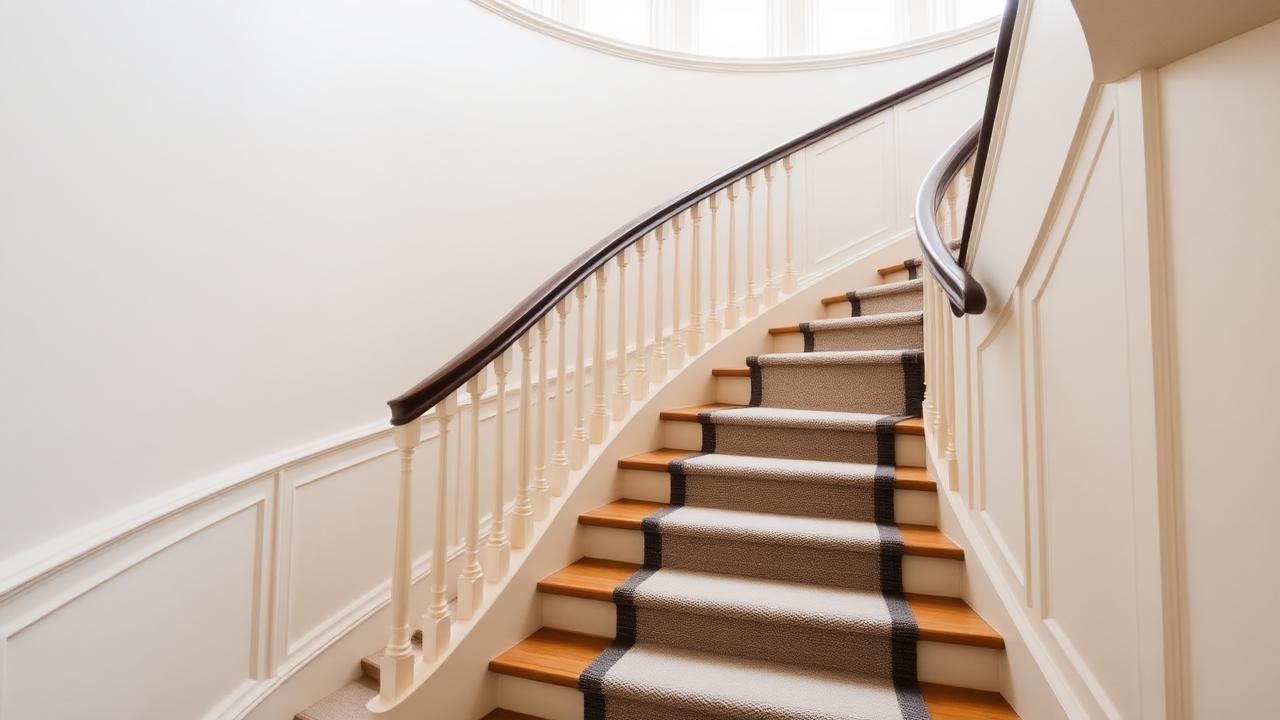
- Measure the clear tread width at the narrowest and widest points of the flight, especially important on curved stairs where width can vary step to step.
- Calculate the reveal at 32in on both the narrowest and widest tread using (tread width - 32) / 2.
- Ask your supplier whether the 32in width will be supplied seamless from wide broadloom or seamed from narrower stock.
- If seaming is required, confirm the fitter has specific experience seaming stair runners, not just flat carpet.
- Run the final numbers through the stair runner calculator to sanity-check reveal and total length together.
Pricing and length at 32 inches
Because 32in runners more often require wide-loom broadloom or skilled seaming, expect a price premium over standard 26-28in widths: US fitted pricing for a genuinely seamless 32in wool runner typically runs $32-55 per linear foot, and seamed constructions can add $5-15 per linear foot in labour. UK pricing for an 80-81cm wide runner fitted runs roughly £42-75 per linear metre, again with a premium if seaming is needed. Once width and construction method are settled, calculate total length with the stair runner length calculator: sum tread depth plus riser height for every step, add a landing allowance for any turn or half-landing, and add a waste margin, remembering that curved or winder sections on a wide grand staircase often need a larger waste allowance than a straight flight because more fabric is trimmed away on the inside of each curve.
32in against UK and US roll widths in detail
It is worth spelling out exactly why 81cm is the threshold where roll width starts to dictate construction method. UK narrow broadloom for stair runners is conventionally 68cm or 70cm, and even the wider 80cm option some mills offer falls 1cm short of a true 32in (81.28cm) finished runner. US narrow broadloom for stairs is typically 27in or 30in, both narrower than 32in. In both markets, a genuinely seamless 32in runner therefore has to come from wide-format broadloom, woven at 12ft (3.66m) or 15ft (4.57m) in the US or up to 4-5m in UK wide-width wool ranges, cut lengthwise as a single strip. This is a fundamentally different manufacturing route from narrower runners, and it is why 32in pricing and lead times diverge noticeably from the 24-28in range covered elsewhere in this guide.
Some ranges solve this by weaving bespoke wide-format broadloom specifically for wide runners and hall carpets, while others rely on seaming two lengths of standard 68-70cm or 27-30in narrow stock down the centre. A well-executed centre seam, run with matched pile direction and a skilled hand-stitched or heat-taped join, can be genuinely difficult to spot even close up, but it should always be disclosed and priced as a distinct line item rather than left ambiguous on a quote.
32in on a standard 36in stair versus a 44in grand stair
The reveal maths bears repeating with a wider spread of tread widths, since 32in spans an unusually broad range of suitable staircases. On the US-standard 36in (914mm) tread, 32in gives a tight (36-32)/2 = 2in (5cm) reveal, workable but contemporary rather than classic. On a 42in (1070mm) staircase, the reveal opens to (42-32)/2 = 5in (12.7cm), arguably the sweet spot for this width. On a genuinely grand 44in (1118mm) entrance stair, the reveal reaches 6in (15cm), generous and appropriate for a statement flight. Below 36in, most designers steer homeowners toward 28in instead, since a 32in runner on anything narrower than about 34-36in starts to leave almost no usable reveal at all.
| Staircase width | 32in runner reveal per side | Verdict |
|---|---|---|
| 36in (914mm) | 2in (5cm) | Tight, contemporary look |
| 42in (1070mm) | 5in (12.7cm) | Sweet spot for this width |
| 44in (1118mm) | 6in (15cm) | Generous, grand-entrance scale |
Underlay, padding and fitting considerations at wide widths
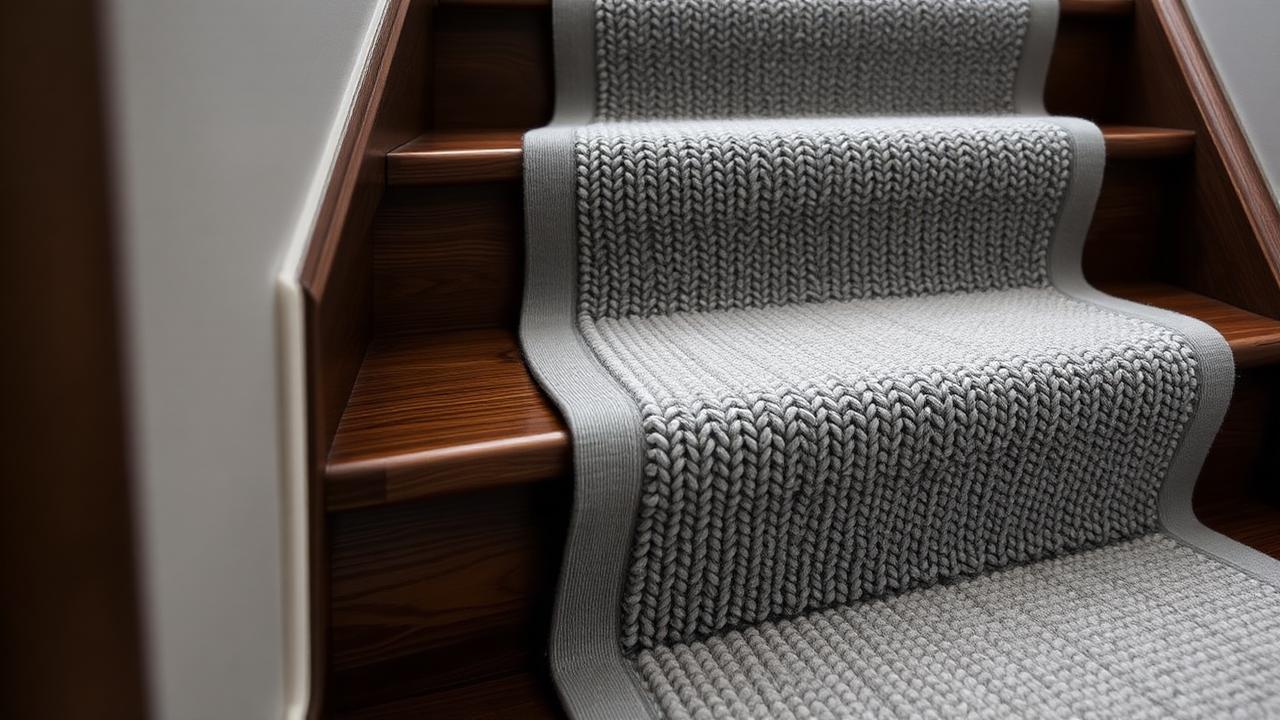
A wider runner also changes some practical fitting details that are easy to overlook. Underlay or pad should be cut a touch narrower than the finished carpet width, typically an inch or so in from each edge, so it does not peek out beyond the binding — on a 32in runner this means sourcing pad wide enough to cover the full width without a seam of its own, since padding is available in its own set of roll widths that do not always line up neatly with 81cm. On curved or winder sections of a wide staircase, more fabric is trimmed away on the inside of each turn than on a narrower runner, so budget a larger waste allowance, commonly 15-20% rather than the 10% typical of a straight flight, when pricing a curved 32in installation.
Budget extra waste on curved 32in flights
Curved and winder sections consume more fabric per step on a wide 32in runner than on a straight flight, because more material is trimmed from the inside of each turn. Allow 15-20% waste on curved staircases rather than the 10% typical of a straight run.
When to choose 32in over stepping up further
Some very wide entrance staircases, beyond about 46-48in clear width, are better served by 36in or even 39in runners rather than pushing 32in to its outer limit, since a reveal beyond roughly 8in per side starts to look under-scaled regardless of how well the runner itself is made. As a working rule, treat 32in as the right choice for staircases between about 36in and 46in wide, and consult a fitter about wider bespoke options outside that range rather than assuming 32in is infinitely scalable simply because it already sits at the wider end of stocked sizes.
Custom widths beyond the stocked 32in size
Some grand staircases fall between the stocked 32in and 36-39in sizes, and most mills offering wide-loom broadloom can cut a genuinely custom width, such as 33in or 34in, from the same wide-format roll used for 32in or 36in orders at little to no cost premium, since the loom width rather than the specific cut width is the real constraint. If your reveal calculation lands awkwardly between two stocked sizes, ask your supplier whether a custom cut from their existing wide-loom stock is available before assuming you must round up or down to the nearest catalogue width, since the wide-format manufacturing route already used for 32in runners makes intermediate widths straightforward to produce.
Weight, handling, and installation labour at 32 inches
A 32in runner is noticeably heavier and more unwieldy to handle on the stairs than a 24-28in runner, particularly in a dense wool or wool-blend construction, and this has a real effect on installation time and cost. Fitters typically need a second pair of hands to manoeuvre a wide roll safely up a stairwell without damaging walls or the runner's own binding, and the additional weight makes stair rods, if used, work harder to hold the carpet securely at each internal angle. Expect labour time for a 32in installation to run 25-40% longer than an equivalent straight flight in 24-26in, which is reflected in the higher fitted price per linear foot or metre already noted for this width, separate from any additional cost attributable to seaming or wide-loom material sourcing.
Know your numbers in 30 seconds
Enter your step count, tread depth and riser height — the stair runner calculator gives you the exact length to order, in metres and feet, with waste included.
Open the stair runner calculatorWhatever you decide, get the numbers first: the stair runner calculator doubles as a stair runner length calculator, adding nosing wrap, landings, winders, pattern repeat and waste so you order the right length the first time.
Frequently asked questions
What is 32 inches in cm for a stair runner?
32 inches converts to 81cm (81.28cm exact). This exceeds common UK narrow broadloom widths of 68-70cm, so 32in runners are typically either cut from wide-loom broadloom woven up to 4m or wider, or seamed from two narrower widths by a specialist fitter.
Do 32 inch stair runners need to be seamed?
Not always. If the runner is cut from wide broadloom, commonly woven up to 12-15ft in the US or 4-5m in UK wide-width wool ranges, it can be supplied as a single seamless strip. If sourced from narrower stock, it will need to be seamed by a specialist fitter.
What size staircase needs a 32 inch runner?
32in suits staircases with a clear tread width of about 38 to 46 inches, giving reveals from roughly 3 to 7 inches per side. It is the standard choice for grand entrance stairs, wide double staircases, and curved feature flights.
How much reveal does a 32 inch runner leave on a 40 inch stair?
(40-32)/2 = 4 inches (about 10cm) per side, a comfortable and well-proportioned margin that suits a wide staircase without looking like an oversized rug, and it is close to the ideal reveal most designers recommend for this tread width.
Is a 32 inch runner more expensive than narrower widths?
Yes, generally. Expect $32-55 per linear foot fitted in the US for a seamless wool runner, with seaming adding $5-15 per linear foot in labour. UK pricing runs roughly £42-75 per linear metre fitted, both higher than typical 26-28in pricing due to wider-loom or seaming requirements.
Can I fit a 32 inch runner on a standard 36 inch staircase?
Yes, though it leaves a tighter 2in reveal per side, which some homeowners choose deliberately for a fuller, more contemporary look. Check the reveal carefully with samples first, since 2in is close to the minimum most designers consider comfortable on a standard-width tread.
How do I avoid a visible seam on a wide stair runner?
Ask your supplier whether the finished runner can be cut as a single strip from wide-loom broadloom rather than seamed from narrower widths, and if seaming is unavoidable, use a fitter with specific stair-runner seaming experience to keep the join as close to invisible as possible.
How do I calculate the length needed for a 32 inch wide runner?
Add the tread depth plus riser height for every step, add a landing allowance for turns, and build in extra waste margin for curved or winder sections, or use the stair runner length calculator for an instant total based on your flight's dimensions.
Know your numbers in 30 seconds
Enter your step count, tread depth and riser height — the stair runner calculator gives you the exact length to order, in metres and feet, with waste included.
Check your stair runner widthReady for real prices?
Get quotes from vetted stair runner suppliers and fitters near you. Free, no account, no obligation.
Every guide is written from hands-on measuring and fitting experience, checked against the calculator’s own maths, and re-reviewed whenever prices or methods change. Read our editorial standards.