

The fundamental difference in weaving
An Axminster carpet is woven on a loom that allows each individual tuft of yarn to be inserted separately. This is similar to how a hand-knotted rug is made, but at industrial speed. The key advantage here is that there are virtually no limits to the number of colours or the complexity of the pattern. In my experience as a fitter, if a client wants a highly detailed floral or a complex geometric pattern that looks the same from every angle, Axminster is the only way to go. The pile is always 'cut,' which gives it a plush, velvet-like feel that is exceptionally durable for stairs.
A Wilton carpet is woven using one continuous strand of yarn that runs through the entire carpet, being 'poked up' to the surface where the colour is needed and carried along the back where it isn't. This limits the number of colours you can use (usually to 5 or 8 per pattern), but it creates a very dense and stable structure. Wilton looms can also create different textures, such as a mix of 'cut' and 'loop' pile, which creates a carved or embossed look. While Axminster is about colour and pattern, Wilton is often about texture and structural integrity. A 'Face-to-Face' Wilton is one of the most common high-end stair runner carpet types found in modern homes.
Durability on the 'Smile' of the Stair
The 'smile' is the term we fitters use for the way the carpet pile opens up when it is stretched over the nosing of a step. If a carpet is not densely woven, you can sometimes see the backing material through the pile at the edge of the tread—an unsightly effect that ruins the look of a runner. Axminster is generally very good at avoiding this because the tufts are inserted vertically and densely. However, a high-quality Wilton is often even denser because of that continuous yarn running through the back, which 'packs' the pile tightly together.
Both are 'contract grade' materials, meaning they are designed to handle the heavy foot traffic of hotels and stately homes. On a domestic staircase, either will last 20 to 30 years if properly maintained. The real difference in durability comes down to the yarn quality. Look for a 'woven-through-the-back' construction, which ensures the tufts can never be pulled out. Whether you choose Axminster or Wilton, using a stair runner calculator ensures you have enough material to allow for pattern matching, which is especially important for these high-end weaves.
How much runner do I need?
Woven carpets like Axminster and Wilton are expensive, so you don't want to over-order. However, because they almost always have a pattern, you must account for the 'pattern repeat' to ensure the design lines up perfectly on every step. Here is a baseline calculation for a standard 13-step flight.
| Component | UK (cm) | US (in) |
|---|---|---|
| Tread Depth | 25 cm | 10 in |
| Riser Height | 19 cm | 7.5 in |
| Nosing Wrap | 2 cm | 0.75 in |
| Step Subtotal | 46 cm | 18.25 in |
| 13 Steps Total | 598 cm | 237.25 in |
| Finishing Allowance | 60 cm | 24 in |
| Base Material | 6.58 m | 21.77 ft |
| With 15% Pattern/Waste | 7.57 m | 25.04 ft |
Know your numbers in 30 seconds
Enter your step count, tread depth and riser height — the stair runner calculator gives you the exact length to order, in metres and feet, with waste included.
Open the stair runner calculatorDesign Flexibility vs Textural Depth
If you are looking for a bespoke runner with your family crest, a specific tartan, or a complex oriental rug design, Axminster is the gold standard. Because each tuft is independent, the loom can 'paint' with wool. This is why you see Axminster in luxury hotels and casinos—it allows for massive, non-repeating designs. In a home hallway, an Axminster runner can be the piece of art that defines the entire entrance.
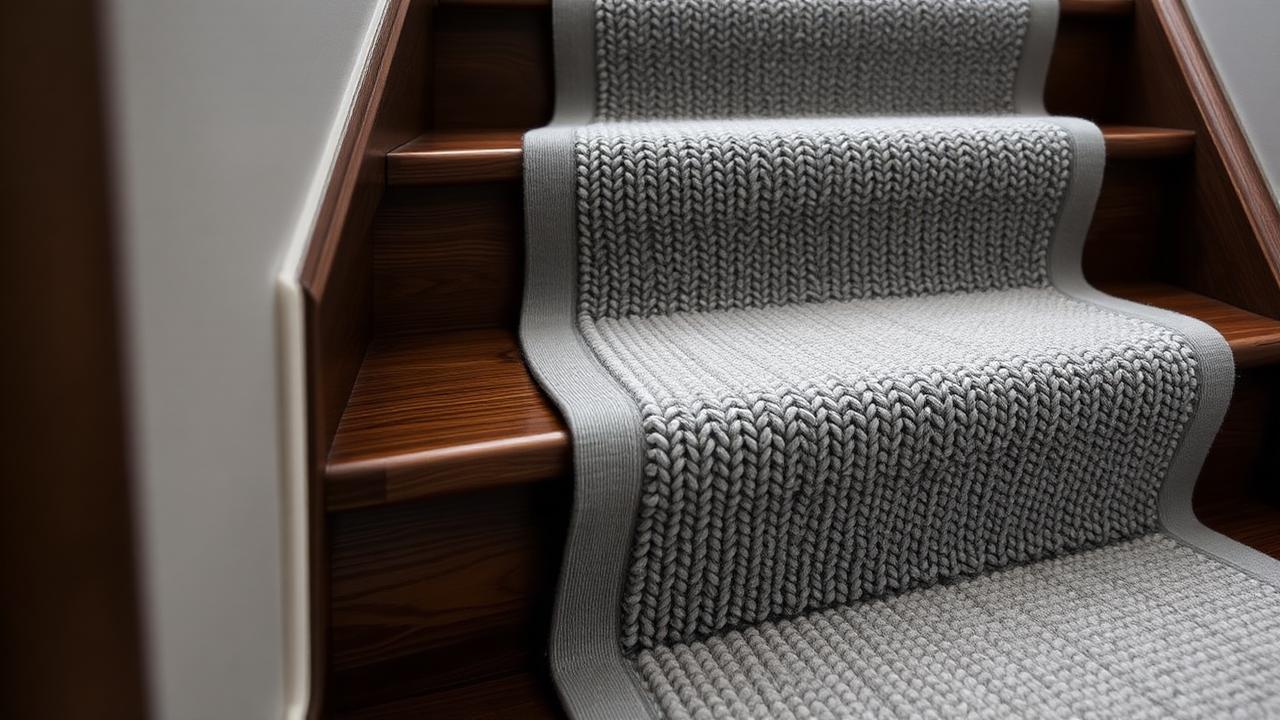
Wilton is the choice for those who prefer a more understated, textural luxury. Because Wilton looms can create loops and cuts at different heights, they produce beautiful 'sculpted' patterns in a single colour or a limited palette. A grey-on-grey Wilton with a subtle geometric 'high-low' texture can look incredibly sophisticated and modern. It feels slightly firmer than Axminster, which some people prefer for the stability it provides on a staircase. I often find that Wilton is the 'quiet luxury' option, while Axminster is for those who want to make a bold statement.
Pattern Matching
When fitting an Axminster runner with a large pattern, always buy at least one full pattern repeat extra. Nothing looks worse than a beautiful runner where the pattern 'jumps' or is cut off halfway through at the top landing.
- Axminster allows for unlimited colours and complex patterns.
- Wilton is known for its structural density and textural variety.
- Both weaves are exceptionally durable for high-traffic stairs.
- Axminster pile is always 'cut,' providing a velvet-like finish.
- Wilton can feature 'cut and loop' textures for a 3D effect.
- Both require professional fitting and high-quality underlay.
- Axminster is often used for bespoke and traditional rug designs.
- Use a stair runner calculator to account for complex pattern repeats.
Conclusion: Which should you choose?
The choice between Axminster and Wilton usually comes down to your aesthetic goals. If you have a specific, multi-coloured pattern in mind, Axminster is your only choice. It is the pinnacle of patterned carpet technology. If you want a dense, textured, and incredibly stable runner that might be a bit more subtle in its design, a Wilton is a fantastic investment. Both represent the absolute best of British and European carpet weaving history, and neither will disappoint in terms of quality or longevity on your stairs.
Whatever you decide, get the numbers first: the stair runner calculator doubles as a stair runner length calculator, adding nosing wrap, landings, winders, pattern repeat and waste so you order the right length the first time.
Frequently asked questions
Why is Axminster so expensive?
The cost comes from the complexity of the loom and the quality of the yarn. Because every tuft is individually placed, the process is slower and allows for much higher detail than standard tufted carpets. It is truly a piece of industrial art.
Can you have a loop pile Axminster?
No, by definition, the Axminster process creates a cut pile. If you want a loop pile or a mix of textures, you should look at a Wilton or a dedicated flatweave runner.
Is Wilton better for modern homes?
Often, yes. Wilton's ability to create subtle, single-colour textures (like a 'carved' look) fits the minimalist aesthetic of many modern homes better than the multi-coloured patterns typical of Axminster.
Which is easier to clean, Axminster or Wilton?
Both are usually made from high-quality wool or wool-nylon blends, so they clean very well. Because Axminster is always a cut pile, it doesn't snag as easily as a loop-pile Wilton might if you have pets with sharp claws.
Do Axminster carpets shed?
Like all high-quality wool carpets, Axminster will 'shed' small fibres for the first few months. This is normal and doesn't affect the quality of the carpet; it’s just the excess fibres from the manufacturing process working their way out.
What is 'Face-to-Face' Wilton?
This is a modern weaving technique where two carpets are woven at the same time, one on top of the other, joined by the pile yarn. A blade then cuts them apart down the middle. It’s an efficient way to produce high-quality, dense Wilton carpet.
Can I use a domestic vacuum on an Axminster runner?
Yes, but use a vacuum with a beater bar for cut pile carpets. This helps to lift the dirt from deep within the dense weave. Avoid using overly aggressive settings that might 'fuzz' the yarn.
Which weave is better for 'winders' (turning stairs)?
Axminster is often slightly easier to work with on winders because the independent tufts allow for a bit more flexibility in how the carpet is 'dressed' around a curve without showing the backing.
Know your numbers in 30 seconds
Enter your step count, tread depth and riser height — the stair runner calculator gives you the exact length to order, in metres and feet, with waste included.
Use our stair runner calculator to plan your weaveReady for real prices?
Get quotes from vetted stair runner suppliers and fitters near you. Free, no account, no obligation.
Every guide is written from hands-on measuring and fitting experience, checked against the calculator’s own maths, and re-reviewed whenever prices or methods change. Read our editorial standards.