

What makes berber different
Berber carpet is a looped pile construction, traditionally made from wool with characteristic flecks of colour, though most modern berber-style stair runners use nylon or wool-blend loops for extra resilience. The looped structure lies flat and resists crushing better than a cut pile, which is exactly why it performs so well on stairs — the highest-wear surface in most homes. Because the loops are tightly packed, dirt and debris tend to sit on the surface rather than working down into the pile, making berber noticeably easier to vacuum clean.
Choosing a colour and fleck pattern
Berber's classic look includes subtle flecks of a darker or lighter tone mixed through a base colour. This flecking is not just decorative — it is functional, hiding everyday dust, pet hair, and minor soiling far better than a flat, solid colour. Warm oatmeal and taupe tones remain the most popular choices for hallways and stairs because they coordinate with almost any wall colour, but darker charcoal berber blends work well in high-traffic homes with pets or children.
Loop height and durability
Not all berber is equal. Low, tight loops are the most durable and best suited to stairs, while looser, higher loops (sometimes marketed as a shag-berber hybrid) look plush but are prone to snagging — a real risk on stairs where nosing edges and stair rods can catch a loose loop. If you have pets with claws, insist on a tight, low-loop berber and avoid anything advertised as a looser boucle weave.
| Berber Grade | Loop Height | Best Use |
|---|---|---|
| Commercial-grade | Low, dense | Heavy-traffic stairs, rentals |
| Residential standard | Medium | Family homes, moderate traffic |
| Decorative/boucle | High, looser | Low-traffic accent areas only |
Know your numbers in 30 seconds
Enter your step count, tread depth and riser height — the stair runner calculator gives you the exact length to order, in metres and feet, with waste included.
Open the stair runner calculatorHow much runner do I need?
For a 13-step flight in US units: 10 in tread + 7.5 in riser + 0.75 in nosing wrap = 18.25 in per step, giving 237.25 in over 13 steps. Add 24 in for finishing to reach 261.25 in (21.77 ft), then add an 8% waste margin for approximately 23.5 ft total. In metric: 25 cm + 19 cm + 1.9 cm = 45.9 cm per step, 596.7 cm over 13 steps, plus 60 cm finishing gives 656.7 cm, and with 8% waste that is roughly 7.1 m.
Watch for snag points
If you are fitting stair rods over a berber runner, choose rods with smooth, rounded finials and avoid anything with a rough or textured surface that could catch a loop and start a run.
- Choose a low, tight loop for stairs, not a loose boucle weave.
- Flecked colourways hide dirt better than solid tones.
- Wool berber offers luxury feel; nylon berber offers budget durability.
- Avoid decorative high-loop berber on high-traffic flights.
Wool versus synthetic berber
Traditional wool berber has a beautiful natural texture and excellent resilience, bouncing back from compression better than most synthetics, but it comes at a higher price point and needs professional cleaning for tough stains. Nylon berber is significantly cheaper, resists staining well with modern stain-treatments, and is often the better choice for rental properties or households on a tighter budget. Both perform well as stair runners provided the loop height is kept low and tight.
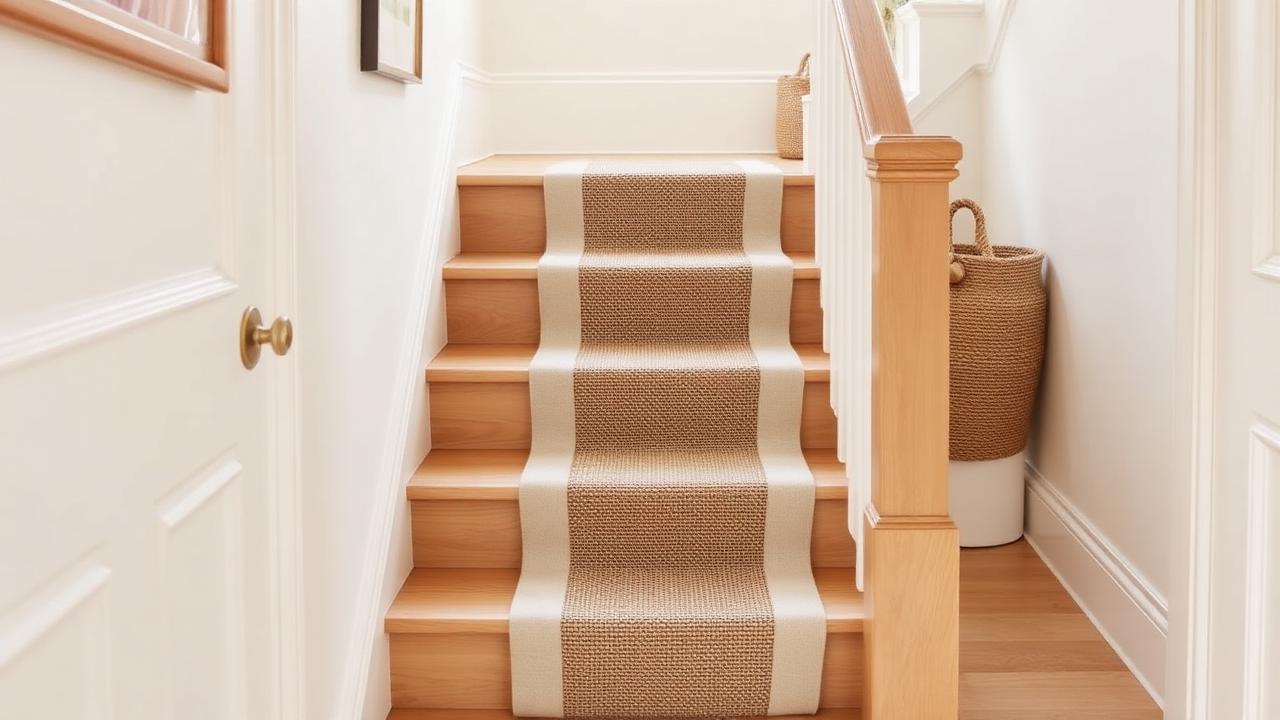
Whichever grade you choose, run your measurements through the stair runner calculator first so you order the correct quantity from a single dye lot — berber's fleck pattern can vary noticeably between production batches.
Fitting steps specific to berber
Because berber's looped construction lies very flat, fitters typically use a slightly firmer underlay than they would with a deep cut pile, so the loop structure has something solid to sit on rather than sinking unevenly. When stapling, keep fixings just behind the crease rather than directly through a loop row, since stapling through a loop can pull and distort it, creating a visible flat spot right where the eye first lands on each step.
At the nosing, a berber runner wraps cleanly because the loops do not fluff or shed at a cut edge the way a cut pile can, but it is still worth having any raw edges bound or serged if you are trimming the runner to width, since an unfinished berber edge can slowly unravel a loop row over time under repeated foot traffic.
Cost bands for berber
Berber sits in a wide price range depending on fibre. Nylon commercial-grade berber is one of the more affordable durable options on the market, while a genuine wool berber with a fine fleck sits considerably higher, reflecting both the raw material cost and its superior long-term resilience.
| Berber Type | US Cost/ft | UK Cost/m |
|---|---|---|
| Nylon commercial-grade | $15-25 | £30-50 |
| Nylon residential standard | $22-35 | £45-70 |
| Wool berber | $45-75 | £90-150 |
- Use a firmer underlay to support berber's flat loop structure.
- Keep staples behind the crease, not through a loop row.
- Bind or serge any raw cut edges to prevent loop unravelling.
- Choose fibre grade based on traffic level, not just budget.
Ongoing maintenance favours berber over most cut piles: a suction-only vacuum setting (avoiding an aggressive beater bar that can pull at loops) keeps the surface clean without stressing the weave, and an annual professional clean lifts embedded grit that daily vacuuming misses. Check high-traffic steps every few months for any single pulled loop, since catching and trimming it early prevents a small snag from working loose into a larger visible run down the flight.
Spec checks before ordering berber
Confirm the loop height and density figures on the spec sheet rather than judging from a photograph alone, since berber's performance on stairs depends heavily on how tight and low the loop actually is. Ask for the manufacturer's recommended traffic rating, and match it to your household's actual footfall rather than the minimum rating for a spare room or bedroom.
Request a large enough sample to see the fleck pattern properly, and check it against your lighting at different times of day, since fleck colours can shift noticeably under warm artificial light compared to daylight from a nearby window or skylight.
Whatever you decide, get the numbers first: the stair runner calculator doubles as a stair runner length calculator, adding nosing wrap, landings, winders, pattern repeat and waste so you order the right length the first time.
Frequently asked questions
Is berber good for stairs?
Yes, its dense low-loop construction resists crushing and hides dirt well, making it a strong choice for high-traffic stairs.
Is wool or nylon berber better for stairs?
Wool offers superior natural resilience and feel; nylon is more affordable and highly stain-resistant.
Does berber snag easily?
Low, tight-loop berber resists snagging well; looser decorative boucle weaves are more prone to catching and running.
How do I clean a berber stair runner?
Vacuum regularly with a suction-only or gentle beater bar setting, and blot spills immediately to avoid staining.
Is berber suitable for households with pets?
Yes, provided you choose a tight, low-loop grade — loose loops can be more easily caught by claws.
Does berber show footprints?
Less than plush cut pile, thanks to its looped structure, though very light colours may still show some traffic patterns.
How much berber runner do I need for 13 steps?
Roughly 23-24 ft (7-7.3 m), including nosing wrap, finishing allowance, and an 8% waste margin.
Can berber be repaired if a loop snags?
Yes, a professional can often re-secure or trim a pulled loop without needing to replace the whole runner.
Know your numbers in 30 seconds
Enter your step count, tread depth and riser height — the stair runner calculator gives you the exact length to order, in metres and feet, with waste included.
Plan your berber runner with the stair runner calculatorReady for real prices?
Get quotes from vetted stair runner suppliers and fitters near you. Free, no account, no obligation.
Every guide is written from hands-on measuring and fitting experience, checked against the calculator’s own maths, and re-reviewed whenever prices or methods change. Read our editorial standards.