

What you are actually buying
'Black stair runner carpet' covers two very different products at the shop counter. The first is a piece of black broadloom carpet — sold by the roll, usually 4 m or 12-13 ft wide — cut down to a runner width and finished with bound, serged or whipped edges. The second is a ready-made runner: a fixed-width roll, often 25, 27, 30 or 33 in wide, already edged, sold by the linear foot or metre and simply cut to your stair length. Both end up looking similar once fitted, but they differ in cost, lead time, and how easily you can match a non-standard staircase width.
Broadloom cut-to-order gives you exact width control, which matters on older houses where staircases are rarely a round number of inches. Ready-made runners are faster and often cheaper per linear foot, but you are locked to their stock widths, and on a staircase that falls between two stock sizes you either accept an odd margin or pay for a custom cut anyway.
Fibre and construction: what actually matters in black
| Fibre / construction | Wear on stairs | Look in black | Notes |
|---|---|---|---|
| 100% wool, woven Axminster/Wilton | Excellent, industry benchmark | Deep, rich, slightly variegated | Highest price point, best longevity |
| Wool-nylon blend (80/20) | Very good, nylon protects nosing wear | Slightly flatter than pure wool | Best value-to-performance ratio for stairs |
| 100% nylon (solution-dyed) | Very good, colourfast under sun | Uniform, can look slightly synthetic | Best choice for stairwells with skylights |
| Polyester (PET) | Fair, crushes faster underfoot | Soft-looking, budget-friendly | Softer feel but shorter lifespan on stairs |
| Sisal or wool-sisal in black-dyed fibre | Very durable but coarse texture | Matte, textured, casual | Not suitable for bare feet or very young children |
Solution-dyed nylon deserves a specific mention for black carpet: the colour is mixed into the fibre before it is extruded, rather than dyed onto the surface afterward, so it does not fade or bronze under UV the way a surface-dyed black can. If your staircase has a skylight, a landing window, or gets afternoon sun on the top few treads, this is the single spec change most likely to keep the black even across the whole flight five years from now.
Ask for the pile weight in writing
Retailers describe stair carpet quality in vague marketing terms; the number that actually predicts longevity is pile weight in grams per square metre (or ounces per square yard). For a main staircase, ask for at least 1,300-1,500 g/m2 (roughly 38-44 oz/sq yd); anything lighter is a bedroom-grade carpet being sold for a job it was not built for.
Backing and binding choices
The backing affects how well staples or grippers hold and how the runner behaves at the nosing. A woven jute or synthetic action-back holds fixings securely and resists the creeping that happens when foot traffic drags a runner downward over months. A felt backing is softer underfoot but stretches more over time and needs re-tensioning sooner.
Edge finishing on a cut-to-width black runner is not cosmetic — it stops the carpet fraying at the exact spot where feet land hardest, the edge nearest the tread nosing. Serged (overlocked) edges are the cheapest and least durable; bound edges with a cotton or wool tape are the standard for a stair-grade job; whipped edges, hand-stitched in a matching or contrasting yarn, cost more but are the most durable and the easiest to repair if a corner frays years later.
Choosing the width
For a standard 36 in (91 cm) US staircase or a comparable 90-100 cm UK staircase, a 27-30 in (68-76 cm) runner is the traditional proportion, leaving a margin of exposed timber each side that is wide enough to look intentional but narrow enough that the runner still reads as the dominant surface. Go narrower, to 24-25 in, for a more modern or minimal look, and wider, to 33-36 in, if you want maximum tread coverage for households with small children or reduced mobility.
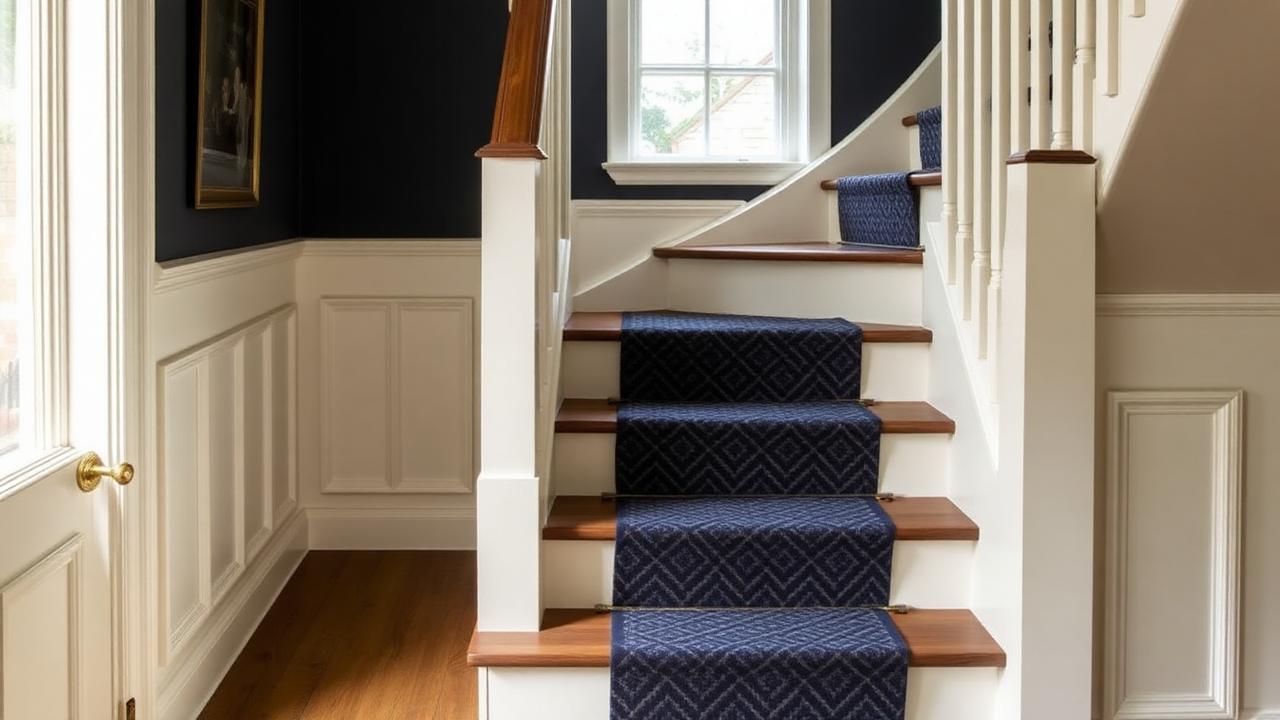
- Measure the narrowest point of the staircase, usually at a winder or a tight turn, not just the bottom straight run.
- Decide your margin — most schemes use 3 to 5 in (7.5 to 13 cm) of exposed timber on each side as a starting point.
- Subtract twice the margin from the staircase width to get your working runner width.
- Round to the nearest stock width if buying ready-made, or confirm the exact cut width if ordering broadloom.
- Check the width against any winders or curved sections separately, since a width that fits the straight flight can bind on a turn.
- Confirm the binding tape colour against the carpet before ordering — black binding on a near-black wool is the safest, most forgiving match.
Costing it out
| Item | Typical US | Typical UK |
|---|---|---|
| Broadloom black wool-blend, per sq yd/sq m | $30-65 | GBP 26-58 |
| Ready-made bound black runner, per linear ft/m | $24-52 | GBP 19-42 |
| Cutting and binding service (if not pre-bound) | $6-12 per linear ft | GBP 5-10 per linear m |
| Stair-grade underlay | $4-9 per sq yd | GBP 5-9 per sq m |
| Professional fitting, straight flight | $28-58 per step | GBP 22-48 per step |
A thirteen-step straight flight in a wool-nylon blend, professionally fitted with underlay, typically lands in the low four figures in dollars or a comparable sum in pounds; a full wool broadloom job with winders costs meaningfully more. Feed your own step count and chosen quality into a stair runner cost calculator before ordering, since winders and curved sections can add a third again to both material and labour over a straight flight of the same length.
Code and safety notes
IRC R311.7 in the US and Approved Document K / Part K in the UK both focus on tread geometry, handrail requirements and slip resistance rather than carpet colour, but both frameworks care that the nosing edge remains visually distinct and that the tread surface does not become a slip hazard. On black carpet, choosing a pile with reasonable grip — a twist or Berber loop rather than a very smooth, dense velvet — and keeping the pile height under about 0.5 in (13 mm) helps meet the spirit of both codes' concern with secure footing.
Fitting and living with it
Fit black stair runner carpet the same way as any quality runner: strip back to sound timber, fit stair-grade underlay wrapped over each nosing, centre and tension from the bottom up, and check the pattern or pile lay direction is consistent before the final staple line. Because black shows dust and lint more readily than mid-tone colours, vacuum weekly rather than fortnightly, and keep an offcut in storage for future repairs — matching a discontinued black exactly, even a year later, can be genuinely difficult.
Know your numbers in 30 seconds
Enter your step count, tread depth and riser height — the stair runner calculator gives you the exact length to order, in metres and feet, with waste included.
Open the stair runner calculatorWhatever you decide, get the numbers first: the stair runner calculator doubles as a stair runner length calculator, adding nosing wrap, landings, winders, pattern repeat and waste so you order the right length the first time.
Frequently asked questions
Is broadloom or ready-made black stair carpet cheaper?
Ready-made is usually cheaper per linear foot for standard widths because it is mass-produced and pre-bound. Broadloom becomes better value once your staircase width falls outside stock sizes, since a custom-cut runner avoids either an awkward margin or paying separately for a bespoke ready-made order.
What pile weight should I ask for in a black stair carpet?
Aim for at least 1,300 to 1,500 grams per square metre (roughly 38 to 44 ounces per square yard) for a main staircase. Lighter weights are typically bedroom or occasional-room grades and will show wear at the nosing edge within a year or two of daily use.
Does black carpet fade in sunlight?
Surface-dyed black can fade or take on a bronze tint under UV exposure, especially near skylights or landing windows. Solution-dyed nylon, where the colour is mixed into the fibre before extrusion, resists this far better and is worth the small price premium on a sun-exposed staircase.
What edge finish lasts longest on a black runner?
A hand-whipped edge in a matching yarn is the most durable and the easiest to repair years later, followed by a machine-bound tape edge. Serged or overlocked edges are the cheapest but fray first, exactly at the point nearest the tread nosing where wear concentrates.
How wide should black stair runner carpet be?
For a standard 36 inch US staircase, 27 to 30 inches is the traditional proportion, leaving 3 to 4.5 inches of exposed timber each side. Narrower widths around 24 inches suit a more modern look, while wider widths up to 33 or 36 inches maximise tread coverage.
Can black stair carpet be fitted over winders?
Yes, but winders and curved sections need separate width checks and usually cost more to fit than a straight flight of the same length, because the runner has to be eased and tacked around the pie-shaped treads without puckering.
Is wool or nylon better for a black stair runner?
Wool gives the richest, deepest black and the best feel underfoot but costs more. A wool-nylon blend around 80/20 is the common professional recommendation for stairs, since the nylon content adds abrasion resistance exactly where black wool alone would wear fastest, at the nosing.
Know your numbers in 30 seconds
Enter your step count, tread depth and riser height — the stair runner calculator gives you the exact length to order, in metres and feet, with waste included.
Work out my runner lengthReady for real prices?
Get quotes from vetted stair runner suppliers and fitters near you. Free, no account, no obligation.
Every guide is written from hands-on measuring and fitting experience, checked against the calculator’s own maths, and re-reviewed whenever prices or methods change. Read our editorial standards.