
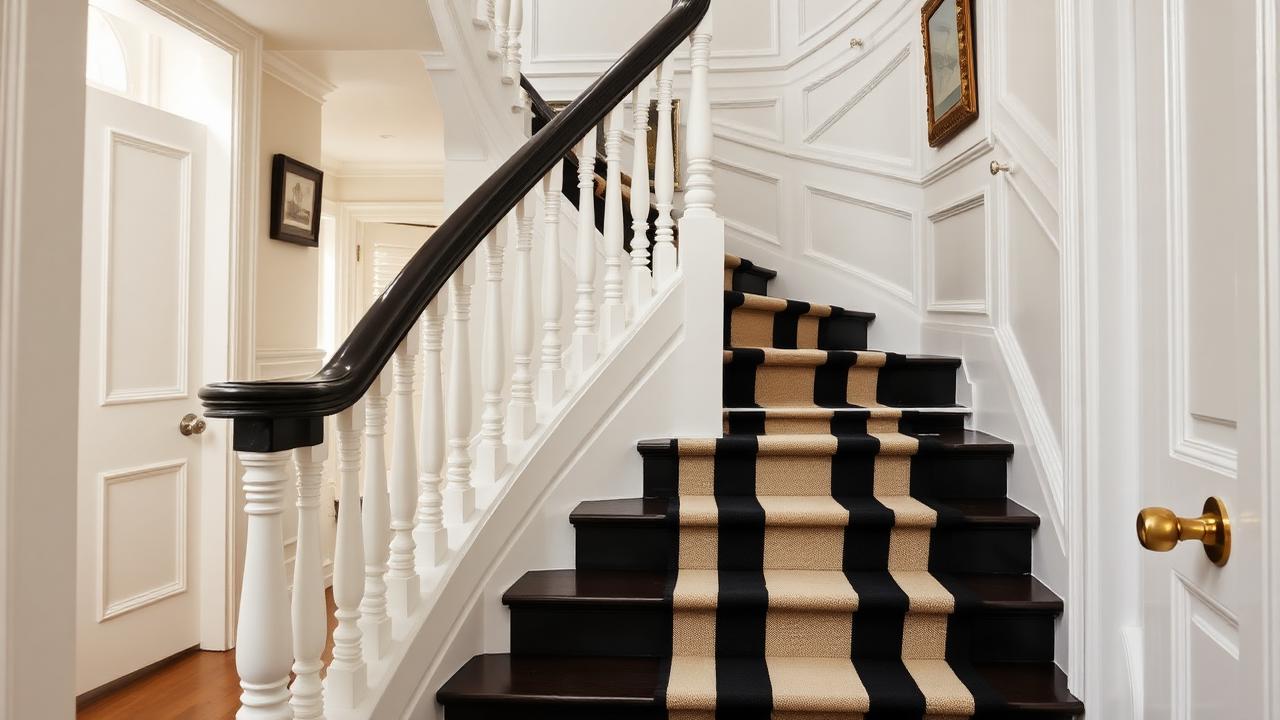
Why black reads differently on a modern staircase
Black is the least forgiving colour a staircase can wear, and also the most rewarding when it is done properly. On a flat floor, black carpet just sits there. On a staircase, black is broken up by eleven or thirteen changes of plane — tread, riser, tread, riser — each catching light at a different angle, so a genuinely modern black runner never looks like a single flat slab. It looks like a ribbon of shadow climbing the stairs, and that is the effect people are chasing when they search for this look rather than a plain dark grey.
The modern part of the brief usually means three things in practice: a narrower runner than a traditional Victorian-style hall would use, a low-profile weave rather than a deep pile, and hardware — if any — kept to slim black rods or none at all. A wide, deep-pile black runner with brass rods reads as period grand hallway. A narrow, flat-weave black runner with white-painted risers and no visible fixings reads as contemporary architecture.
Choosing the right black, not just any black
Very few carpets are truly jet black; most 'black' ranges are actually a near-black charcoal, graphite or espresso brown-black, and the difference only shows up once the runner is on the stairs under real light. A blue-black reads cold and slightly industrial. A brown-black warms up next to oak. A true neutral black is the hardest to source and the most versatile, but it also shows dust and pet hair more than either of the tinted options because there is no undertone to hide behind.
Always test on the stairs, not the showroom floor
Tape a sample to a riser and a tread and view it at both ends of the day. Showroom lighting is flat and even; your stairwell almost certainly is not. A black that looks perfect under fluorescent tube lighting can look patchy and greenish under a warm hallway bulb at night.
Pile type and how it behaves in black
| Pile type | Look in black | Practicality | Best paired with |
|---|---|---|---|
| Flat weave / flatweave wool | Matte, architectural | Shows lint and pale threads badly, hides pile crush well | Painted white treads, glass balustrade |
| Low-loop Berber | Slight texture, less flat | Hides everyday dust better than flat weave | Oak treads, brass or matte black rods |
| Cut pile velvet | Rich, almost liquid | Shows footprints and pressure marks constantly | Formal contemporary schemes, low traffic |
| Twist / heather-black | Softened, slightly grey-flecked | Best all-round hider of dust and hair | Family homes wanting the black look without the upkeep |
If you have pets, children, or simply do not want to vacuum daily, a twist or heather-black pile is the honest recommendation over a true flat velvet, even though the velvet photographs better. The difference only shows up two weeks after installation, which is exactly when most buyers wish someone had told them.
Sizing a modern black runner
Modern schemes tend to run narrower than the traditional default. Where a classic runner might take up 75-80% of a 36 in (91 cm) staircase width, a modern black runner often sits at 60-70%, leaving a wider margin of exposed timber or painted stringer either side. On a 36 in staircase that means a 22-24 in runner rather than the more traditional 27-30 in, though this is a style choice, not a rule — measure your own staircase width rather than copying a photograph, because the proportion only works if the margins are equal and the treads are wide enough to take it.
Length is where people underestimate. Every tread and every riser adds to the total, plus an allowance for the run-out at top and bottom and any waste from squaring a repeat if the weave has one. A stair runner length calculator does this arithmetic properly, factoring in nosing wraps that a simple tape-measure estimate misses, and it is worth running before you order — black material is expensive to reorder if you come up short by half a step.
Installing a black runner without it looking scruffy fast
- Strip the staircase back to bare, sound timber and fill any gaps around the nosing — black shows dust in the seams that a lighter colour hides.
- Fit a dense, stair-grade underlay cut narrower than the runner and wrapped over each nosing, never running the full width.
- Centre the runner using a chalked line up the middle of the flight, checking against a level rather than the tread edge.
- Staple or grip from the bottom riser upward, tensioning with a knee kicker every two or three steps so the pile does not ripple.
- Vacuum-test the finished flight in daylight before fitting any rods; black shows crumbs of backing dust that other colours conceal.
- Fit slim black or unlacquered matte hardware last, if using rods, so fingerprints from installation do not mark the pale metal finishes nearby.
What it costs in real terms
| Item | Typical US | Typical UK |
|---|---|---|
| Black wool-blend runner, broadloom | $32-70 per sq yd | GBP 28-60 per sq m |
| Ready-made bound black runner, per linear ft | $26-55 | GBP 20-45 per linear metre |
| Stair-grade underlay | $4-9 per sq yd | GBP 5-9 per sq m |
| Fitting, straight flight | $28-58 per step | GBP 22-48 per step |
| Slim matte black rods (optional) | $14-30 per rod | GBP 12-25 per rod |
For a straight thirteen-step flight with a small landing, expect the material and fitting together to land in the low-to-mid four figures in dollars, or the mid three-to-low four figures in pounds, depending on quality and whether rods are added. Run your own step count through a cost calculator rather than trusting an average, because narrow modern widths use noticeably less material than a traditional wide runner and the saving is real.

US and UK code notes worth knowing
Neither IRC R311.7 in the US nor Approved Document K / Part K in the UK specify a colour, but both care about the tread surface being slip-resistant and the nosing being consistent in profile. A very dark, low-friction cut pile can visually hide the nosing edge in dim light, which is a genuine safety point — many designers solve this by adding a slim contrasting binding or a pale stripe near the nosing edge on black runners, which also happens to look sharp against the black field.
Living with a black runner
Black hides stains that would show badly on cream, but it shows dust, lint, pet hair and bleached patches from sun exposure with total honesty. Vacuum more often than you would with a mid-tone runner, rotate curtains or blinds if a stair window gets direct sun on part of the flight, and keep a spare offcut for repairs, because a black repair patch that does not match exactly is far more visible than a mismatch on a patterned or lighter runner.
Know your numbers in 30 seconds
Enter your step count, tread depth and riser height — the stair runner calculator gives you the exact length to order, in metres and feet, with waste included.
Open the stair runner calculatorWhatever you decide, get the numbers first: the stair runner calculator doubles as a stair runner length calculator, adding nosing wrap, landings, winders, pattern repeat and waste so you order the right length the first time.
Still deciding on material, width or pattern? Our hub on stair runners compares weaves, widths, backings and fitting styles side by side, then hands the numbers straight to the calculator.
Frequently asked questions
Does a black stair runner make a staircase look smaller?
It can if the runner is wide and the walls are dark too. Keep the runner narrower than a traditional style, leave generous exposed timber either side, and pair with pale walls and risers; the contrast actually makes the staircase feel taller and more sculptural rather than smaller.
What is the most practical black pile for a family home?
A heather-black twist pile is the best all-round choice. It hides dust, pet hair and everyday footprints far better than a flat velvet or true flat weave, while still reading as a clean modern black from normal viewing distance on the stairs.
Should I add a contrasting binding to a black runner?
It is worth considering for safety as much as looks. A slim pale binding near the nosing edge keeps the step edge visible in low light, since a very dark, matte pile can visually blend with a dark tread edge, which matters more on stairs than on any other floor.
How wide should a modern black runner be on a 36 inch staircase?
Many modern schemes use 22 to 24 inches rather than the more traditional 27 to 30 inches, leaving a wider margin of exposed timber either side. It is a style choice, not a rule, so measure your own staircase and treads before deciding on the narrower proportion.
Will a black runner show wear faster than a lighter colour?
Wear itself is not faster, but it is more visible as a change in sheen rather than a change in colour, since crushed or worn pile catches light differently even in black. Choosing a twist or loop pile over a smooth cut pile reduces how obvious this sheen change becomes over time.
Can I fit a black runner over an existing carpet?
No. Any lump, seam or worn patch in an old carpet will telegraph through a new runner within weeks, and it is especially visible in black under raking light. Lift the old carpet, fix the treads, and fit fresh underlay before laying the new runner.
Does black hide stains well?
It hides many liquid stains and general soiling better than pale colours, which is a genuine advantage. It does not hide dust, lint, pet hair or sun bleaching, all of which show up more obviously against a uniform dark field than they would on a busier pattern or mid-tone colour.
Know your numbers in 30 seconds
Enter your step count, tread depth and riser height — the stair runner calculator gives you the exact length to order, in metres and feet, with waste included.
Measure my staircaseReady for real prices?
Get quotes from vetted stair runner suppliers and fitters near you. Free, no account, no obligation.
Every guide is written from hands-on measuring and fitting experience, checked against the calculator’s own maths, and re-reviewed whenever prices or methods change. Read our editorial standards.