
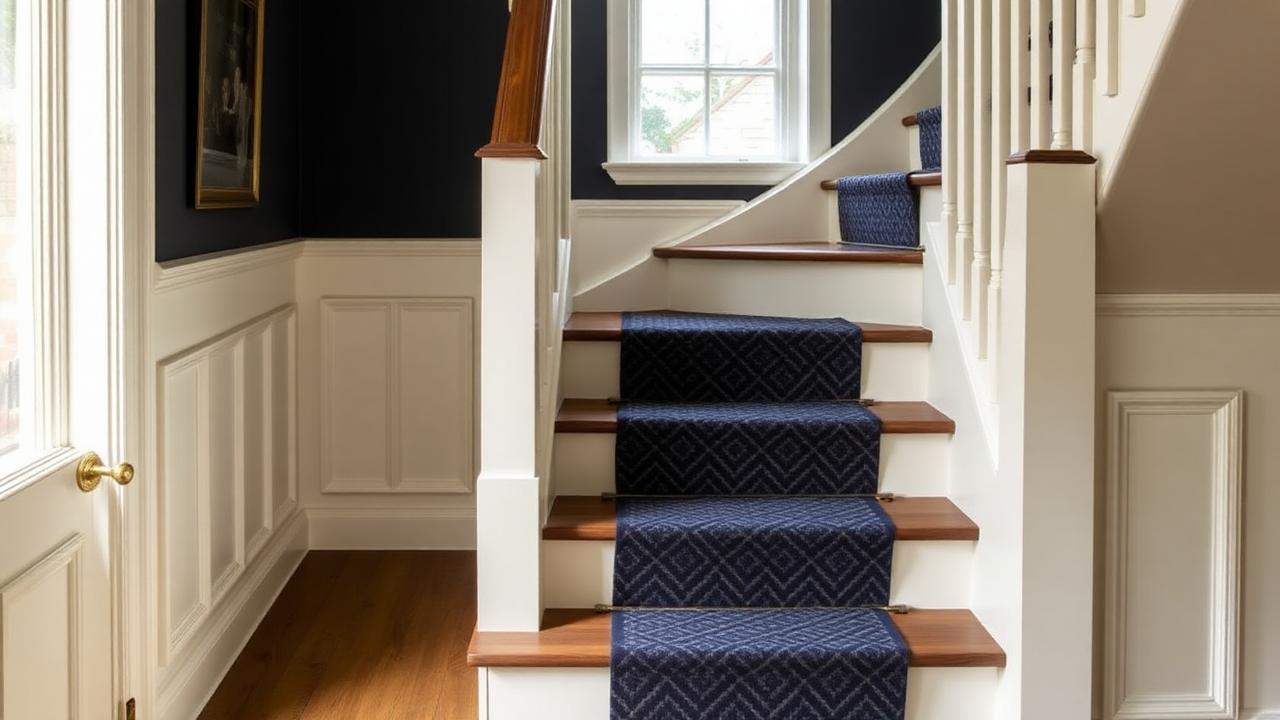
Why blue works so well on stairs
Blue is one of the most versatile colours for a stair runner because it spans such a wide practical range, from a near-black navy that behaves like a dark neutral, through mid-tone denim and slate blues, to soft powder and duck-egg shades that lighten a hallway. Navy in particular has become a go-to choice for stair runners because it hides dirt and wear almost as well as charcoal, while giving off more warmth and character than plain grey.
Lighter blues bring a fresher, coastal feel and work particularly well in homes with a lot of natural light in the stairwell, but they show dirt and scuffing more readily than a deep navy, so they suit lower-traffic homes or households without young children and pets better than the darkest shades.
Choosing your shade of blue
Navy and deep indigo are the most forgiving and versatile, pairing with almost any wall colour and wood tone. Mid-blues (denim, slate, steel) add more personality while still being relatively practical. Pale blues (powder, duck-egg, sky) are the most decorative choice and work best as a deliberate style statement rather than a purely practical decision.
| Shade | Practicality | Best for |
|---|---|---|
| Navy / indigo | Excellent, hides dirt well | Busy family hallways |
| Denim / slate | Good | Transitional, coastal interiors |
| Powder / duck-egg | Moderate, shows marks | Lower-traffic, light-filled stairs |
How much runner do I need?
For a 13-step flight: 10 in tread + 7.5 in riser + 0.75 in nosing wrap = 18.25 in per step, giving 237.25 in across 13 steps. Add 24 in finishing for 261.25 in (21.77 ft). With an 8-10% waste margin, order roughly 23.5-24 ft. In metric: 25 cm + 19 cm + 1.9 cm = 45.9 cm per step, times 13 steps is 596.7 cm, plus 60 cm finishing is 656.7 cm, plus waste is approximately 7.1-7.3 m. If your blue runner has a pattern, such as a herringbone weave or a border stripe, increase the waste margin to 10-13% for clean alignment.
| Step | US (in/ft) | UK (cm/m) |
|---|---|---|
| Per-step total | 18.25 in | 45.9 cm |
| 13 steps | 19.77 ft | 5.97 m |
| Plus finishing | 21.77 ft | 6.57 m |
| With waste | 23.5-24 ft | 7.1-7.3 m |
Know your numbers in 30 seconds
Enter your step count, tread depth and riser height — the stair runner calculator gives you the exact length to order, in metres and feet, with waste included.
Open the stair runner calculatorTest blue swatches under artificial light
Blue can shift dramatically between daylight and warm artificial hallway lighting, sometimes reading as grey or even green under certain bulbs. Always view your sample under the lighting you'll actually use at night.
Fibre and pattern combinations
Solid navy in wool or nylon is the most classic choice, but blue also works beautifully in herringbone weaves, tonal stripes, and geometric patterns. A blue-and-cream stripe adds a nautical, coastal feel, while a blue-and-charcoal herringbone leans more contemporary and tailored. If you're pairing the runner with existing blue accents elsewhere in your home, bring a paint swatch or fabric sample with you when choosing, since blue tones can clash subtly even within the same colour family.

- Navy hides dirt nearly as well as charcoal or black.
- Pale blues need more frequent cleaning in high-traffic homes.
- Herringbone or striped blue patterns need extra waste allowance.
- Always test swatches under your actual hallway lighting.
Whether you choose a bold navy or a soft powder blue, sizing the order correctly with a stair runner calculator ensures you don't run short partway through a flight that's otherwise perfectly planned.
Fitting steps for a blue runner
Installation follows the standard sequence — underlay, gripper, tensioned fixing tread by tread — but with a solid or near-solid colour like navy, any unevenness in tensioning shows up more obviously than it would on a busy pattern, since there's no print to distract the eye from a slight ripple. Insist your fitter checks tension at every third or fourth step during the install, not just at the end.
Lighting checks during fitting
Because blue shifts so much under different light sources, it's worth asking your fitter to unroll a length of the runner in the actual stairwell before final fixing and viewing it under both daytime and evening lighting. This is a five-minute check that avoids the disappointment of committing to a shade that reads differently once it's permanently fixed.
Cost bands for blue runners
Solid navy in nylon is one of the more affordable stair runner options overall, since it doesn't require the more complex weaving or printing processes that patterns need. Wool navy costs more but offers richer depth of colour, while patterned blues (herringbone, stripe) sit above solid colours in both fibres due to the extra weaving complexity.
| Style | Fibre | Relative cost |
|---|---|---|
| Solid navy | Nylon | Budget |
| Solid navy | Wool | Mid-range |
| Blue herringbone/stripe | Wool-blend | Mid to premium |
| Blue herringbone | 100% wool | Premium |
- View swatches under both daylight and warm evening bulbs before ordering.
- Ask your fitter to check tension every few steps on a solid colour runner.
- Increase waste allowance for herringbone or striped blue patterns.
- Bring paint or fabric samples from adjoining rooms to check for clashing blue tones.
Maintaining a blue runner
Navy and darker blues hide dirt well but still need regular vacuuming since grit works into the pile base even when invisible. Pale blues need more frequent attention, including prompt blotting of spills, since lighter shades show staining faster. A stain-treated fibre is worth the extra cost on any blue runner in a family home.
Whatever you decide, get the numbers first: the stair runner calculator doubles as a stair runner length calculator, adding nosing wrap, landings, winders, pattern repeat and waste so you order the right length the first time.
Frequently asked questions
Is navy or pale blue more practical for stairs?
Navy is far more practical, hiding dirt and wear nearly as well as charcoal or black.
How much runner do I need for 13 steps?
Around 23.5-24 ft (7.1-7.3 m), including nosing wrap, finishing, and waste.
Does blue look different under artificial light?
Yes, blue can shift toward grey or green under certain warm bulbs, so always test samples under your actual lighting.
What pattern works well in blue?
Herringbone weaves, tonal stripes, and blue-and-charcoal geometrics are all popular choices.
Should I add extra material for a patterned blue runner?
Yes, increase your waste allowance to 10-13% for herringbone, stripe, or geometric patterns.
Is wool or nylon better for a blue runner?
Wool gives deeper, richer colour; nylon is more budget-friendly and equally durable.
Can I mix blue tones in the same home?
Be cautious — different blues can clash subtly, so bring samples from other rooms when choosing.
Does pale blue need more cleaning?
Yes, lighter blues show dirt and marks more readily than navy or mid-tone blues.
Know your numbers in 30 seconds
Enter your step count, tread depth and riser height — the stair runner calculator gives you the exact length to order, in metres and feet, with waste included.
Get your exact yardage with the stair runner calculatorReady for real prices?
Get quotes from vetted stair runner suppliers and fitters near you. Free, no account, no obligation.
Every guide is written from hands-on measuring and fitting experience, checked against the calculator’s own maths, and re-reviewed whenever prices or methods change. Read our editorial standards.