
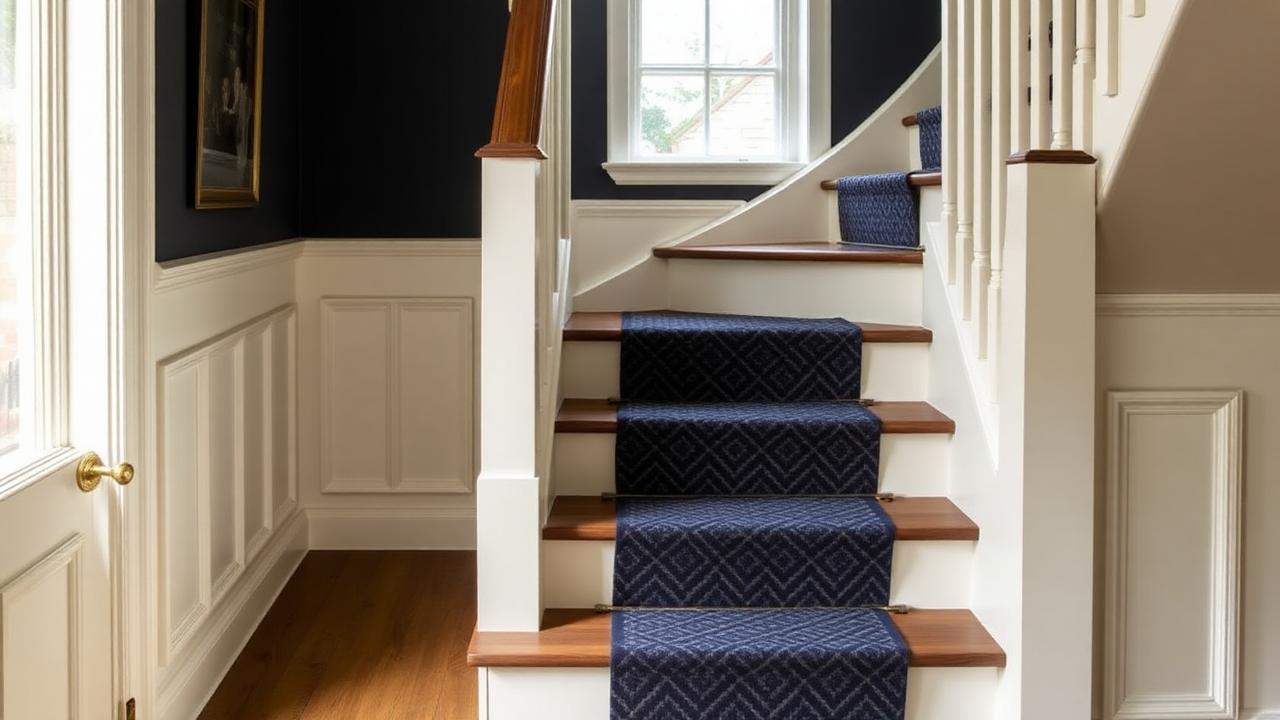
Why neutral wins on stairs
Stairs are one of the highest-traffic zones in a house, and they're also one of the hardest surfaces to change once fitted. A bold colour that feels exciting in the showroom can start to grate after a couple of years, whereas a neutral stair runner in oatmeal, stone, greige, or soft charcoal quietly does its job through every redecoration. Neutral doesn't mean boring either — texture, weave, and a subtle border can do a lot of the visual work without you needing to commit to a strong hue that dates the hallway.
The other practical reason neutrals dominate stair runners is dirt and wear camouflage. A mid-tone neutral — think warm grey or taupe rather than stark white — hides everyday grit, pet hair, and light scuffing far better than either very pale or very dark colours. Very light runners show every mark; very dark runners show every speck of dust and fibre shedding. The sweet spot tends to sit in the mid-tone band, which is exactly where most manufacturers concentrate their neutral ranges.
Choosing the right neutral tone
Walk your landing and hallway walls at different times of day before deciding. Warm neutrals (oatmeal, camel, warm grey) pair naturally with wood tones, brass hardware, and traditional trim. Cool neutrals (dove grey, pewter, cool stone) suit painted white woodwork, black balusters, and more contemporary schemes. If your walls are already a strong colour, a neutral runner is often the best way to calm the space down and let the paint do the talking.
| Neutral shade | Best paired with | Hides dirt? |
|---|---|---|
| Oatmeal / camel | Wood tones, brass | Good |
| Warm grey | White walls, natural light | Very good |
| Dove grey | Black balusters, modern trim | Very good |
| Charcoal | Bold wallpaper, dark trim | Excellent, shows dust |
How much runner do I need?
For a standard 13-step flight, the per-step total is calculated by adding the tread depth, riser height, and nosing wrap: 10 in + 7.5 in + 0.75 in = 18.25 in. Over 13 steps, that's 237.25 in, plus a 24 in finishing allowance at the top and bottom gives 261.25 in, or 21.77 ft. Add an 8-10% waste margin for pattern matching and stapling, and you should order roughly 23.5-24 ft. In metric: 25 cm + 19 cm + 1.9 cm = 45.9 cm per step, times 13 steps is 596.7 cm, plus 60 cm finishing is 656.7 cm, plus waste brings you to about 7.1-7.3 m. This is exactly the kind of sum a stair runner length calculator handles instantly once you enter your own tread and riser dimensions.
| Step | US (in/ft) | UK (cm/m) |
|---|---|---|
| Per-step total | 18.25 in | 45.9 cm |
| 13 steps | 19.77 ft | 5.97 m |
| Plus finishing | 21.77 ft | 6.57 m |
| With waste | 23.5-24 ft | 7.1-7.3 m |
Know your numbers in 30 seconds
Enter your step count, tread depth and riser height — the stair runner calculator gives you the exact length to order, in metres and feet, with waste included.
Open the stair runner calculatorMaterial choices for a neutral runner
Wool and wool-blend neutrals have a natural depth of colour that synthetic fibres struggle to replicate — the fibre takes dye unevenly at a microscopic level, giving a soft heathered look rather than a flat, printed appearance. Nylon neutrals are more uniform and generally cheaper, holding up well to heavy family traffic and stain treatment. Sisal and other natural fibres bring texture and a warm, organic neutral that suits farmhouse and coastal interiors, though they can be rougher underfoot and less forgiving with spills.
- Wool or wool-blend: richest tone, best resilience, higher cost.
- Nylon: budget-friendly, very durable, flatter colour.
- Sisal or seagrass: textured, organic look, needs a sealed backing.
- Wool-sisal blends: softer underfoot than pure sisal with similar texture.
Test the sample under stair lighting
Hallway and stairwell lighting is often dimmer or more directional than a showroom. Always take a sample home and place it on an actual step before ordering the full length of stair runners for your flight.
Pairing with borders and edging
A neutral field colour is the perfect base for a contrast border — a slim navy, forest green, or charcoal edge tape can add definition without overwhelming the palette. If you'd rather keep things fully understated, a self-coloured serged edge in a matching thread keeps the eye on the texture rather than the trim. Either approach works; the decision usually comes down to how much visual interest the rest of your hallway already has.
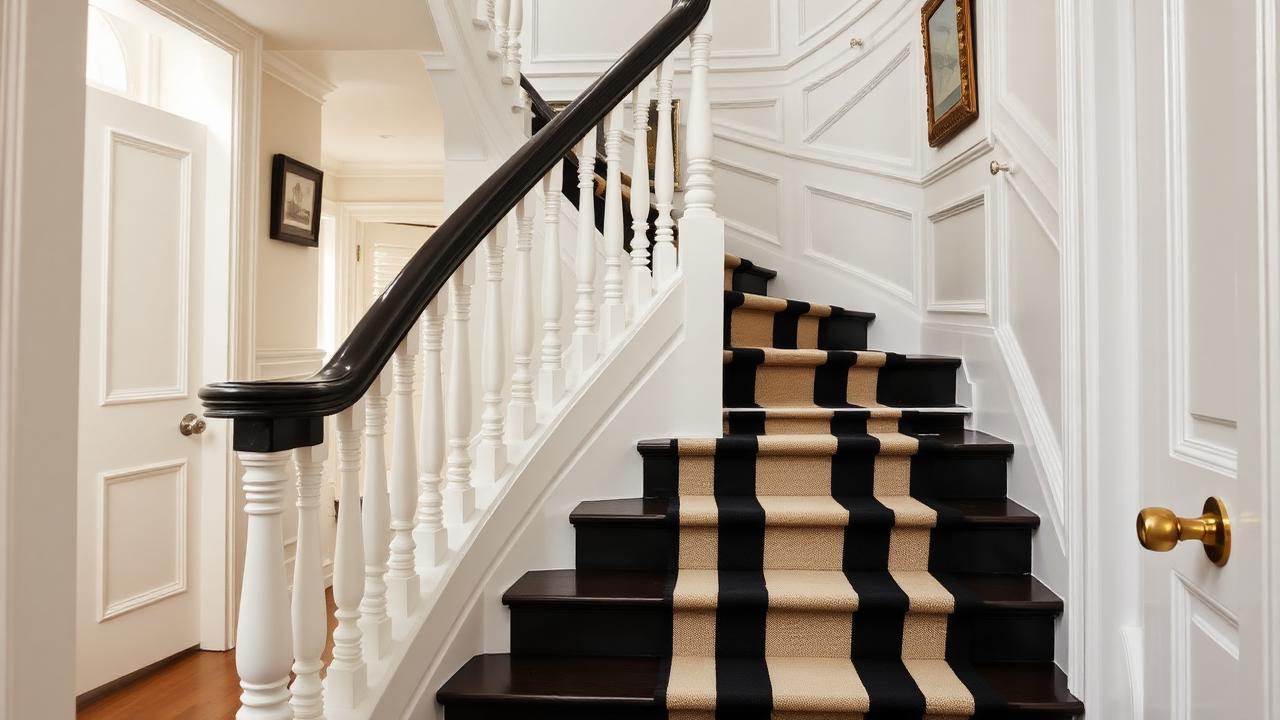
In summary, a neutral stair runner is a low-risk, high-reward choice. Measure carefully, lean toward mid-tone shades for practicality, and use a stair runner calculator to lock in your exact yardage before you order.
Fitting steps for a neutral runner
Most fitters follow the same sequence regardless of colour: strip any old fixings, vacuum and check the treads for damaged wood or loose boards, lay a matched underlay pad cut to width, then fix gripper rod at the back of each tread and the base of each riser. The runner is then tensioned from the top down, stapled or tacked at each tread-riser junction, with a final tuck and trim at the newel post. On a 13-step flight this typically takes a two-person crew 3-4 hours, longer if the treads are uneven or if you're adding stair rods.
What to check before the fitter arrives
Clear the staircase completely, including any wall-mounted rail brackets that might be in the way, and check that your tread and riser measurements match what was used to place the order. A discrepancy of even 0.5 in (1.3 cm) per step multiplies across 13 steps into a shortfall of 6.5 in (16.5 cm), which is enough to leave the runner short at the top or bottom.
Cost bands and what affects price
Pricing for a neutral stair runner varies mainly by fibre, width, and whether you supply your own underlay and fitting labour. As a rough guide for a 13-step flight at 27-30 in (68-76 cm) wide: budget nylon runs lower, mid-range wool-blend sits in the middle, and pure wool with stair rods and professional fitting sits at the top. Fitting labour typically adds a meaningful chunk on top of material cost, so always ask for a separate quote for materials versus install.
| Spec | Budget | Mid-range | Premium |
|---|---|---|---|
| Fibre | Nylon | Wool-blend | 100% wool |
| Width | 24-27 in (61-68 cm) | 27-30 in (68-76 cm) | 30-32 in (76-81 cm) |
| Underlay | Basic felt | Rubber-crumb | Dense felt/rubber combo |
| Fitting | DIY possible | Professional recommended | Professional required |
- Confirm pile weight (measured in oz per sq yd or g per sq m) matches the traffic level of your household.
- Ask for the backing type — latex or action-backed runners hold gripper better than plain woven backing.
- Check the colourfastness rating if the stairwell gets direct sunlight.
- Request the same batch or dye lot number if ordering extra later for repairs.
Maintenance for a neutral runner
Vacuum a neutral runner at least weekly, more often in a busy household, using a setting without a rotating beater bar on wool to avoid pulling fibres. Blot spills immediately with a clean cloth rather than rubbing, and use a wool-safe or fibre-appropriate cleaner for any stain treatment. Rotate a spare offcut into use for professional deep cleaning tests before treating the full flight, since some cleaning products can slightly alter mid-tone neutrals.
Frequently asked questions
What is the most practical neutral colour for stairs?
A mid-tone warm or cool grey hides everyday dirt and wear far better than very pale or very dark shades.
Will a neutral runner look boring?
Not if you choose a textured weave or add a contrast border — texture and edging do the visual work instead of colour.
How much runner do I need for 13 steps?
Roughly 23.5-24 ft (7.1-7.3 m) once nosing wrap, finishing allowance, and waste are included.
Is wool or nylon better for a neutral runner?
Wool gives richer, heathered tone and great resilience; nylon is more budget-friendly and very durable.
Should I add a border to a neutral runner?
It's optional. A contrast border adds definition, while a matching serged edge keeps things minimal.
Do neutral runners show stains more?
Very pale neutrals show stains faster than mid-tone shades, so consider stain-treated fibres if you have kids or pets.
Can I use the same neutral on the landing?
Yes, matching the runner and landing carpet in the same neutral creates a seamless, high-end look.
How do I calculate my exact yardage?
Enter your tread depth, riser height, and step count into a stair runner calculator to get a precise, waste-inclusive figure.
Know your numbers in 30 seconds
Enter your step count, tread depth and riser height — the stair runner calculator gives you the exact length to order, in metres and feet, with waste included.
Get your exact length with the stair runner calculatorReady for real prices?
Get quotes from vetted stair runner suppliers and fitters near you. Free, no account, no obligation.
Every guide is written from hands-on measuring and fitting experience, checked against the calculator’s own maths, and re-reviewed whenever prices or methods change. Read our editorial standards.