
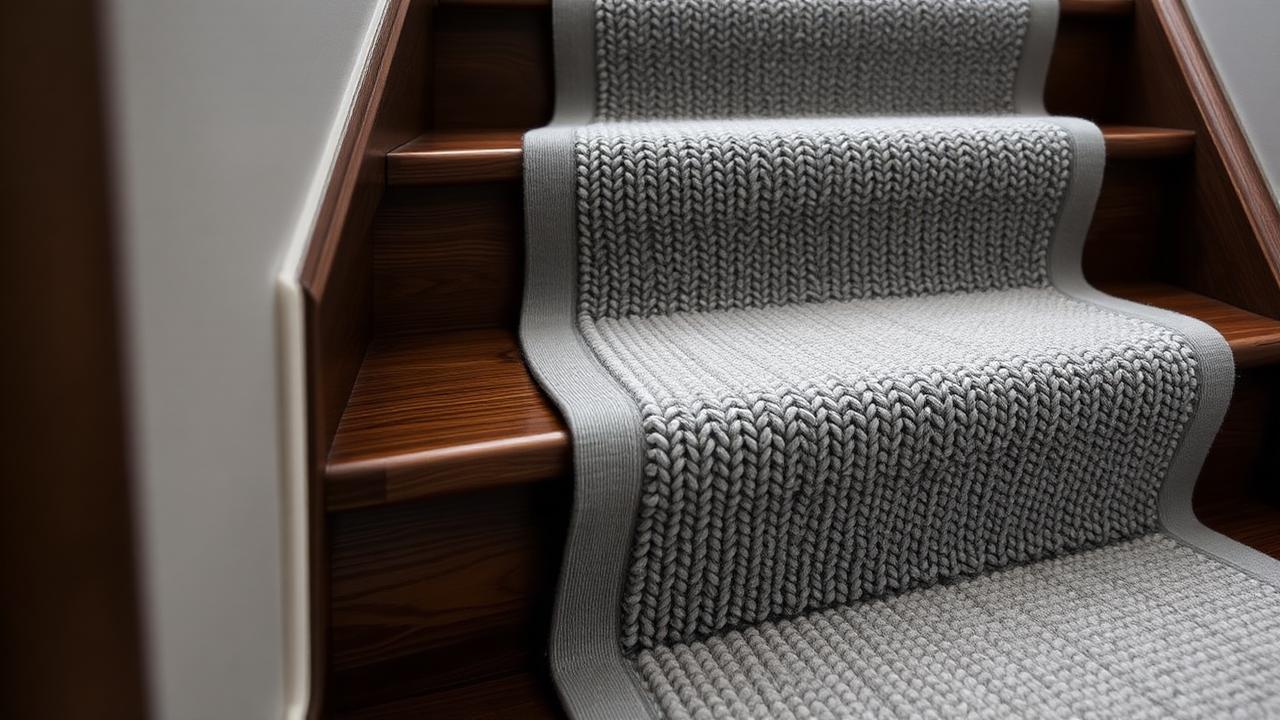
Why wool resists crushing
Wool fibre has a natural crimp and elasticity that lets it spring back after being compressed, which is exactly the stress a stair nosing applies thousands of times a year. Nylon can match wool's raw abrasion numbers, but wool's recovery from crush is what keeps a stair runner looking fresh at the nosing years after nylon loop pile would show permanent flattening.
Spec sheet
| Property | Typical value |
|---|---|
| Fibre content | 80/20 wool-nylon blend or 100% wool |
| Pile type | Loop, cut pile, or berber loop |
| Face weight | 900–1,600 g/m² |
| Wear rating | Very good to excellent (80/20 best) |
| Roll widths | 66cm, 68cm, 80cm, 4m broadloom |
| Price per linear ft (US) | $25–$70 |
| Price per linear m (UK) | £35–£100 |
Wool vs 80/20 wool-nylon blend
Pure wool has the best hand and the best natural stain and fire resistance, but the 80/20 wool-nylon blend, with 20 percent nylon added for tensile strength, is now the standard choice for stair runners because it wears roughly twice as long as pure wool for a modest price premium and a barely perceptible change in feel.
Know your numbers in 30 seconds
Enter your step count, tread depth and riser height — the stair runner calculator gives you the exact length to order, in metres and feet, with waste included.
Open the stair runner calculator- Wool resists staining reasonably well because the fibre surface repels liquid briefly, giving time to blot spills before they set.
- Static build-up is low compared with some synthetics, though not zero.
- Wool sheds lint for the first few months after installation; this settles with regular vacuuming and is normal.
- Wool is naturally flame retardant, a genuine advantage over most synthetics for stairs, a key fire escape route.
Wool and moisture
Wool tolerates damp better than sisal or jute but is not moisture-proof; it can absorb odours and support mildew if left wet, so it is not the first choice for a basement stair or an entry landing that floods.
Pile height and construction
Wool stair runners come in flatweave, low loop, cut pile and berber-style loop constructions. Lower, denser piles wear best on stairs; anything over about 8mm pile height is more prone to crushing and matting at the nosing regardless of fibre quality.
Wear rating and warranty comparison
Wool and wool-blend stair runners carry the longest warranties of any common fibre because mills have decades of performance data to back them. An 80/20 wool-nylon blend commonly ships with a 20 to 25 year wear warranty on a residential stair, roughly double a pure wool product and far ahead of any natural plant fibre, reflecting wool's superior crush recovery under repeated nosing flex.
| Blend | Typical wear warranty | Stain warranty |
|---|---|---|
| 100% wool | 10-15 years | 5-10 years |
| 80/20 wool-nylon | 20-25 years | 10-15 years |
| 50/50 wool-nylon | 15-18 years | 8-12 years |
Buying checklist with price bands
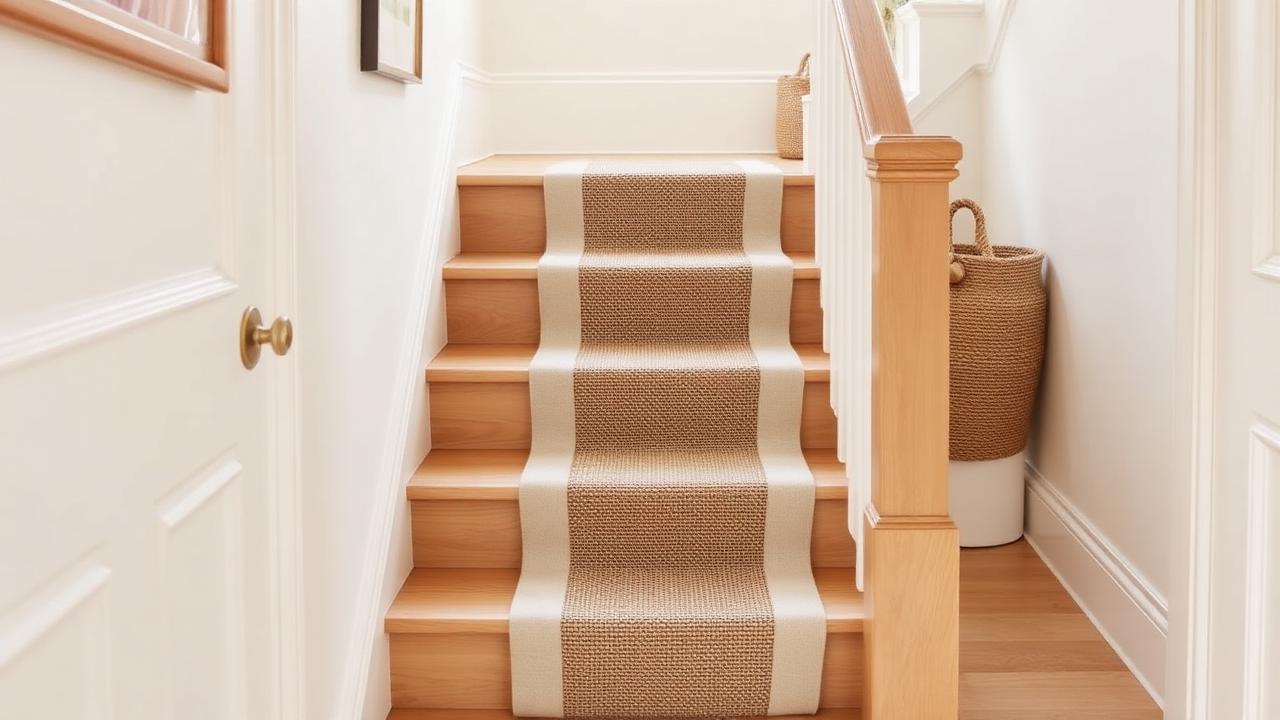
Wool stair runner pricing swings widely by pile type, weight and whether it is a bespoke narrow-loom weave or cut from broadloom, so use face weight and construction rather than brand name as your main buying filter.
| Spec tier | Price per linear ft (US) | Price per linear m (UK) |
|---|---|---|
| Entry 80/20 loop, narrow loom | $28-$38 | £38-£52 |
| Mid-range 80/20 cut or berber loop | $40-$55 | £55-£78 |
| Premium 100% wool, bespoke weave | $60-$85+ | £85-£120+ |
- Ask for the face weight in g/m2, not just the pile height, since a low dense weight often wears better than a tall light one.
- Confirm whether the price quoted includes underlay, fitting and rods or carpet only.
- Request an offcut sample to check for colour batch variation before ordering a full flight.
Cost ranges and what drives them
Wool pricing is driven mainly by fibre content ratio, weave complexity and whether the runner is cut from a narrow stair-specific loom or a wide broadloom roll. A narrow-loom 80/20 wool runner often costs less per foot than the same blend cut from broadloom, because narrow looms weave to the exact stair width with almost no offcut waste, while broadloom cutting for a narrow runner wastes a large share of the roll.
Trade tips from fitters
- Order 5-8% extra length even on wool, since natural fibre content can still show minor batch variation across a long run.
- Ask for the same dye lot number on every roll section if the job needs more than one length.
- Fit wool with a firm, not overly soft, underlay; too much cushioning encourages faster pile crush at the nosing despite wool being resilient.
- Vacuum weekly from day one; wool holds grit that acts like sandpaper on the fibre if left to build up.
British wool versus New Zealand wool
Many premium wool stair runners specify the wool's country of origin, most commonly British wool or New Zealand wool, since fibre characteristics differ slightly by breed and climate. New Zealand wool, often from Romney sheep, tends to have a slightly finer, more lustrous fibre popular in branded carpet ranges, while British wool, from breeds like Blackface, is coarser and prized for rustic, heritage-style runners. Both perform well on stairs; the choice is mostly aesthetic and regional preference rather than a durability difference.
Allergies and indoor air quality
Wool is naturally hypoallergenic in the sense that it does not off-gas volatile organic compounds the way some synthetic backings and adhesives can, and its fibre structure actually traps airborne dust and allergens rather than releasing them back into the air until vacuumed, unlike some smoother synthetic surfaces. Regular vacuuming with a HEPA-filtered vacuum is recommended on any wool stair runner in a household with allergy sufferers, ideally weekly.
Wool blends beyond 80/20
While 80/20 wool-nylon is the industry standard for stairs, some ranges offer a 50/50 or even 25/75 wool-nylon blend at a lower price point, trading some of wool's soft hand and natural stain resistance for a cheaper product that still looks like wool from a normal viewing distance. These blends suit buyers who want the wool aesthetic on a tighter budget but should not be marketed or bought as equivalent to genuine 80/20 performance.
Whatever you decide, get the numbers first: the stair runner calculator doubles as a stair runner length calculator, adding nosing wrap, landings, winders, pattern repeat and waste so you order the right length the first time.
Frequently asked questions
Is British wool better than New Zealand wool for stair runners?
Neither is objectively better; British wool tends to be coarser and suits rustic or heritage schemes, while New Zealand wool is often finer and more lustrous, common in premium branded carpet ranges. Both wear comparably well on stairs.
Is wool carpet good for people with allergies?
Generally yes. Wool does not off-gas the way some synthetic products can, and its fibre structure traps dust and allergens until vacuumed rather than releasing them into the air, though regular HEPA vacuuming is still recommended.
Does wool need professional cleaning?
Periodic professional cleaning every 12 to 18 months is recommended for wool stair runners to remove embedded grit that regular vacuuming misses, which extends the fibre's life considerably compared with vacuuming alone.
Is wool the best material for a stair runner?
For most homes, yes, particularly an 80/20 wool-nylon blend. It combines natural stain resistance, fire resistance and excellent recovery from nosing crush, though it costs more than synthetics.
How long does a wool stair runner last?
A quality 80/20 wool blend typically lasts 15 to 20 years on a main staircase; pure wool runs slightly less, around 10 to 15 years.
Does wool shed on stairs?
New wool carpet sheds loose fibre for the first few weeks to months after installation. This is normal and reduces with regular vacuuming; it is not a sign of poor quality.
Is 100% wool or 80/20 wool blend better for stairs?
80/20 wool-nylon blend is generally better for stairs specifically, since the added nylon increases tensile strength and wear resistance at the nosing with minimal impact on look or feel.
Is wool worth the extra cost over synthetic on stairs?
For a main, daily-used staircase, yes for most homeowners. Wool's crush recovery and stain resistance mean it visibly outperforms budget synthetics at the nosing after five years, and its 20+ year lifespan on an 80/20 blend usually works out cheaper per year than replacing a cheaper synthetic twice.
Know your numbers in 30 seconds
Enter your step count, tread depth and riser height — the stair runner calculator gives you the exact length to order, in metres and feet, with waste included.
Cost my wool runnerReady for real prices?
Get quotes from vetted stair runner suppliers and fitters near you. Free, no account, no obligation.
Every guide is written from hands-on measuring and fitting experience, checked against the calculator’s own maths, and re-reviewed whenever prices or methods change. Read our editorial standards.