
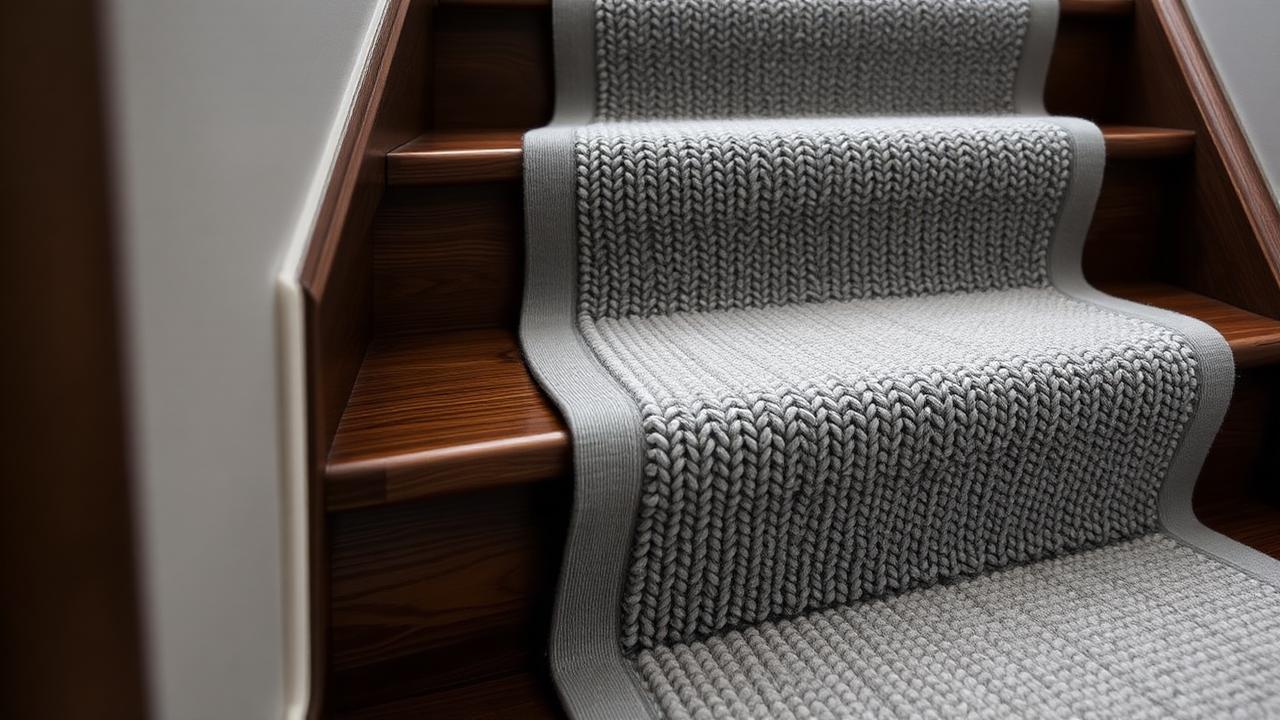
The five natural fibres used on stairs
Sisal, jute, seagrass, coir and wool cover the vast majority of natural fibre stair runners on the market, and each behaves differently underfoot. Sisal is stiff, highly textured and extremely durable, but its coarse surface has among the lowest coefficient of friction of any common stair fibre when it becomes even slightly worn, making it a genuine slip risk without a rubberised backing. Jute is softer and more affordable than sisal but far less durable and prone to moisture damage, generally unsuitable for anything but very low-traffic secondary stairs. Seagrass has a natural water-resistant coating that makes it slippery when new, easing slightly with wear, but it is rarely recommended for a main staircase for that reason. Coir is the roughest and most rigid of the group, better suited to entrance mats than a full stair run. Wool, while technically an animal fibre rather than a plant fibre, is grouped with natural-fibre options in most buying guides because it shares their appeal of a non-synthetic origin, and it significantly outperforms all four plant fibres on stair safety.
Natural fibre comparison for stairs
| Fibre | Slip risk on bare stairs | Durability | Best use |
|---|---|---|---|
| Sisal | High without grip backing | Excellent | Low-traffic feature stairs, always with grip backing |
| Jute | Moderate | Fair, degrades with moisture | Occasional-use secondary stairs only |
| Seagrass | High, especially new | Good | Rarely recommended for main stairs |
| Coir | Very high | Excellent, very stiff | Entrance areas rather than full flights |
| Wool | Low to moderate, good grip | Excellent | Main staircases, high traffic |
Because of these differences, most fitters recommend wool or a wool-sisal blend for a primary staircase and reserve pure sisal, jute, seagrass or coir for secondary stairs, cellar stairs, or as a landing carpet rather than the stair flight itself.
Making sisal and jute safer on stairs
- Choose a runner with an integral rubber or latex non-slip backing rather than a plain woven back.
- Fit with a firm, grippy underlay pad specifically rated for natural fibre, not a soft foam pad meant for wool or synthetic carpet.
- Add clear anti-slip nosing strips or a contrasting non-slip binding tape at the front edge of every tread.
- Avoid natural fibre entirely on stairs used by very young children or anyone with mobility concerns; wool or a low-pile synthetic is the safer default.
- Check local building and fire codes — some jurisdictions restrict certain natural fibres on stairs in shared or rental buildings.
Cost per step by fibre
| Fibre | US cost per step, installed | UK cost per step, installed |
|---|---|---|
| Sisal (with grip backing) | $28-55 | £24-46 |
| Jute | $18-36 | £15-30 |
| Seagrass | $22-42 | £18-35 |
| Coir | $16-32 | £13-27 |
| Wool | $32-68 | £27-57 |
Use the stair runner length calculator to convert a per-step estimate into a total project cost for your exact flight, since step count, width and any half-landings all change the final figure.
Humidity matters more than most buyers expect
Jute and seagrass both absorb moisture readily and can develop mildew odour or discolouration in humid basements, coastal homes, or houses without climate control. In consistently humid climates, wool or a synthetic natural-fibre-look runner is the safer long-term choice.
Know your numbers in 30 seconds
Enter your step count, tread depth and riser height — the stair runner calculator gives you the exact length to order, in metres and feet, with waste included.
Open the stair runner calculatorWhich natural fibre to choose
For a main, daily-use staircase, wool remains the recommended natural fibre for the balance of safety, durability and comfort. For a genuinely low-traffic or purely decorative secondary stair, sisal with a proper grip backing gives the strongest natural-fibre texture. Reserve jute, seagrass and coir for landings, entrance areas or feature runs where slip risk and moisture exposure are lower priorities than look and cost.

How much natural fibre runner to order
Natural fibre rolls are usually sold in fixed broadloom widths (commonly 13ft/4m, sometimes 6.5ft/2m for narrower sisal weaves), so ordering the right total length matters more than it does with made-to-measure wool, since offcuts cannot easily be reused elsewhere. On a typical 13-step US flight with 10in going and 7.5in rise, allow roughly 13 x (10+7.5)/12 = 19ft of running length before waste, then add 5-10% for pattern-free natural fibre cutting, landing you at 20-21ft. The equivalent UK flight with 25cm going and 19cm rise needs 13 x (25+19)/100 = 5.7m, plus 5-10% waste, or roughly 6-6.3m. Run your own step count and measurements through the stair runner calculator rather than relying on these worked figures, since even small differences in going or rise change the total meaningfully over a 13-step flight.
| Flight size | US running length needed | UK running length needed |
|---|---|---|
| 9 steps, standard rise/going | ~14.5ft (incl. waste) | ~4.4m (incl. waste) |
| 13 steps, standard rise/going | ~20.5ft (incl. waste) | ~6.2m (incl. waste) |
| 17 steps with half-landing | ~28ft (incl. waste) | ~8.5m (incl. waste) |
Blended natural-look options worth considering
Buyers drawn to the texture of sisal or seagrass but wary of the slip risk increasingly choose a wool-sisal blend or a synthetic sisal-look runner instead of the pure plant fibre. A wool-sisal blend typically runs 60-80% wool with the remainder sisal for texture, keeping most of wool’s grip and comfort while adding a coarser visual finish; expect to pay $30-55 per step installed in the US (£25-46 in the UK), sitting between pure wool and pure sisal on cost. A polypropylene sisal-look runner costs less again, roughly $18-34 per step installed ($15-28 in the UK), and resists moisture far better than any genuine plant fibre, though it lacks the same natural surface feel underfoot.
Blend vs pure fibre at a glance
- Pure sisal: strongest texture, highest slip risk without backing, moderate cost.
- Wool-sisal blend: good compromise on grip and texture, mid-range cost.
- Sisal-look synthetic: best moisture resistance, lowest natural feel, lowest cost.
- Pure wool: best all-round safety and comfort, no natural-fibre texture at all.
Whichever option you land on, the wider category of stair runners built from natural or natural-look fibre continues to be one of the fastest-growing segments in stair carpet, largely because it pairs well with both period and contemporary timber stairs without the higher price of hand-woven wool patterns.
Ventilation and acclimatisation before fitting
Natural fibre rolls should be allowed to acclimatise in the room where they will be fitted for at least 24-48 hours before installation, since sisal, jute and seagrass all expand and contract slightly with ambient humidity. Fitting a roll straight from a cold delivery van into a heated stairwell can lead to slight rippling within the first few weeks as the material settles to the room’s humidity. This acclimatisation step is rarely needed for wool or synthetic runners but matters enough with plant fibres that most reputable fitters build it into their quoted timeline as standard.
Frequently asked questions
Is a natural fiber stair runner safe on stairs?
It depends on the fibre. Sisal, jute, seagrass and coir all carry a higher slip risk than wool unless fitted with a rubberised grip backing and a firm underlay; wool is the safest common natural-fibre choice for stairs.
What is the most durable natural fiber for a stair runner?
Sisal and wool are both excellent for durability. Sisal is stiffer and more abrasion-resistant; wool offers similar longevity with better comfort and grip underfoot.
Can you put jute on stairs?
Jute can be used on stairs but is best limited to low-traffic secondary staircases, since it degrades faster than sisal or wool and is more vulnerable to moisture damage.
How much does a natural fiber stair runner cost?
Installed cost per step ranges from about $16-32 (£13-27) for coir up to $32-68 (£27-57) for wool, with sisal, jute and seagrass falling in between depending on backing and quality.
Does seagrass work well on a main staircase?
Not usually. Seagrass has a natural water-resistant coating that makes it slippery, particularly when new, so it is more often used on landings or low-traffic areas than a main flight of stairs.
Do natural fiber stair runners need a special underlay?
Yes, a firm, grippy pad rated for natural fibre (rather than a soft foam pad designed for wool or synthetic carpet) is recommended, along with a proper grip-backed runner.
Know your numbers in 30 seconds
Enter your step count, tread depth and riser height — the stair runner calculator gives you the exact length to order, in metres and feet, with waste included.
Measure my stairsReady for real prices?
Get quotes from vetted stair runner suppliers and fitters near you. Free, no account, no obligation.
Every guide is written from hands-on measuring and fitting experience, checked against the calculator’s own maths, and re-reviewed whenever prices or methods change. Read our editorial standards.