
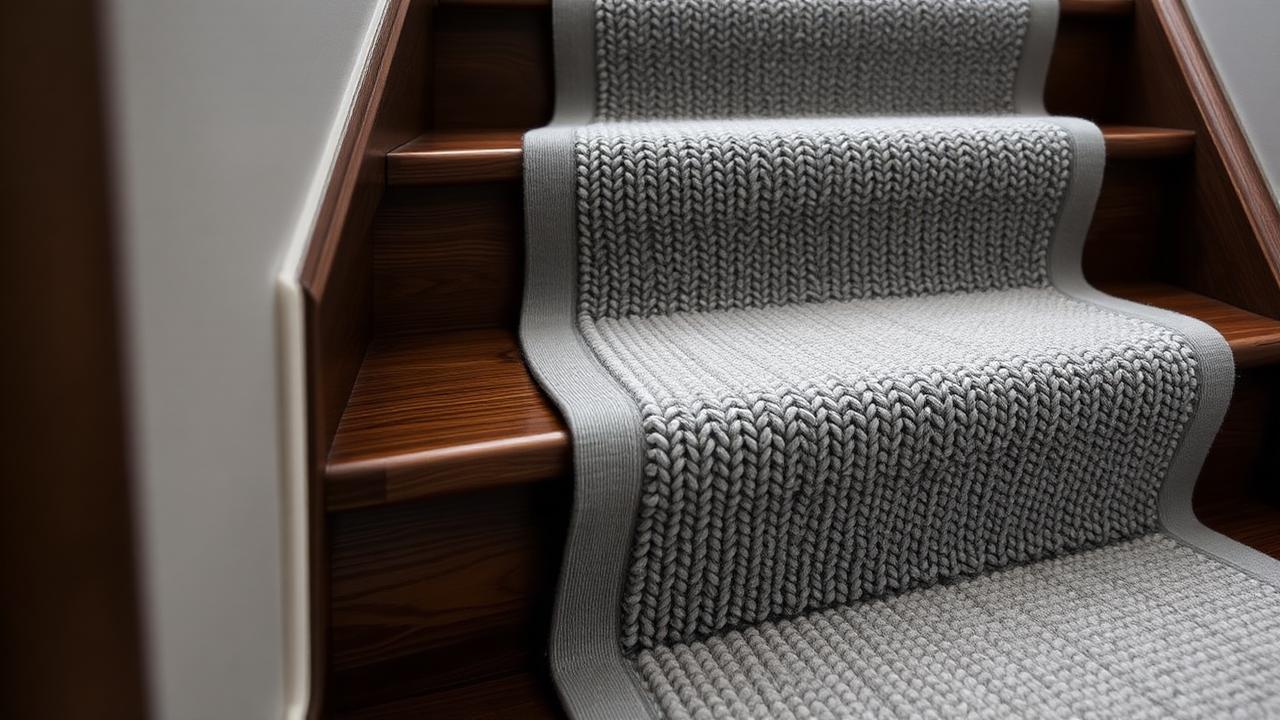
What makes a berber runner 'linear'
Classic berber carpet is defined by its looped pile construction, usually flecked with darker fibres against a natural or oatmeal base. A linear berber takes this a step further by weaving the loops into a subtle ribbed or corduroy-style texture that runs the length of the runner. This gives a country stair runner more visual interest than a flat berber while still reading as neutral and understated in a hallway or farmhouse staircase. The linear texture also does a good job of hiding footfall marks and vacuum lines, which is a genuine practical advantage on a well-used staircase.
Because the ribbing runs lengthwise, it is important to check the direction of the pattern before you buy. On a stair runner, the lines should run parallel to the edges of the runner, following the pitch of the stairs, rather than running across each tread. A reputable stair runner supplier will confirm the orientation of the weave before cutting your length, but it is worth asking directly if you are ordering a bespoke length.
Fibre and durability considerations
Country linear berber runners are typically made from wool, wool-blend, or hardwearing nylon. Wool berbers have a warm, natural handle and tend to resist crushing well, but pure wool loop pile can be prone to snagging if you have pets with claws. A wool-nylon blend, often around 80/20, gives you the classic berber look with added stain and wear resistance, which is usually the better choice for a busy family staircase.
- Wool berber: warm handle, excellent look, moderate snag risk with pets.
- Wool-nylon blend: best all-round choice for durability and appearance.
- 100% nylon berber: most affordable and stain-resistant, less luxurious underfoot.
- Always check the twist and loop density; a denser loop resists crushing better.
How much stair runner do I need?
Use the same method as any straight flight. Add the tread depth, riser height, and a nosing allowance per step, multiply by the number of steps, then add a finishing allowance top and bottom. For a 13-step flight in US units: 10 in tread + 7.5 in riser + 0.75 in nosing wrap = 18.25 in per step. Across 13 steps that is 237.25 in, plus 24 in of finishing allowance gives 261.25 in, or 21.77 ft. Add an 8-10% waste margin for pattern matching on a linear weave and you should order around 23.5-24 ft. In metric terms: 25 cm + 19 cm + 1.9 cm = 45.9 cm per step, 13 steps = 596.7 cm, plus 60 cm finishing = 656.7 cm, and with waste, roughly 7.1-7.3 m.
| Measurement | US (in/ft) | UK (cm/m) |
|---|---|---|
| Per-step total | 18.25 in | 45.9 cm |
| 13 steps | 19.77 ft | 5.97 m |
| With finishing | 21.77 ft | 6.57 m |
| With waste margin | 23.5-24 ft | 7.1-7.3 m |
Know your numbers in 30 seconds
Enter your step count, tread depth and riser height — the stair runner calculator gives you the exact length to order, in metres and feet, with waste included.
Open the stair runner calculatorChoosing width and gap
Country-style stair runners tend to look best with a generous gap on either side to show off exposed timber treads or a painted staircase. A 4-6 in (10-15 cm) gap on each side is common for this look, so measure your total staircase width carefully and use a stair runner length calculator alongside a width check to make sure the finished proportions look balanced before you order.
Order a sample first
Linear berber weaves can look quite different in a showroom than under your own stairwell lighting. Always request a sample large enough to see a full repeat of the ribbing before committing to a full-length order.
Fitting and edge finishing
Because berber loop pile can fray if cut carelessly, always have your runner edge-bound or serged by the supplier or an experienced fitter. A neat, bound edge not only looks more professional but also stops the loops unravelling with repeated vacuuming over the years. If you are using stair rods rather than a tackless fitting, a linear berber sits particularly well under rods because the flat weave shows off the hardware nicely without an overly deep pile bunching around the bar.

Underlay and padding specifics
A berber loop weave needs the right underlay to perform well on stairs. Too soft a pad lets the nosing edge flex and accelerates loop crushing, while too firm a pad can telegraph the step edge through the pile. Most fitters recommend a firm, low-profile pad around 0.3-0.4 in (7-10 mm) thick specifically for stairs, rather than the thicker 0.5-0.6 in (12-15 mm) pad you might use on a flat hallway floor. Ask your fitter to use a separate stair-rated pad rather than off-cuts from a room installation, since the density requirements are genuinely different.
Checking your own measurements before ordering
If your staircase differs from the 13-step example above, the same per-step formula still applies. Take three tread depths and three riser heights at different points on the flight, since older properties in particular can have steps that vary by 0.25-0.5 in (6-12 mm) from top to bottom. Use the largest riser and tread measurement you find, not an average, when calculating your nosing wrap allowance, so you do not come up short on the final cut.
| Staircase width | Recommended runner width | Typical side gap |
|---|---|---|
| 30 in (76 cm) | 24-27 in (60-68 cm) | 1.5-3 in (4-8 cm) each side |
| 36 in (91 cm) | 27-30 in (68-76 cm) | 3-4.5 in (8-11 cm) each side |
| 42 in (107 cm) | 30-36 in (76-91 cm) | 3-6 in (8-15 cm) each side |
Cost bands to expect
Pricing for a country linear berber runner varies by fibre and finishing, but as a rough guide, budget-friendly nylon berber weaves typically run lower per linear foot than a wool-nylon blend, with pure wool sitting at the top of the range. On top of the carpet itself, factor in binding or serging, underlay, and fitting labour, which together can add a meaningful amount to the headline material price. Always ask for a single all-in quote covering material, underlay, binding, and fitting so you can compare suppliers on a like-for-like basis.
- Take three tread and three riser measurements before ordering, using the largest figures.
- Specify a firm, stair-rated underlay around 0.3-0.4 in (7-10 mm) thick.
- Request an all-in quote covering material, underlay, binding, and fitting labour.
- Re-check width and gap once the runner arrives, before the final cut is made.
Long-term maintenance schedule
Vacuum a berber stair runner at least weekly, using a setting appropriate for a looped pile so the beater bar does not snag individual loops. Blot spills immediately rather than rubbing, and have the runner professionally cleaned roughly every 12-18 months depending on household traffic. On the busiest three or four steps nearest the bottom of the flight, expect visible wear a little sooner than the rest of the run; some households choose to have the runner periodically flipped or shifted slightly to even out wear, though this depends on the fitting method used.
In summary, a country linear berber stair runner offers a durable, textural, and understated option for a traditional or farmhouse staircase. Measure carefully, choose a wool-blend for durability, and always confirm the weave direction before your final order.
Whatever you decide, get the numbers first: the stair runner calculator doubles as a stair runner length calculator, adding nosing wrap, landings, winders, pattern repeat and waste so you order the right length the first time.
Still deciding on material, width or pattern? Our hub on stair runners compares weaves, widths, backings and fitting styles side by side, then hands the numbers straight to the calculator.
Frequently asked questions
What is a linear berber weave?
It is a looped berber carpet with a subtle ribbed or corduroy-style texture running along its length, adding visual interest to a flat berber weave.
Is berber good for stairs?
Yes, provided it is a dense, tightly-looped weave designed for stairs. Loose loop pile can snag, so check the construction before buying.
How much runner do I need for 13 steps?
Roughly 23-24 ft (7-7.3 m) once you include nosing wrap, top and bottom finishing, and an 8-10% waste allowance.
Does wool or nylon berber wear better?
A wool-nylon blend typically gives the best balance of natural look and long-term durability on stairs.
Can I use stair rods with a berber runner?
Yes, the relatively flat weave of a linear berber works well with rods, showing off the hardware without excessive bulk.
What gap looks best with a country runner?
A 4-6 in (10-15 cm) gap on each side is typical for a farmhouse or country look, showing off the surrounding timber.
Will berber snag with pets?
Pure wool loop pile can snag with claws, so a wool-nylon blend or a denser weave is a safer choice for households with dogs or cats.
Should I bind the edges?
Always. Binding or serging prevents the loops from fraying over years of vacuuming and foot traffic.
Know your numbers in 30 seconds
Enter your step count, tread depth and riser height — the stair runner calculator gives you the exact length to order, in metres and feet, with waste included.
Work out your length with the stair runner calculatorReady for real prices?
Get quotes from vetted stair runner suppliers and fitters near you. Free, no account, no obligation.
Every guide is written from hands-on measuring and fitting experience, checked against the calculator’s own maths, and re-reviewed whenever prices or methods change. Read our editorial standards.