

Why hardwood stairs need special treatment
Hardwood stairs are one of the riskiest surfaces in the home when they are bare, especially with socks or smooth-soled shoes. A stair runner adds traction down the centre of the tread while leaving an attractive border of exposed wood on either side. But fitting a runner to hardwood is different from fitting one over an existing carpeted or plywood subfloor, because you cannot simply staple or tack into a finished wood tread without leaving permanent holes and risking splits along the grain.
Most professional installers use one of three methods on hardwood: a stair rod system that clamps the runner at each riser without penetrating the wood, a hook-and-loop (touch-fastener) strip that is screwed into the underside of the nosing where it is invisible, or a hollow-back tackless strip designed for hardwood that grips with fewer, shallower pins. Whichever method you choose, always confirm it is compatible with hardwood before you order, because gripper designed for concrete or plywood subfloors can crack a hardwood nosing.
Measuring your hardwood staircase
The measuring process is the same as for any stair runner: measure the tread depth, the riser height, and add an allowance for the nosing wrap on every step. What changes on hardwood is the importance of getting the width right, because any runner that sits crookedly on a hard, reflective wood surface is far more visible than one on a carpeted stair. Use a stair runner length calculator to confirm your total yardage before you buy, and always measure every step individually if your hardwood stairs are older, since decades of wear can leave slightly uneven tread depths.
How much runner do I need?
For a 13-step flight: 10 in tread + 7.5 in riser + 0.75 in nosing wrap = 18.25 in per step. Across 13 steps that is 237.25 in. Add 24 in for finishing at the top newel and bottom step, giving 261.25 in, or 21.77 ft. With a 10% waste allowance for pattern matching and fitting error, order about 24 ft. In metric terms: 25 cm + 19 cm + 1.9 cm = 45.9 cm per step, times 13 steps is 596.7 cm, plus 60 cm finishing is 656.7 cm, and with 10% waste you should order roughly 7.3 m.
| Measurement | US (in/ft) | UK (cm/m) |
|---|---|---|
| Per-step total | 18.25 in | 45.9 cm |
| 13 steps | 19.77 ft | 5.97 m |
| With finishing allowance | 21.77 ft | 6.57 m |
| With 10% waste | 24 ft | 7.3 m |
Know your numbers in 30 seconds
Enter your step count, tread depth and riser height — the stair runner calculator gives you the exact length to order, in metres and feet, with waste included.
Open the stair runner calculatorChoosing a runner that suits wood tones
Warm oak and walnut stairs generally pair well with runners that have some depth of colour, such as deep reds, forest greens, or warm neutrals, since these tones complement rather than compete with the wood grain. Very pale, honey-toned hardwood can carry lighter runners, including natural fibre weaves like sisal or jute-look synthetics, without the border of exposed wood looking washed out. Avoid runners with a strong cool undertone on warm hardwood, as the mismatch is more noticeable on stairs than on a flat floor because you see both surfaces from multiple angles as you walk.
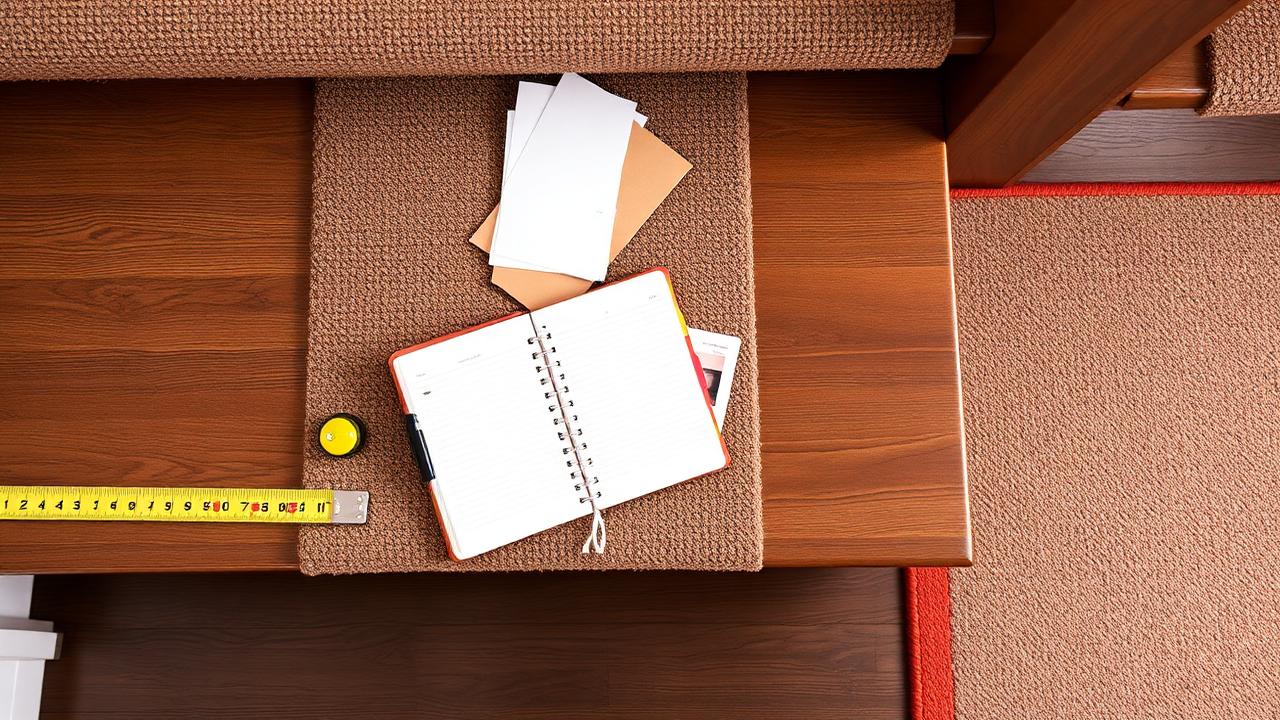
Protect the wood during fitting
Always lay a protective drop cloth over the treads while positioning and stapling or clamping your runner in place. A dropped tool or a staple gun misfire can chip a finished hardwood nosing in seconds.
Fixing methods compared
- Stair rods: clamp the runner without penetrating the wood, ideal for a traditional look.
- Touch-fastener strips: screwed under the nosing overhang, invisible from above, good for a modern minimal look.
- Hollow-back tackless strip: designed for hardwood, uses fewer and shallower pins than standard gripper.
- Double-sided carpet tape: a temporary or low-traffic solution, not recommended for a permanent family staircase.
Underlay considerations on hardwood
A quality underlay is still important on hardwood stairs, both for comfort underfoot and to protect the wood from the abrasive backing of the carpet runner over time. Choose a thin, dense stair-specific underlay rather than a thick cushioned pad, because a stair runner needs to sit tightly against the nosing to avoid a spongy, unsafe edge. Underlay that is too thick can also make the runner ride up over the tread edge, which looks unfinished and wears faster.
Maintenance on hardwood stairs
Vacuum your runner weekly and check the exposed wood border for scuffs, since this area gets more direct foot traffic on the edges than a fully carpeted staircase. If you notice the runner shifting slightly over months of use, check that your rods or tackless strip haven't loosened, as movement on a hard surface is more likely to cause a trip hazard than on carpet, where friction naturally holds things in place.
In summary, a hardwood stair runner is a rewarding project that protects your investment in real wood flooring while adding safety and warmth. Measure carefully, choose a wood-safe fixing method, and use a stair runner calculator to confirm your yardage before ordering.
Still deciding on material, width or pattern? Our hub on stair runners compares weaves, widths, backings and fitting styles side by side, then hands the numbers straight to the calculator.
Frequently asked questions
Will a stair runner damage my hardwood stairs?
Not if you use a wood-safe fixing method such as stair rods, touch-fastener strips screwed under the nosing, or hollow-back tackless designed for hardwood.
Do I need underlay on hardwood stairs?
Yes, a thin dense stair-specific underlay improves comfort and protects the wood finish from abrasion, but avoid thick cushioned pads.
How wide should my runner be on hardwood stairs?
Most hardwood stair runners are 27 to 32 inches wide on a standard 36 to 42 inch staircase, leaving a visible wood border on each side.
Can I install a hardwood stair runner myself?
Yes, with stair rods or touch-fastener systems, though tackless strip installation is best left to a professional fitter for a clean finish.
What colour runner works best on hardwood?
Warm-toned hardwood suits deep, rich colours, while pale hardwood can carry lighter natural fibre tones without washing out.
How much runner do I need for a 13-step hardwood staircase?
Roughly 23 to 24 feet or 7 to 7.3 meters, depending on your exact tread, riser, and waste allowance.
Will the runner scratch my hardwood?
A well-fitted runner with a proper underlay and correct fixing method will not scratch the wood; issues typically arise from loose fixings or missing underlay.
Should I seal my hardwood before fitting a runner?
Yes, it is best practice to finish and seal your hardwood stairs before installing the runner, since exposed borders will still need protection.
Know your numbers in 30 seconds
Enter your step count, tread depth and riser height — the stair runner calculator gives you the exact length to order, in metres and feet, with waste included.
Work out your length with the stair runner calculatorReady for real prices?
Get quotes from vetted stair runner suppliers and fitters near you. Free, no account, no obligation.
Every guide is written from hands-on measuring and fitting experience, checked against the calculator’s own maths, and re-reviewed whenever prices or methods change. Read our editorial standards.