
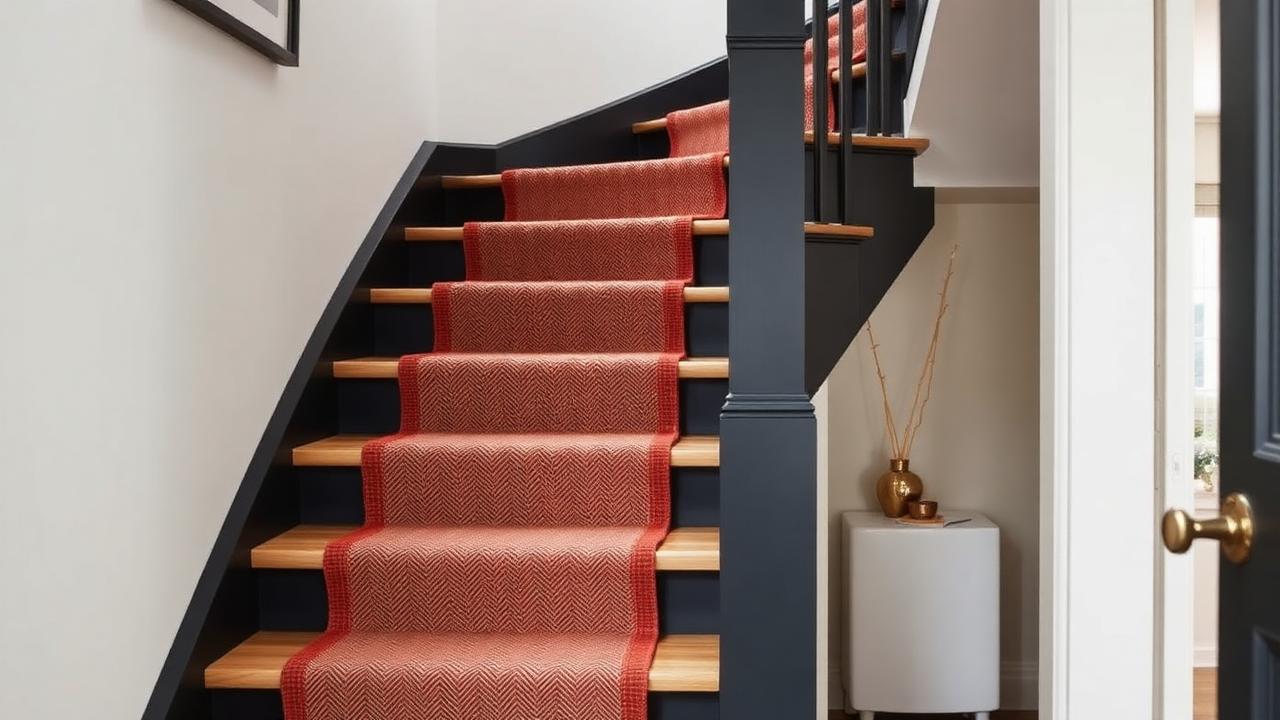
What defines a herringbone weave
Herringbone gets its name from the fishbone pattern created by the weaving structure itself, not from a printed design. Yarns are woven at alternating diagonal angles, producing a subtle, textural zigzag that reads as a solid colour from a distance but reveals rich depth up close. This makes herringbone stair runners a popular pick for buyers who want more visual interest than a flat weave without committing to a bold stripe or geometric print.
Herringbone is most commonly found in wool or wool-blend construction, since the weave shows best in a fibre with good body and definition. It is available in both natural, undyed tones and richly dyed colourways, from deep charcoal to soft oatmeal.
Pattern direction matters on stairs
Unlike a straight stripe, herringbone has a clear directional grain. When fitting, the zigzag should run consistently down the flight, typically with the point of each ‘V’ facing up the stairs. On winders or curved sections, the weave will naturally distort slightly around the turn, and this is one area where an experienced fitter is worth the investment, since a poorly aligned herringbone pattern on a winder is very noticeable.
How much runner do I need?
For a 13-step flight: 10 in tread + 7.5 in riser + 0.75 in wrap = 18.25 in per step, totalling 237.25 in. Adding 24 in for finishing gives 261.25 in or 21.77 ft. With an 8% waste allowance for cutting and directional matching, order approximately 23.5 ft. In metric terms: 25 cm + 19 cm + 1.9 cm = 45.9 cm per step, 596.7 cm over 13 steps, plus 60 cm finishing is 656.7 cm, and with 8% waste that comes to roughly 7.1 m. The stair runner length calculator handles this instantly if you input your own tread and riser dimensions.
| Step | US (in/ft) | UK (cm/m) |
|---|---|---|
| Per-step total | 18.25 in | 45.9 cm |
| 13 steps | 19.77 ft | 5.97 m |
| With finishing | 21.77 ft | 6.57 m |
| With waste | 23.5 ft | 7.1 m |
Know your numbers in 30 seconds
Enter your step count, tread depth and riser height — the stair runner calculator gives you the exact length to order, in metres and feet, with waste included.
Open the stair runner calculatorOrder a little extra for pattern matching
Because herringbone has a strong visual grain, ask your supplier whether the pattern repeat runs continuously along the roll length, and add a small buffer if it does not, to avoid an awkward join partway down the flight.
Colour and border pairing
Herringbone stair runners pair well with a solid contrasting border, which frames the texture nicely and helps define the edge against painted stringers. A neutral herringbone with a navy or forest green border is a classic, timeless combination in both US and UK homes.
Where herringbone works best
Herringbone suits traditional hallways, period homes, and anywhere you want understated pattern rather than bold colour. It also hides light soiling and footfall marks better than a flat weave, which helps in busy households.
Herringbone scale and staircase width
Herringbone weaves come in different scales, from a tight, fine zigzag to a broad, chunky one. On a narrow staircase, around 27-30 in (68-76 cm) wide, a fine-scale herringbone reads more cleanly since a large-scale weave can look cramped or get visually cut off at the edges. On wider stairs, 36 in (90 cm) or more, a broader herringbone has room to show its full repeat and creates a more dramatic effect.
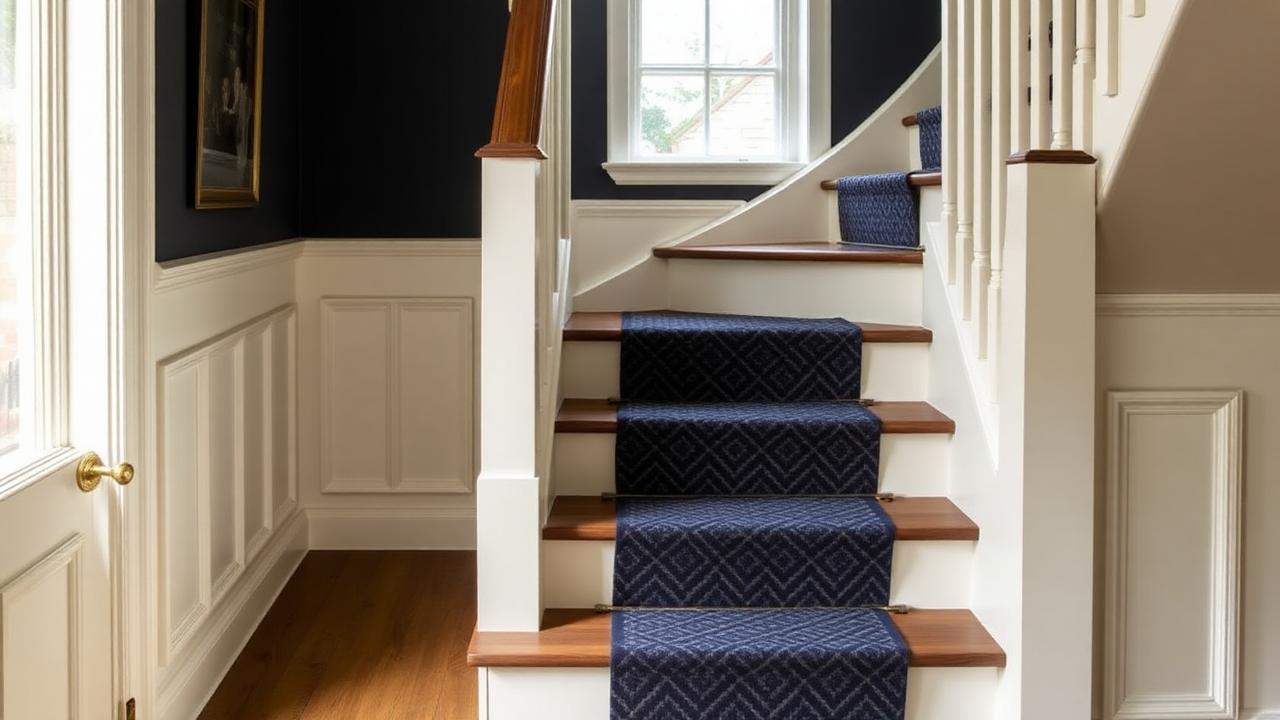
Fitters also recommend checking how the weave meets the edge of the runner before ordering. A clean edge finish that does not cut a herringbone repeat awkwardly in half looks far more considered, and a good supplier will confirm this before cutting your length.
Cost bands for herringbone runners
| Grade | US cost per ft | UK cost per m |
|---|---|---|
| Wool-blend herringbone, standard | $18-30 | £40-66 |
| Pure wool herringbone | $28-45 | £62-99 |
| Custom-dyed or bespoke herringbone | $40-65 | £88-143 |
Spec checklist for herringbone
- Confirm the weave scale suits your staircase width
- Check the roll length against a continuous pattern repeat to avoid mid-flight joins
- Ask whether the herringbone is symmetric so it looks correct from both sides on an open staircase
- Confirm border or binding colour against a physical sample, not just a screen image
Living with a herringbone runner
Because the pattern is woven rather than printed, herringbone tends to age gracefully, with wear showing as gentle flattening rather than a faded or peeling print. Vacuum in the direction of the weave where possible and rotate any door mats near the stairs to reduce grit transfer, which is the main driver of visible wear on any wool-based runner.
Herringbone on winders and curved stairs
A herringbone weave will visibly distort as it turns around a winder or curved section, since the diagonal structure of the weave cannot bend in the same way a flat weave can without the zigzag angle changing. Some homeowners accept this as part of the character of the material, while others prefer to have the winder section cut and pieced separately so the herringbone angle resets cleanly at the turn rather than stretching. Discuss this trade-off with your fitter before the job starts, since it affects both material usage and the final look.
Comparing herringbone to other textured weaves
Herringbone sits alongside other textured weaves like basketweave, houndstooth, and diamond twill as an option for buyers who want visual depth without a printed pattern. Basketweave has a more geometric, grid-like texture, while houndstooth introduces a broken check pattern that reads busier than herringbone from a distance. For most traditional and transitional interiors, herringbone remains the most versatile of the group, since its subtle diagonal texture pairs well with both period skirting and more modern trim.
| Weave | Visual busyness | Best interior style |
|---|---|---|
| Herringbone | Subtle | Traditional, transitional |
| Basketweave | Moderate | Casual, coastal |
| Houndstooth | Bold | Statement hallways |
Whatever you decide, get the numbers first: the stair runner calculator doubles as a stair runner length calculator, adding nosing wrap, landings, winders, pattern repeat and waste so you order the right length the first time.
Frequently asked questions
Is herringbone a printed pattern or a weave?
It is a weave structure, not a print, which is why it holds its texture and definition much longer than a printed pattern.
What fibre is best for a herringbone stair runner?
Wool and wool blends show the herringbone texture best and are the most common choice for this weave.
Does the herringbone pattern need to run a specific direction?
Yes, the zigzag should be consistent down the flight, typically with the point facing up the stairs.
Is herringbone harder to fit than a plain runner?
Slightly, particularly on winders or curves, where the weave can visually distort if not aligned carefully.
How much herringbone runner do I need for 13 steps?
Around 23.5 ft (7.1 m), including nosing wrap, finishing allowance, and an 8% waste margin.
Can herringbone stair runners have a border?
Yes, a solid contrasting border is a popular and classic way to frame the texture.
Does herringbone hide dirt well?
Yes, the textured weave disguises light soiling and footfall marks better than a flat, solid weave.
Is herringbone suitable for a modern home?
Yes, in a neutral tone it works well in both traditional and contemporary interiors.
Know your numbers in 30 seconds
Enter your step count, tread depth and riser height — the stair runner calculator gives you the exact length to order, in metres and feet, with waste included.
Calculate your length with the stair runner calculatorReady for real prices?
Get quotes from vetted stair runner suppliers and fitters near you. Free, no account, no obligation.
Every guide is written from hands-on measuring and fitting experience, checked against the calculator’s own maths, and re-reviewed whenever prices or methods change. Read our editorial standards.