

The Aesthetic Power of the Herringbone Pattern
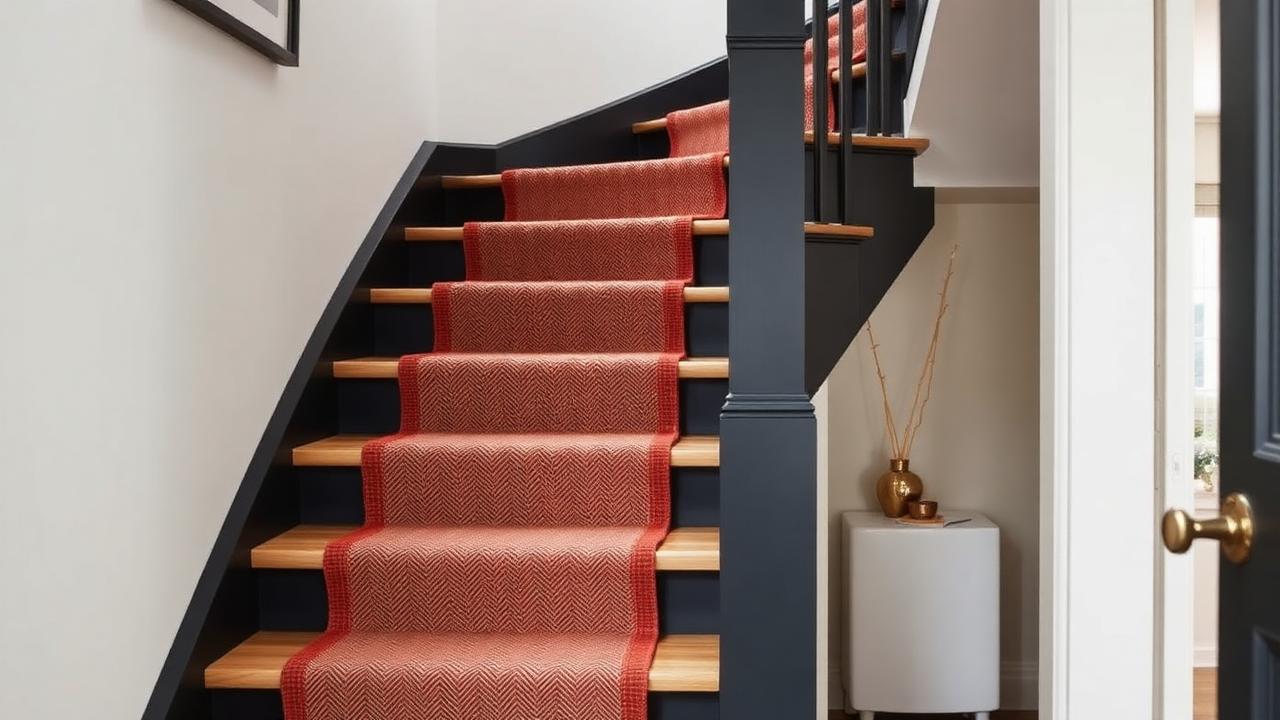
The herringbone pattern is a classic 'V' shaped weaving motif that has been used in textiles and flooring for centuries. When applied to a stair runner, it creates a sense of movement and direction that naturally draws the eye upward. In the world of stair carpets, herringbone is most commonly found in natural fiber materials like sisal, seagrass, and jute, but it is also increasingly available in soft, durable wool blends.
The addition of a border—usually a 2-inch to 5-inch (5-12cm) strip of fabric tape or a different carpet weave—serves to 'frame' the herringbone pattern. This framing effect is particularly effective on stairs because it highlights the clean lines of the staircase and prevents the pattern from feeling like it is simply 'floating' on the wood. Before you start cutting, a stair runner length calculator will help you determine the total linear footage needed, including the extra for the landing returns.
Choosing the Right Border for Herringbone
The border is what truly customizes a herringbone runner. You have two primary options: a fabric tape border (often cotton or linen) or a 'woven-in' border. Fabric tapes allow for the greatest variety of colors and textures, enabling you to match your runner to other elements in your home, such as wall paint or upholstery.
- Cotton Tape: The most common choice, offering a clean, matte finish and a wide range of colors.
- Linen Tape: Provides a slightly more relaxed, textured look that pairs beautifully with chunky sisal weaves.
- Leather Binding: A high-end, luxury option that adds a masculine, sophisticated touch to wool herringbone.
- Serged/Whipped Edge: While not a traditional 'border', an overlocked edge in a contrasting color can provide a minimalist framing effect.
Material Considerations: Sisal vs. Wool
Sisal is the traditional choice for herringbone runners. It is incredibly tough and has a distinct, rustic texture. However, it can be slippery and is not particularly soft underfoot. Wool herringbone, on the other hand, offers a similar visual look with far more comfort and better sound insulation. In the UK, sisal is often chosen for its 'country house' aesthetic, while in the US, wool or synthetic 'sisal-look' carpets are frequently preferred for family homes where comfort is a priority.
| Feature | Sisal Herringbone | Wool Herringbone |
|---|---|---|
| Durability | Extremely High | High |
| Softness | Low (Prickly) | High (Soft) |
| Stain Resistance | Moderate (Water sensitive) | High (Naturally repellent) |
| Cost (UK) | £30 - £60 per m | £50 - £120 per m |
| Cost (US) | $35 - $65 per yd | $55 - $130 per yd |
Measurement and Installation Tips
Installing a bordered runner is significantly more complex than a standard one. The border must remain perfectly parallel to the stair stringers, or the entire installation will look crooked. This is especially challenging on winders (turning steps) where the inner edge of the runner is narrower than the outer edge.
- Measure the width of the stairs and subtract the desired reveal (usually 2-4 inches on each side) to find your runner width.
- Decide on the border width; 2.5 inches (approx 6cm) is the standard for most residential stairs.
- Ensure the underlay is cut about 1 inch narrower than the runner itself to prevent it from peeking out from under the border.
- Use a pneumatic staple gun to secure the runner in the 'crotch' of the stair (where the riser meets the tread) for a tight, professional finish.
Cost Breakdown for Bordered Runners
Adding a border increases the cost of the runner due to the extra labor involved in 'binding' the edges. In the UK, this is often quoted as a price per linear meter of binding, while in the US, it may be a flat fee per stair or a linear yard rate.
| Expense Item | UK Average Price | US Average Price |
|---|---|---|
| Herringbone Runner (13 steps) | £400 - £800 | $500 - $1000 |
| Fabric Border Binding | £150 - £300 | $200 - $400 |
| Installation (Complex/Winders) | £300 - £600 | $400 - $800 |
| Total Estimated Project | £850 - £1700 | $1100 - $2200 |
A Note on Winders
If your staircase has a turn (winders), the border will naturally 'bunch' or 'fan' depending on the angle. A skilled installer will use 'pie-cuts' or mitred joins on the landing to ensure the border remains continuous and aesthetically pleasing.
Maintenance and Longevity
Bordered runners require a little extra care. The fabric tape can sometimes attract lint or dust differently than the main carpet. Regular vacuuming with a crevice tool along the edge of the border will keep it looking crisp. If you choose a light-colored border, consider applying a fabric protector (like Scotchgard) to prevent staining from shoes or paws.
How much runner do I need?
Herringbone weaves consume more material at the cut than a plain-weave stair runner because the diagonal pattern needs to land consistently at each nosing rather than being cut anywhere convenient. Take a 13-step US flight with a 10 in tread run and 7.5 in riser height: the base tread-and-riser calculation gives roughly 17.5 in per step, or about 227.5 in (19 ft) across 13 steps. Because herringbone has a visible directional repeat, budget a 10-12% waste margin rather than the 5% you might use on a flatweave, which lands the practical order at roughly 21-21.5 ft, before adding the separate binding allowance the border itself needs.
In UK metric terms, the same 25 cm going and 19 cm riser gives about 44.5 cm per step and a base length near 5.8 m for 13 steps. With a 10-12% waste margin for the herringbone repeat, that comes to roughly 6.4-6.5 m before binding. If your landing involves a turn, add a further 10-15% specifically on the landing section, since a mitred herringbone corner needs the diagonal weave to appear continuous around the turn, which uses noticeably more offcut than a plain border turning the same corner.
| Section | US length | UK length |
|---|---|---|
| 13-step straight flight, herringbone base | ≈19 ft | ≈5.8 m |
| With 10-12% herringbone waste margin | ≈21-21.5 ft | ≈6.4-6.5 m |
| Landing/turn section (add separately) | +10-15% | +10-15% |
Know your numbers in 30 seconds
Enter your step count, tread depth and riser height — the stair runner calculator gives you the exact length to order, in metres and feet, with waste included.
Open the stair runner calculatorWhatever you decide, get the numbers first: the stair runner calculator doubles as a stair runner length calculator, adding nosing wrap, landings, winders, pattern repeat and waste so you order the right length the first time.
Still deciding on material, width or pattern? Our hub on stair runners compares weaves, widths, backings and fitting styles side by side, then hands the numbers straight to the calculator.
Frequently asked questions
Can I use any fabric for a stair runner border?
While many fabrics can be used, specialized carpet binding tapes are recommended. These are typically heavy-duty cotton or synthetic blends designed to withstand the friction and tension of being walked on and stretched over stair nosings. Delicate fabrics like silk or thin polyester will wear through very quickly.
How wide should the border be on a stair runner?
The most common border width is between 2 and 3 inches (5-7.5cm). This provides enough definition to be noticed without overwhelming the central pattern. For very wide grand staircases, you might go up to 5 inches, but for standard residential stairs, 2.5 inches is generally the 'sweet spot'.
Is a herringbone runner slippery?
Natural sisal herringbone can be quite slick, especially when wearing socks. Wool herringbone or synthetic blends offer much better grip. Regardless of the material, using a high-quality, non-slip underlay (padding) is essential for safety on wooden stairs.
How do you finish a bordered runner at the top of the stairs?
The most common method is to 'tuck and staple' the runner just under the nosing of the top landing. If the runner continues onto the landing, the border should be mitred at the corners to create a professional, rug-like appearance on the flat surface.
Do bordered runners work on curved stairs?
Yes, but they require a master installer. The border must be carefully manipulated to follow the curve without buckling. This often involves hidden 'relief cuts' on the underside of the runner and very precise stapling. It is significantly more expensive than a straight flight installation.
Can I wash a fabric border?
You should not 'wash' it in the traditional sense, as getting the backing wet can damage the carpet and the wood underneath. Instead, use a foam-based upholstery cleaner for localized spots. Always blot, never scrub, to avoid fraying the fabric fibers.
Know your numbers in 30 seconds
Enter your step count, tread depth and riser height — the stair runner calculator gives you the exact length to order, in metres and feet, with waste included.
Stair Runner CalculatorReady for real prices?
Get quotes from vetted stair runner suppliers and fitters near you. Free, no account, no obligation.
Every guide is written from hands-on measuring and fitting experience, checked against the calculator’s own maths, and re-reviewed whenever prices or methods change. Read our editorial standards.