

Why wool needs a different approach than synthetic
Wool is a natural protein fibre with a scaly outer surface, and those scales open up when the fibre gets wet or is agitated, which is exactly the mechanism that lets wool felt into a solid mat if you're not careful. Synthetic stair runners in nylon or polypropylene can shrug off a fairly aggressive scrub and a wet shampoo without much consequence, but do the same thing to a wool runner and you risk permanent texture change, colour bleed if the dye isn't fully colourfast, or a slightly matted patch that never quite recovers its original pile. On a stair, where every step gets compressed underfoot dozens of times a day, that risk is higher than on a flat wool rug, because the fibres are already under more mechanical stress.
The good news is that wool is naturally soil-resistant and self-cleaning to a surprising degree - its structure repels a lot of dry dust and doesn't hold onto odours the way synthetic fibres can, which is part of why designers still specify wool stair runners even on busy family staircases. The trick is working with that natural resilience rather than against it: dry methods do most of the work, and wet cleaning is reserved for spills and occasional deep cleans rather than a weekly routine.
Daily and weekly dry care
Vacuum a wool stair runner with the beater bar or rotating brush switched off, or turned down to its lowest setting, because an aggressive beater bar on wool pile pulls at the fibre tips and accelerates fuzzing over time. Use the suction-only setting most upright vacuums have, or a handheld vacuum with a soft brush attachment, and work in the direction of the pile rather than against it. On a 13-step flight this takes about five minutes and should happen weekly in a normal household, rising to twice weekly if you have pets or heavy foot traffic funnelling through the stairwell.
Every month or so, get right into the edges where the runner meets the stair rods, gripper or binding tape, since dust and grit accumulate there and can work their way under the edge, loosening the fitting over time. A narrow crevice tool is far better for this than the main vacuum head, which usually can't reach into that tight channel along the tread edge.
Never use a steam cleaner on wool
Steam and hot water extraction can shrink and distort wool pile permanently. Stick to cold or lukewarm water for any spot treatment, and always test on a hidden corner or offcut first.
Dealing with spills and stains
Blot a spill immediately with a clean, dry white cloth, working from the outside of the stain inward so you don't spread it further across the pile. Never rub - rubbing drives the liquid deeper into the fibre and can distort the pile texture in the process. For most water-based spills like tea, juice or muddy footprints, a small amount of cold water and a mild wool-safe detergent, applied with a cloth rather than poured directly onto the runner, is usually enough. Blot again with a dry cloth to lift the moisture back out, and let the area air dry fully before walking on it again, which can take several hours on a thicker pile.
For oil-based stains, cooking fat or wax, dry methods work better than water: scrape off any solid residue first, then use a wool-safe dry solvent cleaner sparingly, again testing on a hidden area first. Red wine, one of the most common stair-adjacent spills at a party, responds best to an immediate cold water blot followed by a specific wool-safe wine stain remover rather than salt or bicarbonate of soda, both of which can leave their own residue in the pile.
How much runner do I need?
If you're replacing a worn or stained wool runner rather than just cleaning the one you have, it helps to re-measure properly rather than assume the old length is still right, since underlay and fitting styles change over time. Take a US example: 13 steps, each with a 10 in tread run and a 7.5 in riser height, plus a 1 in nosing wrap allowance for wool's slightly thicker pile. Per step that's 10 + 7.5 + 1 = 18.5 in. Across 13 steps that's 240.5 in, or 20.04 ft. Add a 24 in top-and-bottom finishing allowance for 264.5 in (22.04 ft), then apply a 7% waste margin for wool's tendency to need more careful pattern and pile-direction matching, landing at roughly 23.6 ft to order.
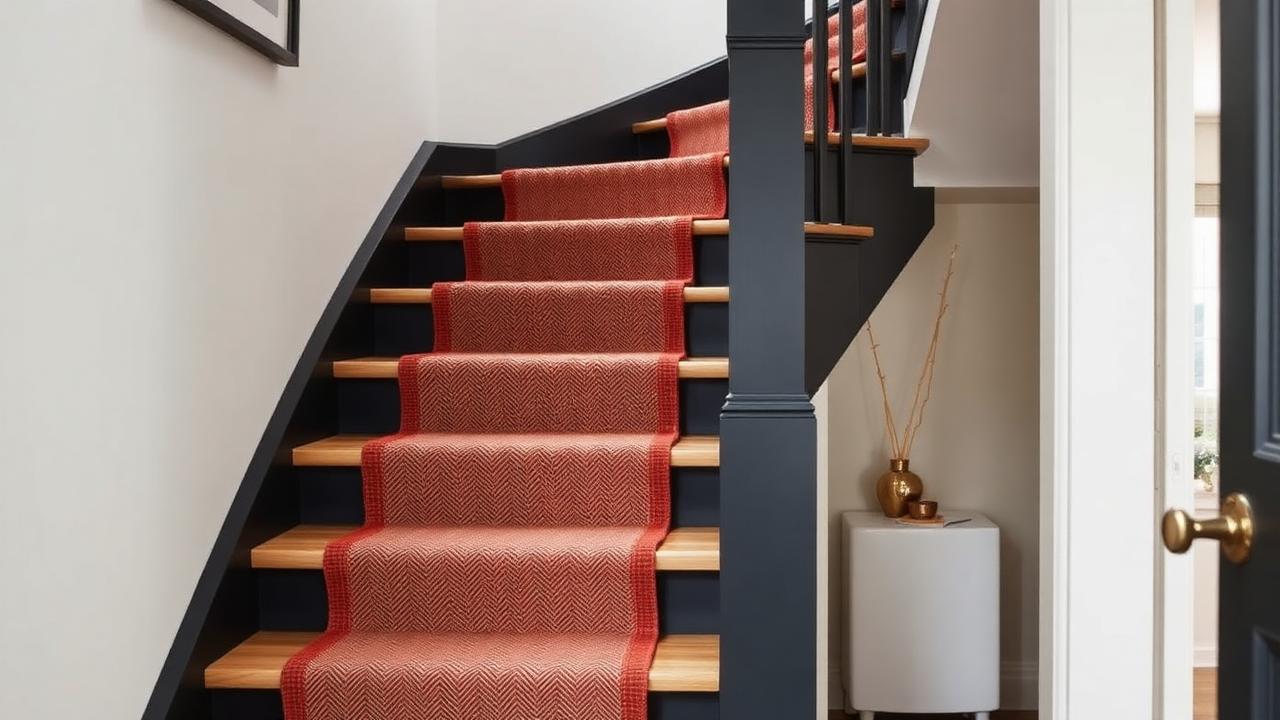
In UK metric terms: 25 cm tread run, 19 cm riser height, 2.5 cm nosing wrap for wool's thicker pile, giving 46.5 cm per step. Across 13 steps that's 604.5 cm, plus 60 cm finishing allowance for 664.5 cm, then a 7% waste margin brings you to roughly 7.1 m. A stair runner calculator will run both unit systems for your exact step count and flag the extra wool waste margin automatically, which saves reworking the sums by hand if you change tread dimensions partway through planning.
Wool sizing worked example
| Measurement | US (in/ft) | UK (cm/m) |
|---|---|---|
| Tread run | 10 in | 25 cm |
| Riser height | 7.5 in | 19 cm |
| Wool nosing wrap | 1 in | 2.5 cm |
| Per-step total | 18.5 in | 46.5 cm |
| 13 steps subtotal | 20.0 ft | 6.05 m |
| With finishing allowance | 22.0 ft | 6.65 m |
| With 7% waste margin | 23.6 ft | 7.1 m |
Know your numbers in 30 seconds
Enter your step count, tread depth and riser height — the stair runner calculator gives you the exact length to order, in metres and feet, with waste included.
Open the stair runner calculatorDeep cleaning and professional care
Even with diligent dry vacuuming, a wool stair runner benefits from a proper deep clean roughly every 12-18 months, or annually in a household with pets or young children. This is best done by a professional using a low-moisture encapsulation or dry compound method rather than hot water extraction, since wool's natural fibre scales and the wool stairs' constant flexing under foot traffic make it more prone to distortion under heavy wet cleaning than a flat wool rug in a low-traffic room. Ask any cleaner you hire specifically whether they're experienced with wool stair runners, since a technique that's perfectly safe on a synthetic hallway carpet can genuinely damage wool pile.
- Vacuum thoroughly first to remove loose grit before any wet or dry-compound treatment.
- Test any product on a hidden offcut or under-tread section first.
- Use cold water and wool-safe detergents only, never hot water or steam.
- Blot, never scrub, and always work from the outside of a stain inward.
- Allow full drying time before foot traffic resumes on treated steps.
- Book a professional low-moisture deep clean every 12-18 months.
Protecting your investment long term
Wool stair runners cost more up front than synthetic alternatives, which makes protecting that investment worth the small extra care effort. Rotate any loose rugs or mats at the base of the stairs regularly so wear doesn't concentrate in one spot, keep pet claws trimmed if animals use the stairs often, and address spills within minutes rather than hours - wool's soil resistance buys you time, but it isn't unlimited. Many homeowners who choose stair runners in wool over synthetics do so because the fibre ages more gracefully and hides everyday wear better, but that only holds true if the basic dry-first, blot-don't-rub cleaning routine is followed consistently from day one.
Whatever you decide, get the numbers first: the stair runner calculator doubles as a stair runner length calculator, adding nosing wrap, landings, winders, pattern repeat and waste so you order the right length the first time.
Frequently asked questions
Can I use a carpet shampoo machine on a wool stair runner?
Only if it's specifically rated wool-safe and used on a low-moisture setting; most standard hot water extraction machines put too much moisture and heat into the pile and risk shrinking or felting the wool fibres.
How often should I vacuum a wool stair runner?
Weekly in a normal household, rising to twice weekly with pets or heavy foot traffic. Use suction only or the lowest beater bar setting to avoid pulling at the wool fibre tips.
Is wool naturally stain resistant?
Wool is naturally more soil and stain resistant than many synthetics because of its fibre structure, but it isn't stain proof, so spills still need blotting immediately rather than being left to sit and dry in.
What's the biggest mistake people make cleaning wool stair runners?
Using a hot steam cleaner or scrubbing vigorously at a stain. Both actions can felt or distort the wool pile permanently, whereas cold water blotting and gentle wool-safe products handle the same spill safely.
Does wool shed more than synthetic stair runner fibres?
New wool runners can shed loose fibres for the first few weeks as manufacturing offcuts work their way out during vacuuming, which is normal and settles down; it isn't a sign of poor quality or ongoing wear.
Can I clean wool stairs myself or do I need a professional?
Regular dry vacuuming and spot-cleaning small spills is fine to do yourself with the right technique, but a full deep clean every 12-18 months is best left to a professional experienced specifically with wool.
Will sunlight fade a wool stair runner?
Wool resists fading better than many synthetics, but prolonged direct sunlight through a stairwell window can still gradually lighten dyed wool, so consider UV-filtering film or blinds on a south-facing stair window.
How do I get pet odour out of a wool runner without damaging it?
Sprinkle a wool-safe dry deodorising powder, leave it for the time stated on the product, then vacuum thoroughly. Avoid wet enzymatic cleaners unless they're specifically labelled wool-safe, since many are formulated for synthetics.
Know your numbers in 30 seconds
Enter your step count, tread depth and riser height — the stair runner calculator gives you the exact length to order, in metres and feet, with waste included.
Work out how much wool runner you need with the stair runner calculatorReady for real prices?
Get quotes from vetted stair runner suppliers and fitters near you. Free, no account, no obligation.
Every guide is written from hands-on measuring and fitting experience, checked against the calculator’s own maths, and re-reviewed whenever prices or methods change. Read our editorial standards.