
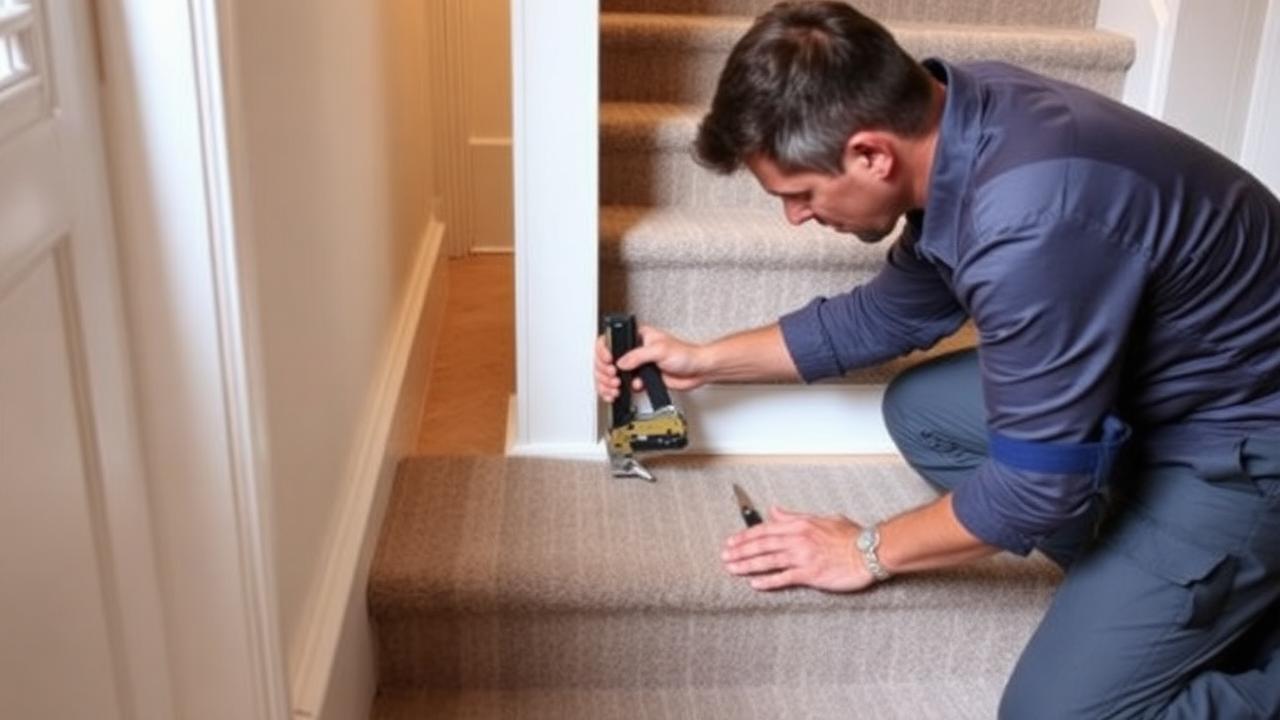
Cutting tools compared
| Tool | Best for | Notes |
|---|---|---|
| Sharp utility/box knife | Straight cuts on backed runners | Change blades often; a dull blade drags the backing |
| Carpet shears | Fine trims, angled cuts, natural fibre edges | Slower but cleanest on loose weaves |
| Row-running knife (carpet cutter) | Long, straight production cuts | Best on flat, uncluttered runs |
| Straightedge or carpenter's square | Guiding any of the above | Essential for a true 90-degree cut |
Cutting from the back
Fold the runner face-down, mark your cut line on the backing, and score along a straightedge rather than trying to cut through the pile from the top. This keeps the face fibres intact right up to the cut edge and gives a far cleaner line than cutting through the pile.
Cutting on the bias
A bias cut, at an angle rather than square across, is occasionally needed where a runner meets an angled winder step or a landing that is not square to the flight below. Mark the angle carefully with a bevel gauge or protractor before cutting, since an incorrect bias angle is very hard to disguise once bound or fitted.
Know your numbers in 30 seconds
Enter your step count, tread depth and riser height — the stair runner calculator gives you the exact length to order, in metres and feet, with waste included.
Open the stair runner calculatorAllowing for pattern repeat
- Identify the repeat length before making any cuts, not after.
- Plan joins to land at a natural break in the pattern rather than mid-motif.
- Buy extra length equal to at least one full repeat to allow matching across a join.
- Dry-lay sections on the floor first to check alignment before committing to a cut.
Seal every raw edge on natural fibres
Sisal, jute and seagrass fray within days if left unsealed. Apply a latex seam sealer or have the edge bound immediately after cutting, especially on any edge that will be turned under or hidden.
Cutting for winders and curves
Winder steps taper from wide at the outer edge to narrow at the inner newel, so each winder tread usually needs its own template rather than a repeated straight cut. Cut a paper or card template from the actual tread first, transfer it to the runner backing, and cut a fraction oversize so you can trim to a precise fit once dry-laid in place.
| Situation | Template needed? | Extra allowance |
|---|---|---|
| Straight tread | No, repeat the same cut | 2-3 in (5-7.5cm) for tensioning |
| Winder tread | Yes, individual template per step | 1/2-1 in (12-25mm) oversize for trimming |
| Curved staircase tread | Yes, individual template, often a professional job | 1-2 in (25-50mm) oversize |
Number each template as you make it and mark which side faces the newel post, since winder templates are rarely symmetrical and an easy mistake is fitting one upside down or on the wrong step during the final lay.
Common cutting errors
- Cutting to exact finished length with no allowance for tensioning and fold-under.
- Using a dull blade, which drags backing fibres and distorts the weave.
- Cutting through the pile from the front instead of scoring the backing.
- Forgetting to account for pattern repeat before the first cut.
Worked example with real numbers
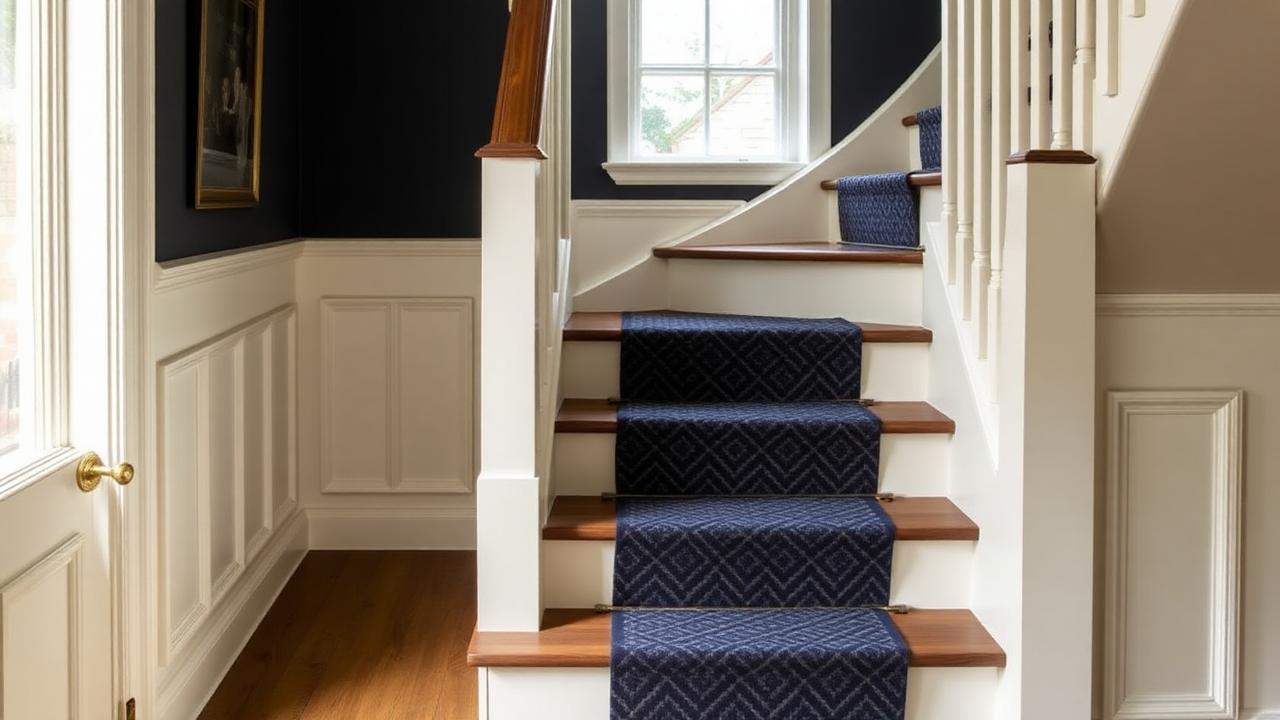
To see how how to cut a stair runner plays out on an actual staircase, take a common 13-step flight with a 10 in (25 cm) tread depth and a 7.5 in (19 cm) riser height. That gives 17.5 in (44 cm) per step, or 227.5 in (5.78 m) of raw length before any waste allowance is added, a figure worth keeping in mind whenever this topic is discussed in isolation from the rest of the job.
| Measurement | Imperial | Metric |
|---|---|---|
| Tread depth | 10 in | 25 cm |
| Riser height | 7.5 in | 19 cm |
| Per step total | 17.5 in | 44 cm |
| 13 steps, raw length | 227.5 in | 5.78 m |
| With 8% waste allowance | 245.7 in | 6.24 m |
When to call a professional instead
Plenty of homeowners handle how to cut a stair runner themselves on a straightforward straight flight, but certain conditions tip the balance firmly towards hiring a fitter. Getting a second opinion before committing materials often costs nothing and can save an expensive mistake on a job that cannot easily be undone.
- The staircase has a turn, winders, a curve or a split level rather than one straight run.
- The existing substrate is damaged, damp, or its condition is genuinely unclear.
- The runner is an expensive natural fibre or bespoke pattern where a cutting mistake is costly.
- You have no experience with a staple gun, knee kicker or carpet seaming on stairs.
- The staircase is the main one in the home and downtime or an unfinished look is not acceptable.
Choosing blades and keeping cuts consistent
A blade that is even slightly dull drags fibres rather than slicing them cleanly, which is the single biggest cause of a ragged cut edge on any runner material. Change utility knife blades far more often than feels necessary, roughly every one to two cuts on a dense wool backing, and keep a dedicated blade for natural fibre work separate from one used on synthetic backings, since resin and latex residue from backing coatings dulls an edge faster than fibre alone. Marking every cut line with a full straightedge rather than a short ruler also keeps a long cut consistent, since even a slight wobble over 30+ in (75cm) is visible once the runner is fitted and lit from an angle.
Repairing damaged gripper without lifting the whole flight
A single damaged or lifted section of gripper strip, often near a heavily used tread, does not usually require refitting the entire flight. Lift the runner carefully back from that tread only, working just far enough to expose the damaged strip, replace or re-nail it, then re-hook and re-tension the runner back onto the repaired section. This localised approach keeps the rest of the flight's tensioning undisturbed and is a job most confident DIYers can complete in under an hour per affected tread.
Cutting tools compared
| Tool | Best for | Notes |
|---|---|---|
| Utility/trim knife | Most runners | Cheap, needs frequent fresh blades |
| Carpet shears | Trimming fitted edges | Good control, slower for long cuts |
| Rotary cutter | Straight synthetic runs | Fast, needs a firm straightedge |
| Heat knife | Synthetic fibres prone to fraying | Seals the edge as it cuts |
Cutting mats and protecting the work surface
Cutting a runner directly on a hallway floor risks scoring the boards or tiles beneath, so lay down a self-healing cutting mat, a sheet of scrap plywood, or at minimum a folded towel or old blanket before scoring through the backing. This small precaution matters most when working on polished timber or stone flooring near the base of the stairs, where a slipped blade can leave a mark that is far harder to fix than the runner cut itself.
Whatever you decide, get the numbers first: the stair runner calculator doubles as a stair runner length calculator, adding nosing wrap, landings, winders, pattern repeat and waste so you order the right length the first time.
Still deciding on material, width or pattern? Our hub on stair runners compares weaves, widths, backings and fitting styles side by side, then hands the numbers straight to the calculator.
Frequently asked questions
Should I cut a stair runner from the front or the back?
Always from the back. Fold it face down, mark the backing, and score along a straightedge with a sharp knife so the face pile stays intact and the edge is clean.
What does cutting a stair runner on the bias mean?
It means cutting at an angle rather than square across, needed where a runner meets an angled winder step or an out-of-square landing. Mark the angle precisely before cutting.
How much extra length should I allow when cutting a stair runner?
Add roughly 2-3 in (5-7.5cm) per step for tensioning and fold-under beyond the exact measured length, plus a full pattern repeat if you need to match a join.
How do I stop the cut edge of a stair runner fraying?
Seal it immediately with a latex seam sealer, or have it bound. Natural fibres like sisal and jute fray within days if left untreated.
What is the biggest mistake people make with this?
Rushing the measuring or prep stage. Most poor outcomes with how to cut a stair runner trace back to a single measurement taken at the wrong point, or a substrate check skipped to save a few minutes, both far cheaper to fix before the runner is cut than after.
Know your numbers in 30 seconds
Enter your step count, tread depth and riser height — the stair runner calculator gives you the exact length to order, in metres and feet, with waste included.
Calculate my cut lengthReady for real prices?
Get quotes from vetted stair runner suppliers and fitters near you. Free, no account, no obligation.
Every guide is written from hands-on measuring and fitting experience, checked against the calculator’s own maths, and re-reviewed whenever prices or methods change. Read our editorial standards.