

The full kit
| Item | Purpose | Typical cost (US) | Typical cost (UK) |
|---|---|---|---|
| Tape measure | Measuring each tread and riser | $8-15 | £6-12 |
| Chalk line or straightedge | Marking the centre line | $8-20 | £6-16 |
| Utility knife with spare blades | Cutting runner and pad | $10-20 | £8-16 |
| Carpet shears | Trimming fine edges | $20-40 | £16-32 |
| Staple gun (manual or electric) | Fixing runner and pad | $25-100 | £20-80 |
| Staples (20-22ga narrow crown) | Fixing | $8-15 per box | £6-12 per box |
| Knee kicker (if using tackless strip) | Tensioning runner onto gripper | $40-90 rental or buy | £30-70 |
| Tackless strip / gripper | Anchoring runner at tread back | $1-2 per linear ft | £1-1.50 per linear m |
| Stair pad / underlay | Cushioning per tread | $3-6 per tread | £2.50-5 per tread |
| Seam tape (waterfall/Hollywood joins) | Joining runner sections | $8-15 | £6-12 |
| Knee pads | Comfort during install | $15-25 | £12-20 |
Know your numbers in 30 seconds
Enter your step count, tread depth and riser height — the stair runner calculator gives you the exact length to order, in metres and feet, with waste included.
Open the stair runner calculatorBuy vs hire
- A knee kicker is the one tool worth renting for a single job, since it is rarely used again.
- A basic staple gun is cheap enough to own outright even for one-off use.
- Carpet shears and a good utility knife pay for themselves on cut quality alone.
Total kit cost by approach
| Approach | Total tool + material spend (13 steps) |
|---|---|
| Staple-only, DIY tools bought new | $180-320 / £145-260 |
| Tackless strip method with kicker rental | $220-380 / £175-305 |
| Reusing an existing tool kit | $60-120 / £50-95 |
Do not skip the underlay line item
It is tempting to trim the budget by skipping pad, but on cut pile runners this is the single item most likely to shorten the runner's working life.
Building a kit you will use again
Most items on a stair runner kit are useful well beyond one staircase. A tape measure, chalk line, utility knife and staple gun all carry over to rugs, flat carpet repairs and general home maintenance, so treating the purchase as a one-off tool investment rather than a single-job expense changes the value calculation considerably.
| Item | Reusable for other jobs? | Worth buying vs one-off hire |
|---|---|---|
| Tape measure, chalk line | Yes, general purpose | Buy |
| Utility knife, carpet shears | Yes, general purpose | Buy |
| Staple gun (manual/electric) | Yes, useful for upholstery too | Buy |
| Knee kicker | Rarely needed again for most homeowners | Hire |
| Pneumatic gun plus compressor | Only if fitting multiple rooms/stairs | Hire unless doing several jobs |
A sensible middle path for most DIYers is to buy the cheap, reusable items outright and hire only the knee kicker or pneumatic set for the day. This typically keeps total spend at the lower end of the ranges above while still giving a professional-standard result on a straight flight.
What professionals bring that DIYers often skip
Installers typically also carry a pattern-matching straightedge, a seam roller, spare tackless strip nails and a stair tool for pressing carpet into tight tread-riser angles. None of these are essential for a first DIY job, but they explain why professional finishes are often crisper at the back corner of each tread.
When to call a professional instead
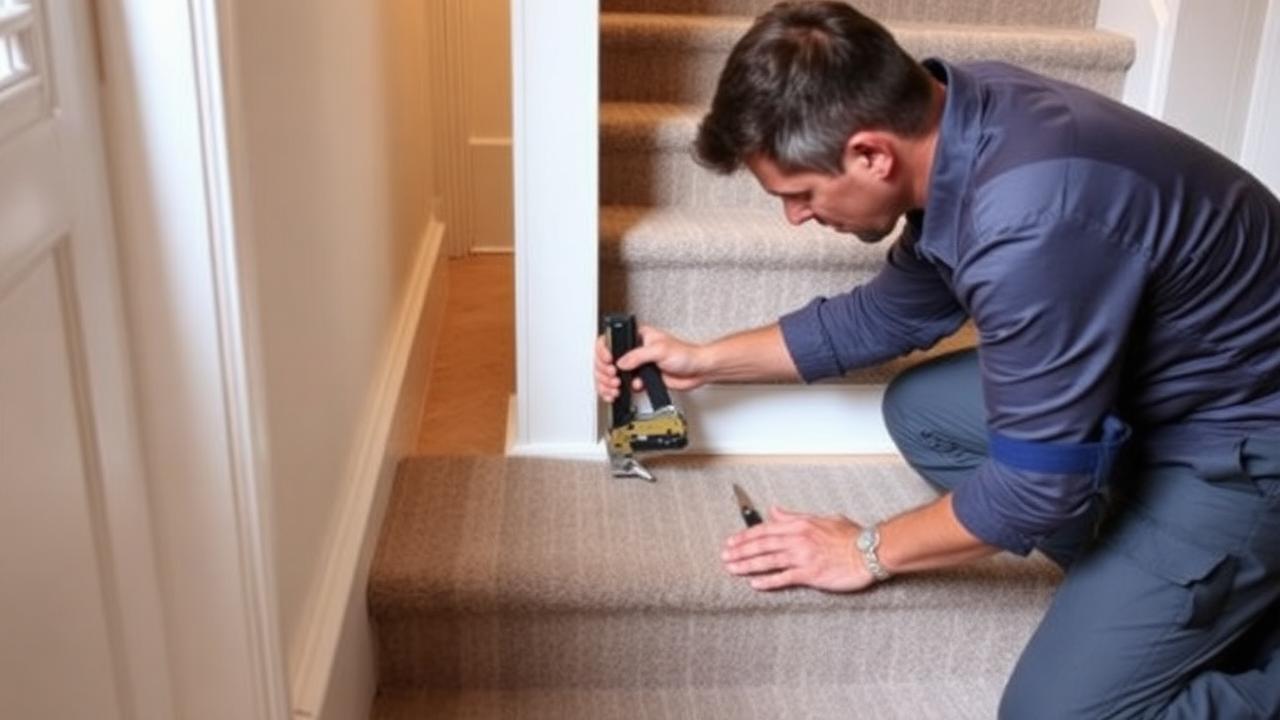
Plenty of homeowners handle stair runner installation kit: everything you need themselves on a straightforward straight flight, but certain conditions tip the balance firmly towards hiring a fitter. Getting a second opinion before committing materials often costs nothing and can save an expensive mistake on a job that cannot easily be undone.
- The staircase has a turn, winders, a curve or a split level rather than one straight run.
- The existing substrate is damaged, damp, or its condition is genuinely unclear.
- The runner is an expensive natural fibre or bespoke pattern where a cutting mistake is costly.
- You have no experience with a staple gun, knee kicker or carpet seaming on stairs.
- The staircase is the main one in the home and downtime or an unfinished look is not acceptable.
Worked example with real numbers
To see how stair runner installation kit: everything you need plays out on an actual staircase, take a common 13-step flight with a 10 in (25 cm) tread depth and a 7.5 in (19 cm) riser height. That gives 17.5 in (44 cm) per step, or 227.5 in (5.78 m) of raw length before any waste allowance is added, a figure worth keeping in mind whenever this topic is discussed in isolation from the rest of the job.
| Measurement | Imperial | Metric |
|---|---|---|
| Tread depth | 10 in | 25 cm |
| Riser height | 7.5 in | 19 cm |
| Per step total | 17.5 in | 44 cm |
| 13 steps, raw length | 227.5 in | 5.78 m |
| With 8% waste allowance | 245.7 in | 6.24 m |
A realistic shopping list order
Buying everything for a stair runner installation kit in one trip avoids the classic DIY problem of running out mid-job on a Sunday when the hardware shop is shut. A sensible order is: confirm your fixing method first (staple-only or tackless strip), buy the fixing hardware and pad together since they are interdependent, then marking and cutting tools, then finishing supplies like seam tape and rods last, since those choices depend on how the main fit turns out. Checking off each category against the table above before checkout is quicker than hunting through a receipt afterwards to see what got missed.
Storing leftover kit for future use
Most stair runner installation kit items outlast a single project by years. Keep spare staples, offcuts of gripper strip, and any leftover seam tape in a labelled box along with the runner's leftover offcut, so a future repair or a rug project elsewhere in the house has both the tools and a colour-matched patch ready to hand, without a repeat trip to the shop for small quantities that are often sold in larger packs than one job needs.
Regional variation within the UK
Even within the UK, fitting convention varies a little by region and by the age of the property. Period homes in London and the South East more commonly specify brass rods and a full gripper installation as standard, reflecting both older staircase construction and client expectations, while newer-build homes across the country increasingly use a rodless gripper finish or direct staples for a cleaner, more contemporary look at lower cost. Neither approach is technically superior; the choice is largely aesthetic and driven by the age and style of the staircase itself.
Whatever you decide, get the numbers first: the stair runner calculator doubles as a stair runner length calculator, adding nosing wrap, landings, winders, pattern repeat and waste so you order the right length the first time.
Still deciding on material, width or pattern? Our hub on stair runners compares weaves, widths, backings and fitting styles side by side, then hands the numbers straight to the calculator.
Frequently asked questions
What tools do I need to install a stair runner myself?
At minimum a tape measure, chalk line, utility knife, staple gun, staples, underlay and, if using tackless strip, gripper and a knee kicker. Total spend is typically $180-380 (£145-305) for a 13-step flight.
Do I need a knee kicker for a stair runner?
Only if you are using the tackless strip (gripper) method rather than direct stapling. Rental is usually cheaper than buying since most DIYers only need it once.
Can I install a stair runner with just a staple gun and no other tools?
You can staple it in place, but you will still need a tape measure and chalk line for accuracy and a sharp knife or shears for clean cuts, so a bare minimum kit is still five to six items.
How much does a full DIY stair runner kit cost?
Roughly $180-380 in the US or £145-305 in the UK for a 13-step flight, including underlay, fixings and a basic staple gun, before the cost of the runner itself.
What is the biggest mistake people make with this?
Rushing the measuring or prep stage. Most poor outcomes with stair runner installation kit: everything you need trace back to a single measurement taken at the wrong point, or a substrate check skipped to save a few minutes, both far cheaper to fix before the runner is cut than after.
Know your numbers in 30 seconds
Enter your step count, tread depth and riser height — the stair runner calculator gives you the exact length to order, in metres and feet, with waste included.
Measure my stairsReady for real prices?
Get quotes from vetted stair runner suppliers and fitters near you. Free, no account, no obligation.
Every guide is written from hands-on measuring and fitting experience, checked against the calculator’s own maths, and re-reviewed whenever prices or methods change. Read our editorial standards.