

Understand the force you are fighting
When someone walks down stairs, each foot lands on the tread and pushes forward and down toward the nosing. Over hundreds of footfalls a day that shear force drags the runner toward the front edge of every step. Any fixing that only resists lifting — a sticky pad, a light tape — will eventually fail, because it is being asked to resist sliding. The no-drill methods that work all convert that shear into either tension or mechanical grip.
| Method | Holds shear | Removable | Best for |
|---|---|---|---|
| Tension rods between newels | Yes | Fully | Rented homes, period stairs |
| Double-sided carpet tape (heavy) | Partly | Mostly | Low-traffic secondary flights |
| Gripper rods on adhesive | Yes | Leaves residue | Solid timber, permanent-ish |
| Hook-and-loop strips | Partly | Fully | Light use, easy lifting for cleaning |
| Non-slip pads only | No | Fully | Not recommended on a flight |
Know your numbers in 30 seconds
Enter your step count, tread depth and riser height — the stair runner calculator gives you the exact length to order, in metres and feet, with waste included.
Open the stair runner calculatorTension rods: the method that actually works
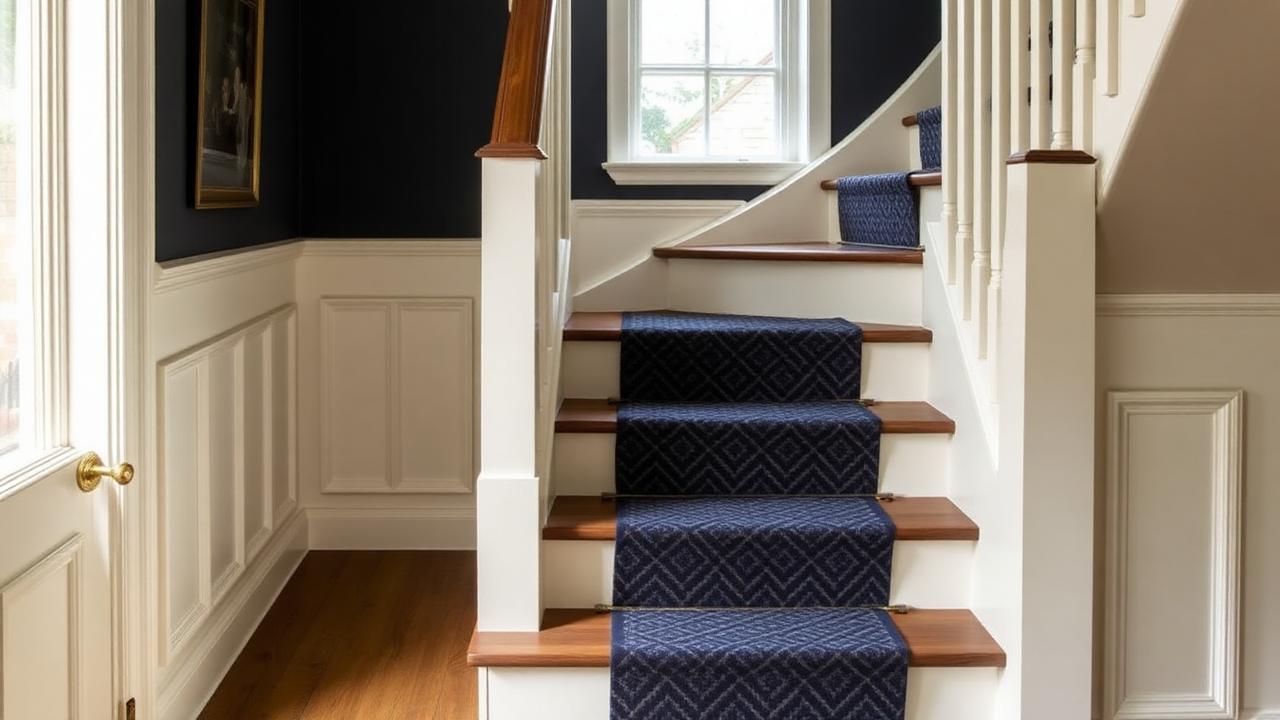
Traditional stair rods sit in brackets that screw down, but tension rods work like a shower rail: they wedge between the two strings or newel uprights and hold the runner in the crotch of every step by pressure. Because the runner is trapped in the angle between tread and riser at each step, the shear force pushes it into the rod rather than past it. It is the only genuinely drill-free method that stands up to a family staircase, and it is fully reversible.
- Measure the internal width at several steps — old stairs taper and one rod length rarely fits all.
- Set the rod hard into the angle where the tread meets the riser, not up on the tread face.
- Check tension monthly for the first few months; timber moves with the heating season.
- Use a thin non-slip underlay beneath the runner so the fabric itself does not creep between rods.
Heavy-duty carpet tape, used properly
Cloth-backed double-sided carpet tape holds far better than the thin foam variety, but only on a clean, dry, dust-free surface. Run a continuous strip across the back of each tread near the nosing and another at the base of each riser, rather than a few short pieces — continuous tape spreads the shear. Expect to renew it every year or two on a main flight, and test it on a hidden patch first, because on old varnish it can lift the finish when removed.
What to avoid
Rug pads and non-slip mesh alone are not a stair fixing. They stop a rug sliding on a flat floor, where the force is gentle and horizontal; on a staircase the runner is being dragged over an edge by every step. Similarly, staples only into the riser with nothing at the nosing will let the tread section balloon. Whatever method you choose, the runner has to be held at both the back of the tread and the bottom of the riser.
Whichever fixing you use, cut the length right first. Measure tread, riser and nosing per step, multiply by the step count and add a tail at top and bottom — the stair runner calculator on the home page does the whole thing including landings and winders.
Whatever you decide, get the numbers first: the stair runner calculator doubles as a stair runner length calculator, adding nosing wrap, landings, winders, pattern repeat and waste so you order the right length the first time.
Still deciding on material, width or pattern? Our hub on stair runners compares weaves, widths, backings and fitting styles side by side, then hands the numbers straight to the calculator.
Frequently asked questions
Can you fit a stair runner without drilling?
Yes. Tension rods wedged between the strings hold a runner securely with no fixings into the timber, and heavy cloth-backed carpet tape works on lower-traffic flights. Non-slip pads alone are not enough on stairs.
Will a no-drill stair runner slip?
Not if the method resists forward shear. Tension rods trap the runner in the angle of every step, so the walking force pushes it into the fixing. Tape and hook-and-loop resist lifting better than sliding, so they need renewing periodically.
Is carpet tape strong enough for stairs?
Heavy cloth-backed double-sided tape is, on a clean dry surface and a secondary flight. Apply it as continuous strips near the nosing and at the base of each riser, not as short patches, and expect to renew it every year or two on busy stairs.
Can renters fit a stair runner?
Yes — tension rods with a non-slip underlay leave no marks at all and come out in an afternoon. Avoid gripper rods on adhesive and avoid tape on painted or varnished timber, both of which can damage the finish on removal.
Do I still need underlay with a no-drill runner?
Yes, and it helps. A thin high-density underlay cut slightly narrower than the runner adds grip against the timber, protects the backing at the nosing and makes the flight noticeably quieter.
Know your numbers in 30 seconds
Enter your step count, tread depth and riser height — the stair runner calculator gives you the exact length to order, in metres and feet, with waste included.
Get your runner length from the stair runner calculatorReady for real prices?
Get quotes from vetted stair runner suppliers and fitters near you. Free, no account, no obligation.
Every guide is written from hands-on measuring and fitting experience, checked against the calculator’s own maths, and re-reviewed whenever prices or methods change. Read our editorial standards.