
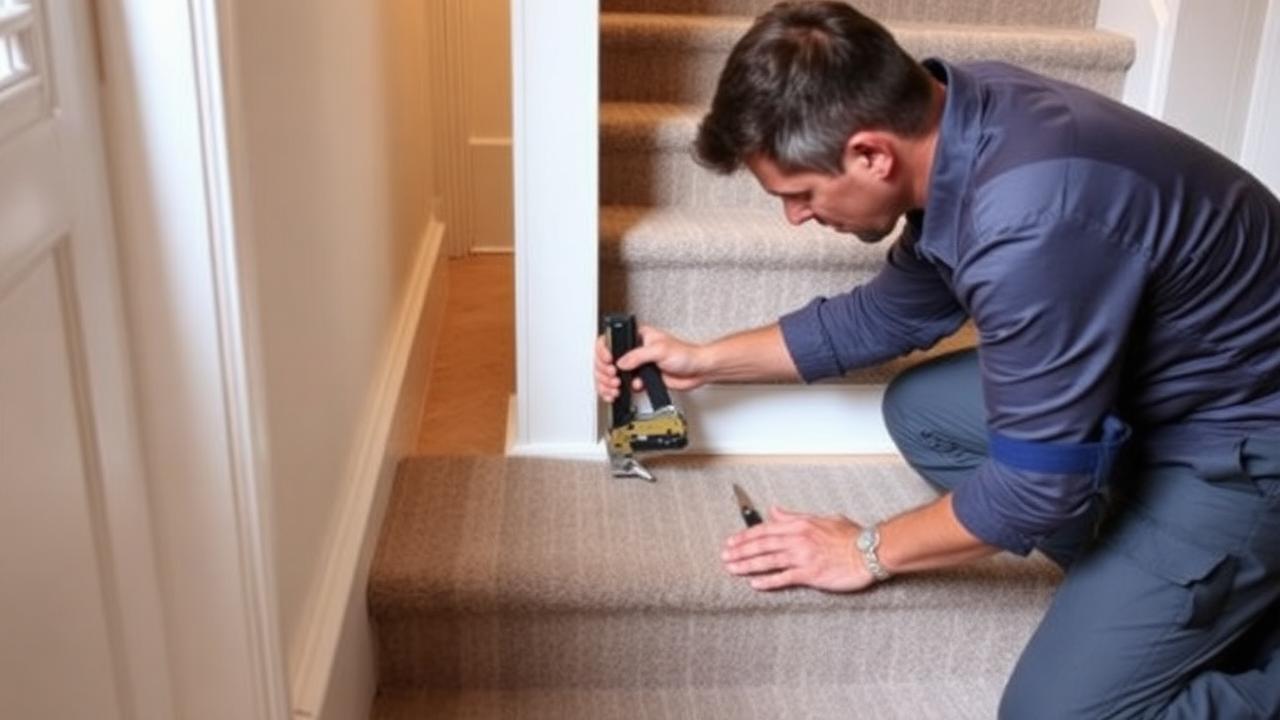
Where staples belong on each step
The two hiding spots that matter are the back corner where tread meets riser, tucked into the shadow line, and the base of the riser where the runner turns onto the next tread. Both are naturally shadowed areas that the eye does not scan when looking down a flight.
| Location | Why it hides staples | Typical spacing |
|---|---|---|
| Back corner (tread/riser junction) | Sits in a natural shadow line | Every 2-3 in (5-7.5 cm) |
| Base of riser (riser/next tread junction) | Hidden under the next tread's overhang | Every 2-3 in (5-7.5 cm) |
| Mid-tread (avoid) | Fully exposed to view and foot traffic | Never place here |
Gauge and crown width choice
A fine 22 gauge wire with a narrow 1/4 in (6 mm) crown disappears into most pile heights, while an 18-20 gauge staple leaves a visibly larger footprint, especially on flatweave and natural fibre runners with a tight, low weave. Match gauge to fibre density: denser wool pile hides a slightly heavier staple than a thin jute flatweave does.
Know your numbers in 30 seconds
Enter your step count, tread depth and riser height — the stair runner calculator gives you the exact length to order, in metres and feet, with waste included.
Open the stair runner calculatorColour-matching staples
- Standard bright steel staples show as small silver flecks against dark pile; some suppliers offer blackened or coated staples for dark runners.
- On natural fibre runners like sisal or jute, staples are far harder to hide because the weave is open; rely on placement more than colour.
- Test a few staples on an offcut under the lighting the stairs actually get before committing to a batch.
Depth control matters as much as placement
A staple driven too shallow sits proud and catches light and fingers; one driven too deep cuts pile fibres and creates a small bald patch that draws the eye more than the staple itself would have. Test fire on a spare offcut and adjust compressor pressure or gun tension before starting the real flight.
| Depth problem | Visible result | Fix |
|---|---|---|
| Too shallow | Staple crown sits above pile, glints under light | Increase driving pressure slightly |
| Too deep | Fibres cut, small bald patch around staple | Reduce pressure, retest on offcut |
| Correct | Crown sits flush with pile surface | No adjustment needed |
Staples versus stair rods for concealment
If a runner absolutely must show no fixings at all, stair rods with concealed clips are the alternative to staples entirely, holding the runner in place mechanically rather than piercing the backing.
Fixing staples that already show
- Remove the offending staple carefully with a flat tool, working from underneath if possible.
- Fluff the crushed pile around the hole with a pin or soft brush.
- Re-fire a finer gauge staple slightly further into the shadow corner.
- If the hole remains visible on a natural fibre runner, a dab of matching yarn worked into the weave can disguise it.
Cost of getting staples right
Upgrading from a basic 18 gauge hammer tacker to a proper 20-22 gauge pneumatic stapler costs roughly $60-180 (£50-145) more but pays for itself on any job where a visible fixing would mean re-doing a step. A stair runner calculator can tell you total yardage, but it will not tell you which staple gauge suits your pile, so check the runner manufacturer's fitting notes as well.

When staples cannot be hidden at all
Very open weave natural fibre runners such as coarse sisal or seagrass will always show some trace of a fixing because the weave itself has visible gaps. In these cases, use fewer, well-placed staples rather than trying to disguise many, and consider a bound edge with a discreet gripper strip system instead.
Staples versus tackless strip and gripper systems
Many professional installers use a tackless gripper strip at the base of each riser and rely on staples only along the back corner and at turns, rather than stapling the entire run of every step. This hybrid approach reduces the total number of visible fixing points while still giving a firm, tensioned hold across the whole flight.
| Fixing approach | Visible fixings per step | Best suited to |
|---|---|---|
| All-staple method | 6-10 staples | Budget fits, DIY installs, any pile type |
| Gripper strip plus corner staples | 2-4 staples | Professional fits, higher pile wool runners |
| Stair rods, minimal staples | 0-2 staples plus rod fixings | Decorative period-style installs |
Compressor pressure and staple gun setup
Before starting the real flight, run a short test on an offcut of the actual runner over the actual subfloor material, timber or plywood, adjusting compressor output in small 5-10 psi increments until the staple crown sits flush without cutting fibres. Subfloor hardness varies between original Victorian timber treads and newer plywood-capped stairs, so a setting that worked on one staircase may need retesting on another.
Keep a staple log for large or multi-flight jobs
On a job spanning more than one flight, note down the gauge, spacing and compressor pressure that worked well on the first flight. This saves repeating the offcut test each time and keeps the finish consistent from top to bottom of a multi-storey staircase.
Staple guns worth using for a stair runner
A cheap hand-operated staple tacker can drive fixings, but it makes consistent depth control almost impossible over a full flight, which is exactly what causes staples to show. A pneumatic or electric staple gun rated for 20-22 gauge fine wire gives repeatable depth every time, which matters more on a stair runner than on any other soft furnishing job in the house because every step is visible from the same viewing angle.
| Gun type | Depth consistency | Typical price |
|---|---|---|
| Hand tacker (manual) | Poor, varies with hand pressure | $15-40 (£12-32) |
| Electric staple gun | Good | $40-90 (£32-72) |
| Pneumatic staple gun with compressor | Excellent | $90-220 (£72-175) |
Reading the room: staple visibility under different lighting
A staple that is invisible under a dim landing bulb can catch a raking shaft of sunlight from a stairwell window and glint clearly. Check placement under the strongest natural light the staircase gets, typically midday if there is a window nearby, not just under evening artificial light, before deciding a fixing pattern is finished.
Whatever you decide, get the numbers first: the stair runner calculator doubles as a stair runner length calculator, adding nosing wrap, landings, winders, pattern repeat and waste so you order the right length the first time.
Still deciding on material, width or pattern? Our hub on stair runners compares weaves, widths, backings and fitting styles side by side, then hands the numbers straight to the calculator.
Frequently asked questions
Where exactly should staples go so they do not show?
In the back corner where the tread meets the riser, and at the base of each riser where it meets the next tread. Both spots sit in a natural shadow line that hides the fixing.
What gauge staple is least visible?
A fine 22 gauge wire with a narrow 1/4 in (6 mm) crown is the standard choice for keeping fixings out of sight on most wool and synthetic runners.
Do coloured or black staples help?
Yes on dark runners, since a bright steel staple can glint as small silver flecks. Some suppliers sell coated staples in darker finishes for exactly this reason.
Can I hide staples on a sisal or jute runner?
Only partially, because the open weave of natural fibre runners shows fixings more readily than dense wool pile. Careful placement matters more than colour-matching here.
What if a staple is already visible after installation?
Remove it carefully, fluff the crushed pile, and re-fire a finer gauge staple further into the shadow corner rather than the original spot.
Is there an alternative to staples that hides fixings completely?
Stair rods with concealed clips hold the runner mechanically with no piercing at all, though they add a decorative element some homeowners prefer to avoid.
Should I staple every few inches along the whole tread?
No. Concentrate fixings in the back corner and at the base of the riser; a hybrid approach with a gripper strip and only a few corner staples per step reduces visible fixing points while keeping a firm hold.
How do I know what compressor pressure to use for my stair runner?
Test on an offcut of the actual runner over the actual subfloor material first, adjusting in small increments until the staple crown sits flush without cutting fibres, since subfloor hardness varies between staircases.
Does staple placement change on a landing tread versus a normal step?
Yes, landing treads are wider and flatter, so fixings are spread further along the back edge rather than concentrated in a single corner, but they should still sit in the shadow line where the tread meets the wall or riser.
Know your numbers in 30 seconds
Enter your step count, tread depth and riser height — the stair runner calculator gives you the exact length to order, in metres and feet, with waste included.
Plan my stair runnerReady for real prices?
Get quotes from vetted stair runner suppliers and fitters near you. Free, no account, no obligation.
Every guide is written from hands-on measuring and fitting experience, checked against the calculator’s own maths, and re-reviewed whenever prices or methods change. Read our editorial standards.