
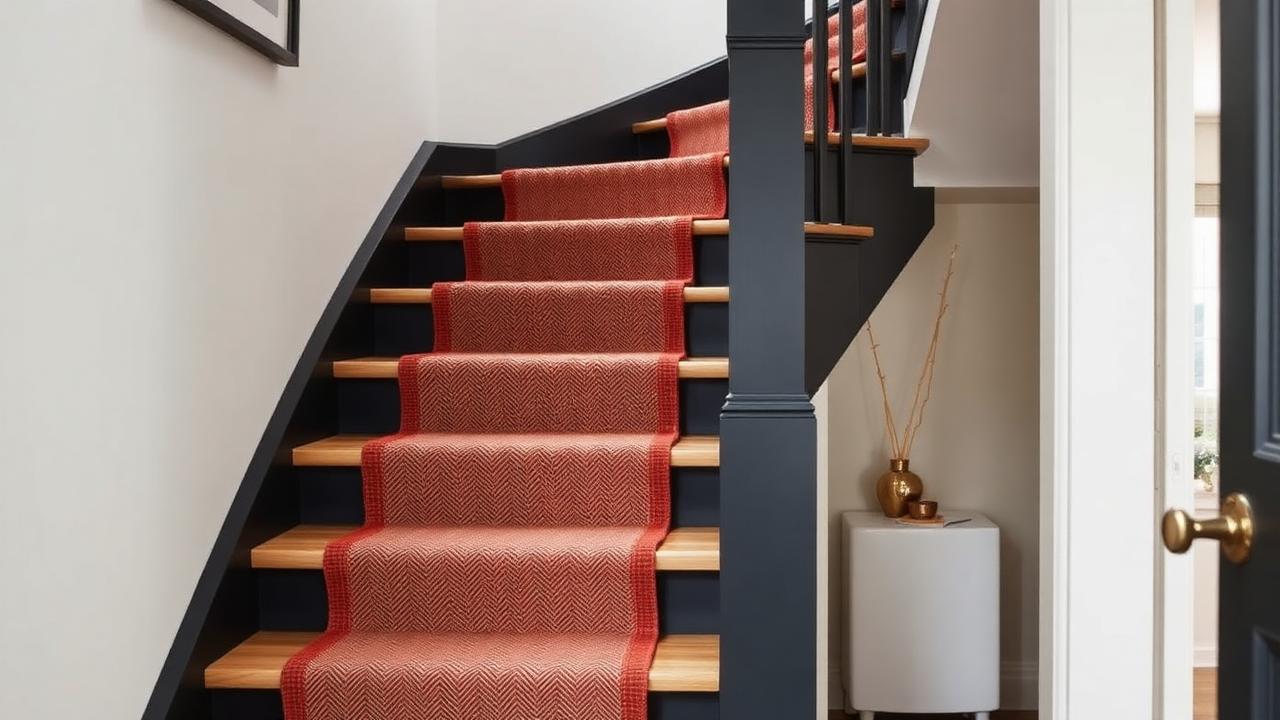
Contemporary vs modern: a useful distinction
Modern, in interiors, often refers to a specific mid-century-onward aesthetic of clean lines and restrained ornament. Contemporary means current — whatever design language is prevailing now, which shifts over time. In practice this means a contemporary stair runner should be specified against present trends in texture, colour and proportion, checked against your specific staircase, rather than copied wholesale from a modern-style template.
Texture-led carpet choices
Current contemporary schemes lean heavily on texture rather than print: bouclé-style loops, ribbed flatweaves, and subtle sculpted patterns created by pile height variation rather than dye. These read as tactile and current in a way flat printed carpet increasingly does not, and they photograph well under the directional lighting common in newer builds.
- Bouclé-effect wool or wool-blend loop for a soft, rounded texture.
- Ribbed or corduroy-style flatweave for a graphic but tonal look.
- Sculpted geometric pile (pattern created by pile height, not dye) for subtlety at a distance and interest close up.
- Textured natural-look synthetic blends where budget or durability rules out pure wool.
Matching runner to staircase architecture
| Staircase type | Contemporary runner approach |
|---|---|
| Open-riser / floating stair | Very low pile or bordered runner that does not obscure the open structure |
| Cantilevered concrete stair | Bold tonal runner that contrasts with the material honesty of the concrete |
| Curved or helical stair | Continuous plain or micro-texture runner to avoid pattern distortion around the curve |
| Straight timber flight in a period shell | Textured neutral runner as a deliberate contrast to traditional joinery |
Colour and lighting
Contemporary interiors increasingly use layered, warm-toned lighting rather than flat overhead light, which changes how a runner colour reads through the day. A cool grey that looks crisp under daylight can look flat and cold under warm evening lamps; a warmer stone or oat tone tends to hold its character better across both.
Test under your actual lighting
View any shortlisted sample under your hallway's daytime and evening lighting before ordering — the difference is often larger on stairs than on a flat floor, because stair lighting is frequently angled and directional.
Proportion and detailing
- Wider-than-traditional runner width, sized to your stair's structural limits.
- Minimal or no contrast border; where a border is used, keep it slim and tonal.
- Continuous run across landings and turns rather than a break at each level, where the staircase allows it.
- Low-profile hardware — grip bars or clips — over full decorative rod sets.
Budgeting a contemporary specification
| Element | Typical cost impact (13-step flight) |
|---|---|
| Texture-led wool-blend base carpet | £550-1,050 / $750-1,400 |
| Continuous run over a landing/turn | +£150-400 / $200-540 for extra material and piecing |
| Low-profile hardware (bars/clips) | £120-340 / $165-450 |
| Full decorative rod set (if preferred instead) | £280-900 / $380-1,200 |
Know your numbers in 30 seconds
Enter your step count, tread depth and riser height — the stair runner calculator gives you the exact length to order, in metres and feet, with waste included.
Open the stair runner calculatorKeeping the look current beyond installation
Because contemporary is a moving target, plan for the runner's likely lifespan (commonly 7-12 years for a well-fitted wool-blend) rather than chasing this year's exact texture. A tonal, texture-led neutral ages more gracefully than a trend-specific colour or pattern, which is worth weighing against the appeal of a very current look right now.

Pairing a contemporary runner with existing joinery
Most staircases were not built yesterday, and a contemporary runner has to sit against skirting, spindles and a handrail that were specified for a different era. Where the joinery is simple and painted, a texture-led runner reads as an easy, current update with no conflict. Where the joinery is heavily moulded or the balusters are ornate turned timber, a very plain runner can look oddly stark against them, and it is often better to keep one detail traditional – a slim contrast piping, say – to bridge old and new rather than fight the joinery outright. Use the stair runner calculator to work out how much runner your specific flight needs before you commit a budget to a pairing that might need a compromise detail like this.
Pattern repeat maths for a wide contemporary runner
A wide, near-full-width contemporary runner still needs repeat maths if the texture has any directional weave, even a subtle ribbed flatweave. On a 13-step flight with a 10in (25cm) going and 7.5in (19cm) rise, the diagonal length per step is roughly 12.5in (32cm), so a 13-step flight needs about 13ft 6in (4.1m) of running length before waste. Add a 5-10% allowance for cutting and any nosing wrap, which brings a typical order to 14ft 3in-14ft 10in (4.35-4.5m). A ribbed or corduroy-style weave with a visible 2-3in repeat should be checked against that total length so the rib pattern does not end on an obviously partial repeat at the top step, in the same way a printed pattern would need centring.
Wear patterns on a texture-led contemporary runner
Loop and sculpted-pile contemporary runners wear differently from traditional cut-pile carpet: the nosing edge on a loop construction tends to flatten evenly rather than fray, so wear shows as a subtle sheen change rather than visible thinning for the first several years. On a stair runner carpet with this kind of construction, rotate any loose entrance mats regularly so grit is not carried straight onto the first two or three treads, which is where 80% of visible wear typically concentrates on any stair runner regardless of style.
Choosing between a self-bound and a hemmed edge
Contemporary runners with a wide, near-full-width format often use a self-bound or serged edge rather than a hemmed fabric border, since a visible border undercuts the clean, architectural line the wide format is going for. A serged edge sits almost flush with the carpet surface and costs less than binding, though it is slightly less durable at the very corner of each step than a folded fabric hem, so on a busy household stair ask your fitter which option their chosen carpet actually supports well before deciding purely on looks.
| Tread depth | Diagonal length per step | 13-step flight, before waste |
|---|---|---|
| 9in (23cm) going, 7in (18cm) rise | 11.4in (29cm) | 12ft 4in (3.77m) |
| 10in (25cm) going, 7.5in (19cm) rise | 12.5in (32cm) | 13ft 6in (4.1m) |
| 11in (28cm) going, 7in (18cm) rise | 13in (33cm) | 14ft 1in (4.3m) |
Whatever you decide, get the numbers first: the stair runner calculator doubles as a stair runner length calculator, adding nosing wrap, landings, winders, pattern repeat and waste so you order the right length the first time.
Frequently asked questions
What is the difference between a modern and a contemporary stair runner?
Modern generally refers to a specific mid-century-onward aesthetic; contemporary means whatever reads as current now, so the exact colours and textures shift over time even though the underlying principle of restraint stays similar.
What carpet texture is currently popular for stair runners?
Texture-led constructions such as bouclé-effect loop, ribbed flatweave and sculpted geometric pile are common current choices, favoured over printed patterns.
Does lighting affect which runner colour looks contemporary?
Yes, warm layered lighting common in current interiors can make cool greys look flat; testing a sample under your actual daytime and evening light is worthwhile before ordering.
Can a contemporary runner go across a landing continuously?
Often yes, and a continuous run across a landing or turn is a common current styling choice where the staircase geometry allows it, though it uses more material.
What hardware suits a contemporary stair runner?
Low-profile grip bars or discreet clips are common, though a matt-finish decorative rod set also works if a slightly more traditional detail is wanted.
How wide should a contemporary stair runner be?
Generally wider than a traditional narrow runner, sized toward the maximum your stair's structure and mouldings allow.
How much does a contemporary stair runner cost?
Roughly £550-1,050 or $750-1,400 for the base carpet on a typical flight, plus hardware and any extra cost for a continuous run over a landing.
Will a contemporary runner date quickly?
A tonal, texture-led neutral tends to age more gracefully than a trend-specific colour or bold pattern, which is worth considering against choosing the most current look available today.
Know your numbers in 30 seconds
Enter your step count, tread depth and riser height — the stair runner calculator gives you the exact length to order, in metres and feet, with waste included.
Price my contemporary runnerReady for real prices?
Get quotes from vetted stair runner suppliers and fitters near you. Free, no account, no obligation.
Every guide is written from hands-on measuring and fitting experience, checked against the calculator’s own maths, and re-reviewed whenever prices or methods change. Read our editorial standards.