
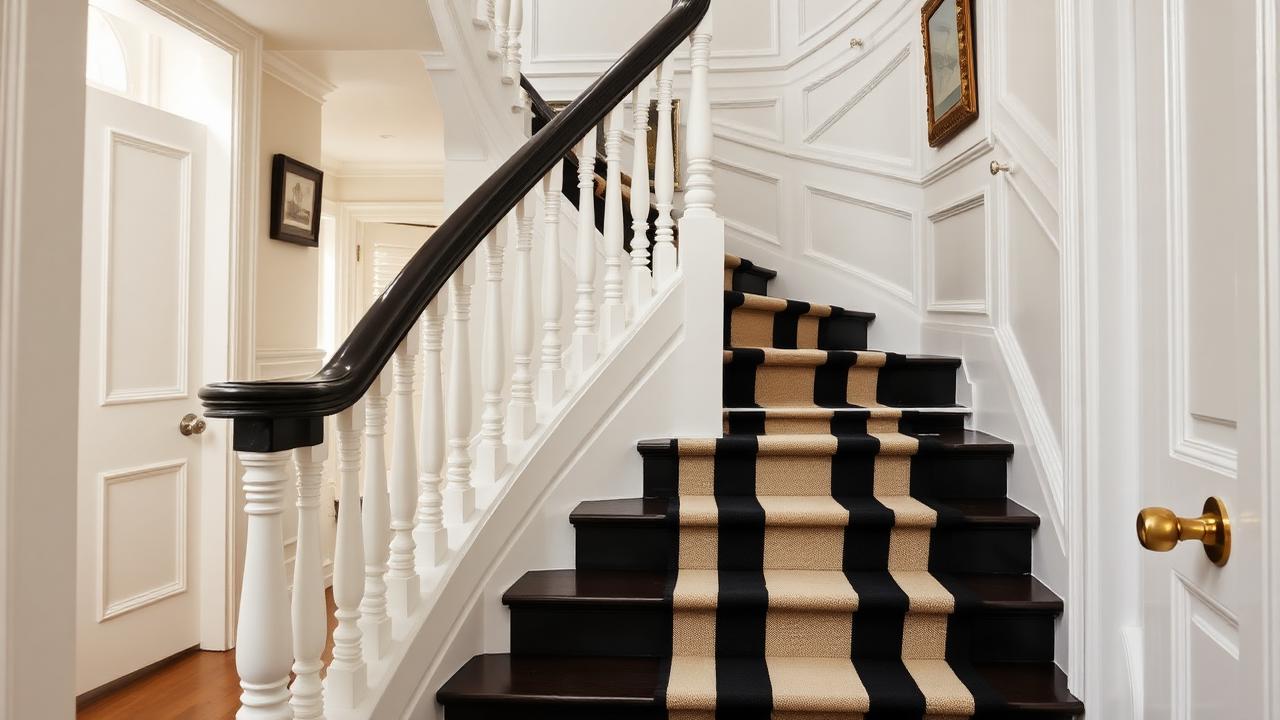
What makes a stair runner look modern
Modern stair runner design leans on restraint: fewer colours, flatter pile, cleaner lines at the edge, and a tighter relationship between runner width and stair width. Where a traditional runner often uses a wide margin, a deep pile and a decorative border, a contemporary scheme tends toward a slightly wider runner with a narrow, crisp margin and a single accent colour or graphic motif rather than an ornate pattern.
Colour and pattern directions
| Style direction | Typical palette | Best paired with |
|---|---|---|
| Monochrome neutral | Grey, charcoal, oatmeal, off-white | Light timber or painted white stringers |
| High-contrast graphic | Black/white or navy/cream geometric | Bold wall colour, minimal decor |
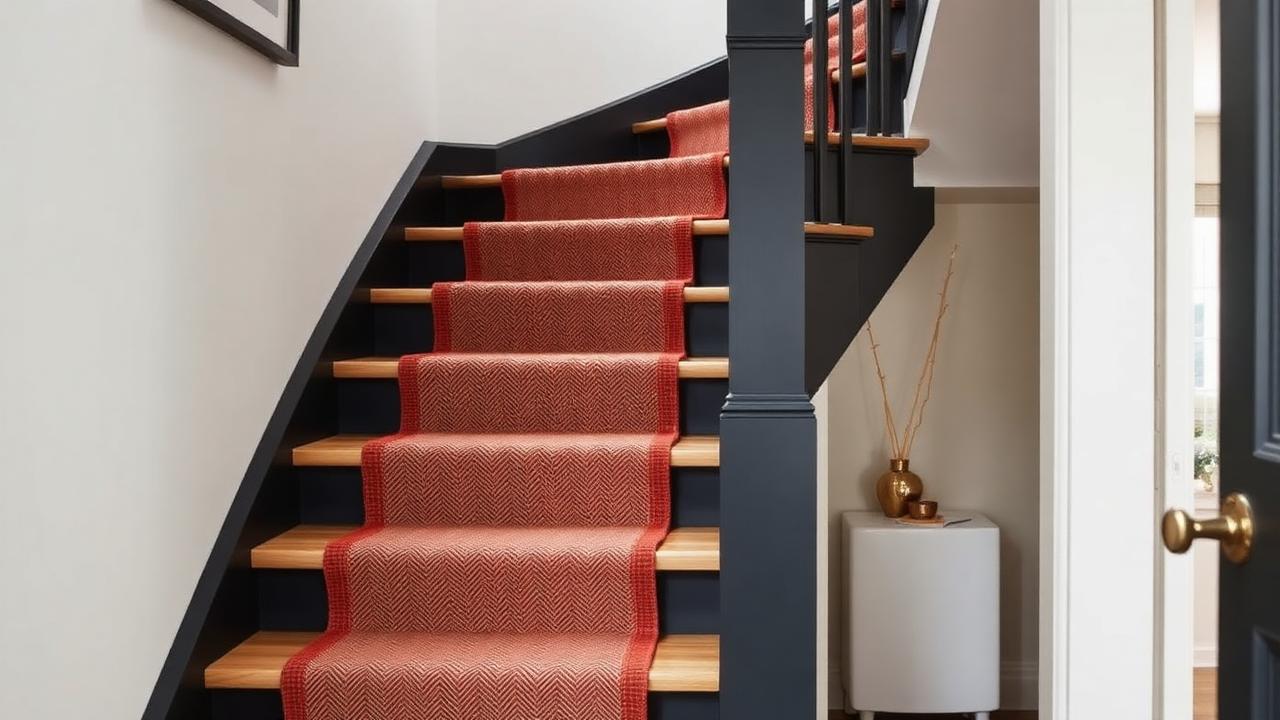
| Warm minimalist | Terracotta, rust, warm taupe | Oak or walnut treads |
| Cool industrial | Slate, steel blue, graphite | Painted black spindles, metal balustrade |
| Single accent stripe | Neutral base with one bold central stripe | Any timber tone, keeps focus narrow |
Fibre and pile for a modern finish
- Low-pile wool loop or wool-blend for a flat, tailored look that photographs cleanly.
- Flatweave synthetic sisal-alikes for a textured but still minimal finish, with better durability than natural sisal.
- Triexta or nylon in a tight loop construction, which holds a crisp edge and resists crushing on the nosing.
- Avoid deep saxony or shag piles - they read as traditional or cosy rather than modern, regardless of colour.
Narrower margins, wider runner
Where a period scheme might leave 5-6in (13-15cm) of tread exposed each side, many modern schemes tighten that to 2-3in (5-8cm), using a wider runner relative to the stair. It reads as more architectural and covers more of the timber, which also suits stairs where the treads are functional rather than a design feature.
Edge and border choices
Self-coloured serged edges, rather than a contrasting decorative border, are the most common modern choice - the goal is a clean line rather than a framed one. Where a border is used, it tends to be a single thin pinstripe in a tonal or high-contrast colour rather than a wide woven border pattern.
Hardware: visible or hidden
Modern schemes usually skip decorative brass or antique stair rods in favour of either no visible hardware (stapled or clipped fixing) or slim matte black / brushed steel rods that read as a deliberate architectural line rather than an ornament. If you do want rods, choosing a finish that matches the balustrade metalwork keeps the look coherent.
Steps to plan a modern stair runner
- Choose your palette first, working from the treads, walls and balustrade rather than picking carpet in isolation.
- Pick a fibre and pile height that stays flat and tailored rather than plush.
- Decide on runner width and margin - narrower margins generally read as more contemporary.
- Select a self-coloured or minimal contrasting edge rather than a heavy woven border.
- Use a stair runner calculator to get an accurate total length, including wrap allowance at each nosing.
- Confirm fixing method (visible slim rods versus hidden staples/gripper) before ordering hardware.
Where modern runners work best
Open-plan hallways with light-filled stairwells, exposed steel or timber balustrades, and homes with a generally minimal material palette are where modern stair runner schemes read most successfully. On a heavily traditional staircase with ornate spindles and a dado rail, an overtly modern runner can feel like a mismatch - a warm minimalist or tonal neutral palette usually bridges the two better than a stark monochrome graphic.
| Staircase style | Modern runner approach that works |
|---|---|
| Open-tread timber with steel balustrade | Monochrome neutral or cool industrial, narrow margin |
| Painted spindles, period cornicing | Warm minimalist, tonal border, moderate margin |
| New-build straight flight, oak treads | Single accent stripe or flatweave neutral |
| Loft/industrial conversion | Cool industrial palette, slim black rods |
Budgeting a modern scheme
Low-pile wool-blend and quality synthetic flatweaves sit in a similar price band to traditional carpets of equivalent quality - a modern look is a design choice, not automatically a premium one. For a typical 13-step flight, budget £400-£900 / $500-$1,100 for mid-range fibre with underlay and fitting, with slim metal rods adding roughly £80-£200 / $100-$250 if you choose to include them.
Lighting and how a modern runner photographs
Stairwells are often lit from a single overhead point or a run of downlights, and a flat, low-pile modern runner reflects that light more evenly than a deep pile, which tends to show shadow lines across the weave direction. This is one practical reason flat weaves and tight loops dominate modern schemes beyond pure aesthetics - they read as crisp and consistent in photographs and under variable daylight, where a plush pile can look patchy depending on the angle it was vacuumed or walked over last.
Eco and recycled fibres in a modern palette
A growing share of modern stair runners use recycled PET (from plastic bottles), regenerated nylon, or wool blended with recycled fibre backing, and these materials suit a minimal palette particularly well because they are commonly produced in flat, undyed or lightly dyed neutral tones rather than the saturated colours associated with virgin synthetic ranges. Buyers choosing a modern look for sustainability reasons should ask suppliers directly about recycled content percentage and backing material, since labelling conventions vary between US and UK suppliers.
Mistakes that undercut a modern scheme
| Mistake | Why it undercuts the look | Fix |
|---|---|---|
| Choosing a deep pile in a neutral colour | Still reads as traditional despite the plain colour | Prioritise flat weave or low loop over colour alone |
| Ornate brass rods on a minimal scheme | Clashes with the architectural intent | Use slim black or brushed steel rods, or skip rods entirely |
| Wide decorative border on a plain field | Reintroduces a traditional framing effect | Use a self-coloured edge or single thin pinstripe |
| Margin too wide for the stair proportions | Runner looks narrow and lost rather than deliberate | Tighten the margin to 2-3in (5-8cm) per side |
Lighting and photography considerations for modern schemes
Modern stair runners are frequently chosen by people who have seen the look in an interiors photograph first, and it is worth knowing that professional stair photography almost always uses raking, low-angle light to exaggerate texture and depth on a flat weave. In an actual home with a single overhead pendant or a run of recessed downlights, a very low-loop or flat weave can look slightly flat and undifferentiated rather than crisp, especially on a north-facing or windowless stairwell. Adding a discreet run of stair-nosing LED strip lighting, or simply upgrading to a warmer colour-temperature bulb at the top of the flight, restores much of the contrast that makes a minimal weave read as considered rather than plain in person.
Coordinating a modern runner with an existing handrail and balustrade
A slim black or brushed-steel rod picks up cues from a matching handrail far more effectively than trying to match paint colour alone, and it is one of the cheapest ways to tie a modern runner into an existing stair system without replacing the balustrade itself. Where the existing balusters are painted white or a traditional turned timber profile, a fully modern runner can look transplanted rather than integrated; in that situation it is often more effective to keep the runner simple and let a single change — new handrail paint, a slim newel cap, or blackened stair rods — do the work of updating the whole run rather than trying to modernise every element at once.
| Existing balustrade | Runner adjustment that helps most | Effect |
|---|---|---|
| Painted white spindles, turned newel | Keep runner flat-weave and self-coloured, avoid bold pattern | Reads updated without clashing with period joinery |
| Black metal or cable balustrade | Match with slim black stair rods, tight low-loop weave | Cohesive, fully contemporary result |
| Glass panel balustrade | Choose a pale neutral runner with minimal border | Keeps the open, light feel glass balustrades are chosen for |
Whatever you decide, get the numbers first: the stair runner calculator doubles as a stair runner length calculator, adding nosing wrap, landings, winders, pattern repeat and waste so you order the right length the first time.
Frequently asked questions
What colour stair runner looks most modern?
Monochrome neutrals (grey, charcoal, oatmeal), high-contrast graphic patterns and cool tones like slate or steel blue read as the most contemporary. The key factor is restraint - a single palette or motif rather than multiple colours or an ornate pattern.
Should a modern stair runner have a wide or narrow margin?
Most modern schemes tighten the exposed margin to around 2-3in (5-8cm) each side, using a wider runner relative to the staircase than traditional designs. This reads as more architectural and covers more of the tread, suiting stairs where the timber is functional rather than a feature.
What pile height suits a modern stair runner?
Low-pile wool loop, tight loop nylon or triexta, and flatweave synthetics all give the flat, tailored finish associated with contemporary schemes. Deep saxony or shag piles tend to read as traditional or cosy rather than modern, whatever colour they are.
Do modern stair runners use stair rods?
Often not - many modern schemes use hidden staple or gripper fixing for a clean line. Where rods are used, slim matte black or brushed steel finishes that match the balustrade metalwork are more common than traditional brass or antique styles.
Can a modern stair runner suit a period house?
Yes, if you soften the approach - a warm minimalist palette or a tonal neutral with a thin contrasting pinstripe bridges a period staircase and a modern runner better than a stark monochrome graphic pattern, which can feel mismatched against ornate spindles or cornicing.
What is the best fibre for a modern stair runner with heavy foot traffic?
Nylon and triexta in a tight loop construction hold their shape and resist crushing on the nosing better than wool loop under heavy daily use, while still giving the flat, tailored look associated with modern schemes.
How much does a modern stair runner cost compared to a traditional one?
Cost is driven by fibre and construction quality, not style - a modern low-pile scheme in mid-range wool-blend or synthetic typically costs the same as an equivalent traditional carpet, roughly £400-£900 / $500-$1,100 fitted for a 13-step flight.
What border works best on a modern stair runner?
A self-coloured serged edge or a single thin tonal or contrasting pinstripe is the most common modern choice, in place of a wide woven decorative border. The goal is a crisp line rather than an ornate frame around the runner.
Know your numbers in 30 seconds
Enter your step count, tread depth and riser height — the stair runner calculator gives you the exact length to order, in metres and feet, with waste included.
Calculate the runner length for your staircaseReady for real prices?
Get quotes from vetted stair runner suppliers and fitters near you. Free, no account, no obligation.
Every guide is written from hands-on measuring and fitting experience, checked against the calculator’s own maths, and re-reviewed whenever prices or methods change. Read our editorial standards.