

Modern and minimal
- Flat, tonal wool in charcoal or oatmeal with a wide bare reveal each side.
- A single thin contrast border running the length of the flight.
- Matt black rods on pale timber for graphic punctuation.
- Low-pile loop in a warm grey — hides traffic, reads architectural.
Traditional and period
- Classic stripe in muted heritage tones with polished brass rods.
- Deep red or bottle green wool on dark stained treads.
- Border-and-field designs that echo a hallway runner.
- Wrapped (Hollywood) fitting to show off moulded nosings.
Farmhouse and country
- Natural sisal or a sisal-look wool with a cotton border.
- Small-scale check or ticking stripe in soft indigo.
- Painted white risers with a natural runner and antique brass rods.
- Jute on a quiet secondary staircase for texture on a budget.
Know your numbers in 30 seconds
Enter your step count, tread depth and riser height — the stair runner calculator gives you the exact length to order, in metres and feet, with waste included.
Open the stair runner calculatorCoastal and calm
- Seagrass or pale flatweave over white-painted risers.
- Faded blue and sand stripes, low pile, wide reveal.
- Pale timber treads with a soft wool in oatmeal or driftwood grey.
Bold and maximal
- Leopard or antelope print — the perennial designer favourite, and surprisingly forgiving of wear.
- Large-scale geometric or chevron on a straight flight where the repeat can breathe.
- Saturated colour — mustard, teal, oxblood — against dark joinery.
- Tartan or plaid on a period staircase with brass rods.
Bold patterns need straight flights
A large repeat looks magnificent running down 13 uninterrupted steps and chaotic through a set of winders. Match the ambition of the pattern to the geometry of the staircase.
Matching runner style to staircase type
| Staircase type | Styles that work well | Styles to avoid |
|---|---|---|
| Straight, wide flight | Large geometric, bold stripe, animal print | Nothing — most patterns suit it |
| Flight with a turn or winders | Small texture, plain wool, subtle fleck | Large-repeat pattern, directional weave |
| Narrow cottage stairs | Pale flatweave, narrow border, light neutral | Very deep colour, thick pile |
| Grand double-height staircase | Wide runner, saturated colour, brass rods | Thin, insubstantial-looking runner |
How reveal width changes the mood
The reveal — the bare timber showing either side of the runner — does as much work as the colour or pattern. A narrow 2in reveal on a wide runner feels formal and traditional, closer to a fully carpeted stair. A generous 4–5in reveal on a narrower runner feels contemporary and shows off the treads themselves, which matters if you have invested in good timber or a striking stain colour. As a guide, the stair runner width calculator can show you exactly how a given runner width plays out against your actual tread width before you order anything.
Practical notes before you commit
| If you want… | Choose |
|---|---|
| Hides dirt on a busy family staircase | Mid-tone multi-colour or small pattern |
| Makes a narrow hall feel wider | Wide reveal, pale runner |
| Feels warm and enclosing | Deep colour, wall-to-wall-ish narrow reveal |
| Lowest long-term cost | Plain low-pile wool blend, no pattern repeat |
Cost by style, roughly
Style choice affects price more than most buyers expect. A plain low-pile wool blend typically runs $30–$55 per linear foot fitted; a patterned wool with a meaningful repeat runs $45–$80 per linear foot once the matching allowance is included; a bespoke or heavily patterned wool-silk blend can pass $100 per linear foot. Natural fibres like sisal and jute sit lower, usually $20–$40 per linear foot, but need a bound wool or cotton border to look finished and to protect the edge from fraying.
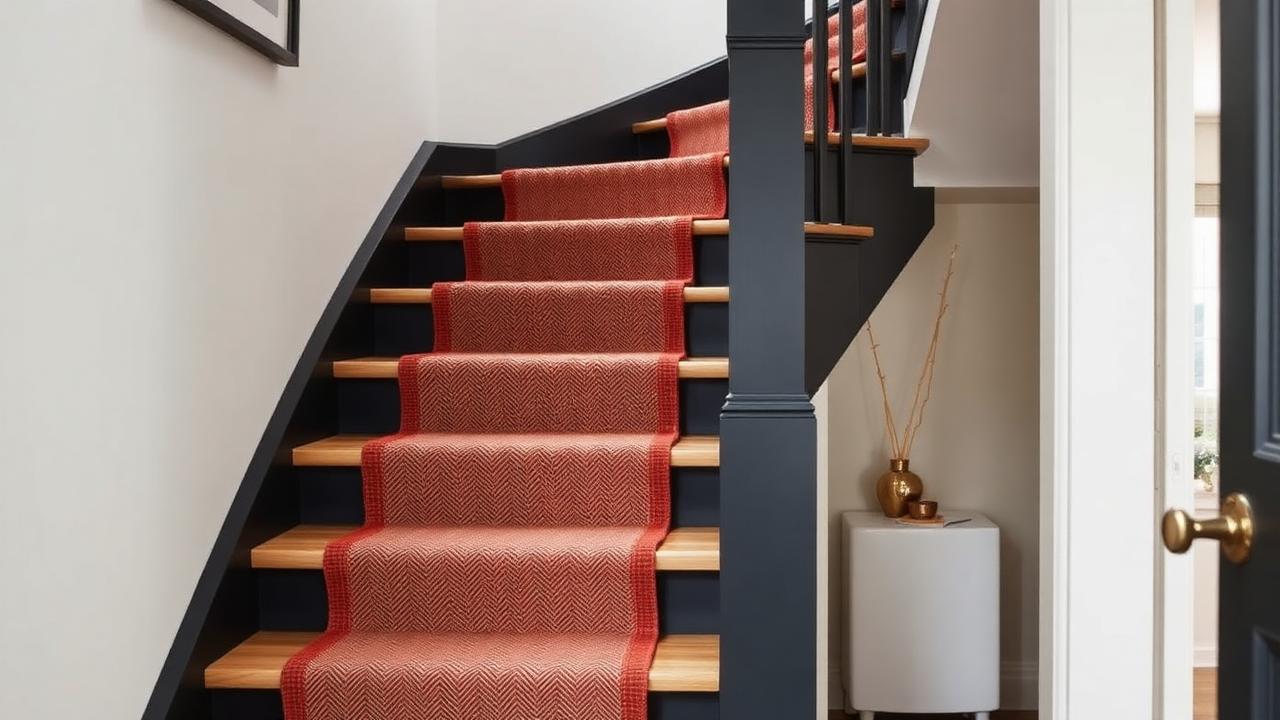
Mistakes to avoid when choosing a style
- Choosing a pattern from a small swatch without seeing how the repeat plays out over a full flight.
- Picking a runner that matches the treads too closely, so the staircase reads as one flat block with no definition.
- Ignoring the landing — a style that looks right on a straight run can look busy or awkward once it turns a corner.
- Forgetting the rest of the house. A staircase seen from an open-plan kitchen needs to sit comfortably with those finishes too.
- Under-ordering for a bold pattern and discovering mid-fit that the repeat cannot be matched with what is left.
Living with the choice day to day
Whatever style you choose, remember the staircase is walked on more per square foot than almost any other surface in the house. Busy patterns and mid-tones are simply lower maintenance, while pale plains and bold plains alike show every mark within weeks on a family staircase with dogs or young children. If you love a pale, plain look but have a busy household, consider it for a quieter secondary staircase and save the practical mid-tone pattern for the main flight.
Ideas for small budgets
- A plain synthetic or wool-blend runner in a mid grey or heathered tone, often $15-$30 per linear foot, holds up as well visually as far pricier options in photographs.
- Fit rods only on the bottom three or four visible steps rather than the full flight, saving most of the hardware cost while still adding a traditional touch.
- Choose a standard stocked width and length rather than a bespoke cut-down size, which avoids binding charges and rush lead times.
- Ask suppliers about end-of-line or discontinued colourways in a good-quality construction — the saving can be 30-50% versus the current season's range.
Ideas for a statement entrance
- A wide, wool runner in a saturated jewel tone with a contrast border, paired with polished brass rods on every step.
- A bold botanical or animal print that continues the theme from an entrance hall rug up onto the stairs.
- A two-tone stripe with a hand-finished leather binding on a grand, wide staircase.
- Pairing a patterned runner with a plain hallway carpet in one of its accent colours, so the stairs read as the deliberate focal point.
Seasonal and rental-friendly ideas
Renters and anyone unwilling to commit to a permanent installation can still dress a staircase using a loose-laid runner held with clips rather than staples and gripper, paired with a lightweight non-slip pad underneath rather than a bonded underlay. This approach sacrifices some durability and security compared with a fully fitted runner, but it is fully reversible at the end of a tenancy and can be refreshed seasonally far more cheaply than a permanent fit, since the runner itself is the only real cost.
Pairing runner style with the rest of the entrance
A staircase rarely sits in isolation — it is usually visible from a front door, a hallway console, or an open-plan living space, so the strongest results come from treating the runner as one part of a connected scheme rather than a standalone decision. Pick up one element already fixed in the space, whether that is a hallway floor tone, a piece of art, or a door colour, and let the runner either echo or deliberately contrast with it rather than ignoring it entirely.
Whatever you decide, get the numbers first: the stair runner calculator doubles as a stair runner length calculator, adding nosing wrap, landings, winders, pattern repeat and waste so you order the right length the first time.
Still deciding on material, width or pattern? Our hub on stair runners compares weaves, widths, backings and fitting styles side by side, then hands the numbers straight to the calculator.
Frequently asked questions
What stair runner style is most timeless?
A plain or subtly textured wool in a mid-tone neutral, with a 3–4in reveal each side. It suits period and modern homes equally and does not date the way a strong pattern can.
Should the stair runner match the hallway carpet?
Either match it exactly, ordering both at once from the same dye lot, or contrast it clearly. A near-match reads as an error.
How do I choose a style if my staircase has winders?
Favour small-scale texture, subtle fleck or plain colour over large directional patterns. Winders force the runner to be pieced and turned, which distorts a big repeat and makes seams far more visible on bold designs.
Is a patterned or plain runner better for resale value?
A plain or subtly textured runner in a neutral tone is the safer choice if you are styling for resale, since it reads as a considered, low-risk finish to the widest range of buyers. Bold pattern is a personal statement that suits homeowners staying long-term.
Can I use different runner styles on different staircases in the same house?
Yes, particularly between a main and a secondary staircase, provided there is a common thread — the same colour family, the same hardware finish, or the same reveal width — so the choices feel related rather than accidental.
Know your numbers in 30 seconds
Enter your step count, tread depth and riser height — the stair runner calculator gives you the exact length to order, in metres and feet, with waste included.
Cost out your favourite lookReady for real prices?
Get quotes from vetted stair runner suppliers and fitters near you. Free, no account, no obligation.
Every guide is written from hands-on measuring and fitting experience, checked against the calculator’s own maths, and re-reviewed whenever prices or methods change. Read our editorial standards.