

Why tight stairs need their own sizing approach
Tight staircases, cottage stairs, loft conversions, older properties with a narrow winding flight, don't follow the standard tread and riser numbers most sizing guides quote. On a lot of the older, tighter properties I've worked on, the tread run can be as shallow as 8-9 in (20-23 cm) rather than the more comfortable 10-11 in (25-28 cm) on a modern staircase, and the riser height climbs to 8-8.5 in (20-21.5 cm) to compensate, making the stair noticeably steeper. That combination changes both your width options and your length calculation, so treating a tight stair like a standard one is a common and costly mistake.
On the width side, a genuinely tight staircase, anything under about 30 in (76 cm) wall to wall, generally can't take anything wider than 22-24 in (56-61 cm) without crowding the stringers or clipping a skirting detail. Some very tight cottage stairs, particularly winding ones with an open string on one side, may only comfortably take 18-20 in (46-51 cm). Measure at the narrowest point along the whole run, and on a winder section specifically, measure the narrowest edge of the winder tread rather than the wider outer edge, since that inner point is what actually constrains your width.
Choosing a runner that suits a steep, narrow flight
A low, dense pile with a tight weave grips better underfoot on a steep stair than a deep, plush pile, which matters more on tight stairs since they're statistically where trips happen most often. A wool or wool-blend runner with a firm backing, or a synthetic runner specifically rated for stairs rather than general flooring use, both perform better here than a soft, deep-pile option that might look lovely on a wide, gentle staircase but compresses unevenly and can feel less secure underfoot on a steep run.
Prioritise slip resistance over pattern on a steep flight
On a genuinely steep or narrow staircase, choose the runner primarily for grip and pile density rather than colour or pattern first. A textured, low-pile weave with a good rubber or PVC-backed underlay reduces slip risk noticeably compared with a smooth, deep-pile runner on the same steep angle.
How much runner do I need?
Tight stairs often have a steeper riser and shallower tread than the more commonly quoted example, so the maths looks a little different. Take a 13-step US flight with a 9 in tread run, an 8 in riser height, and a 0.75 in nosing wrap per step, typical for a tighter cottage or loft stair. Per step that's 9 + 8 + 0.75 = 17.75 in. Across 13 steps that's 230.75 in, or 19.23 ft. Add a smaller finishing allowance of 18 in total (9 in top and bottom) since tight stairs often have less room to tuck extra material at the landing, giving 248.75 in, or 20.73 ft. Apply a slightly higher 8% waste margin, since narrower, steeper flights tend to have more winders and awkward angles that use up more material, and you land at roughly 22.4 ft, so order 22-23 ft.
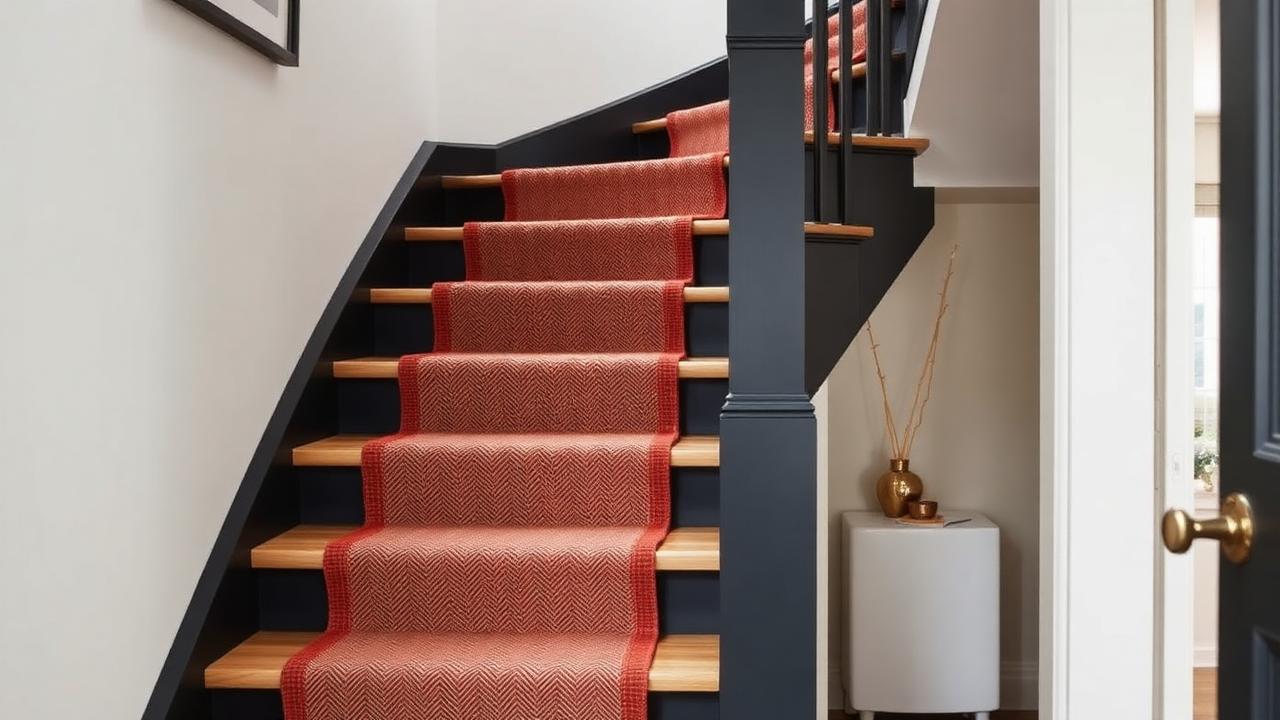
In UK metric terms, that's a 23 cm tread run, 20 cm riser height and 1.9 cm nosing wrap, giving 44.9 cm per step, or 583.7 cm across 13 steps. Add a 46 cm finishing allowance for 629.7 cm, then apply an 8% waste margin to reach roughly 6.8 m. If your tight flight includes winder treads, add a further 10-15% to the winder section specifically, since winders waste more material in cutting than straight treads do.
| Measurement | US (in/ft) | UK (cm/m) |
|---|---|---|
| Tread run | 9 in | 23 cm |
| Riser height | 8 in | 20 cm |
| Nosing wrap per step | 0.75 in | 1.9 cm |
| Per-step total | 17.75 in | 44.9 cm |
| 13 steps subtotal | 19.23 ft | 5.84 m |
| Plus finishing allowance | 20.73 ft | 6.30 m |
| With 8% waste margin | 22.4 ft | 6.80 m |
Know your numbers in 30 seconds
Enter your step count, tread depth and riser height — the stair runner calculator gives you the exact length to order, in metres and feet, with waste included.
Open the stair runner calculatorFitting realities on a tight staircase
Narrow, steep stairs are genuinely harder to fit than a standard flight, there's less room to kneel and work, winders require careful pattern and grain alignment, and a runner that's even slightly too wide will need trimming right at the fitting stage rather than being caught in the measuring. I'd recommend a professional fit on any tight winding staircase even if you're comfortable fitting a straight runner yourself, because the margin for error is smaller and a poor fit on a steep stair is a genuine safety issue, not just a cosmetic one.
- Measure the narrowest point of every straight section and every winder tread individually.
- Measure tread run and riser height on at least three different steps, since tight stairs vary more than standard ones.
- Choose a width 22-24 in for most tight stairs, or 18-20 in for very constrained cottage flights.
- Add extra waste allowance, 8-10%, for winders and awkward angles.
- Get a professional quote for fitting on any winding or open-string tight staircase.
Because tight and steep stairs vary so much more than a standard flight, plug your own actual measurements into a stair runner length calculator rather than relying purely on the worked example above. It's also worth browsing stair runner carpet options specifically marketed for narrow or period stairs, since some suppliers stock narrower widths, 18, 20 and 22 in, as standard rather than as a custom cut, which can save both cost and lead time.
Whatever you decide, get the numbers first: the stair runner calculator doubles as a stair runner length calculator, adding nosing wrap, landings, winders, pattern repeat and waste so you order the right length the first time.
Frequently asked questions
What width stair runner suits a tight staircase?
Most tight staircases under 30 in (76 cm) wide take a 22-24 in (56-61 cm) runner comfortably, while very constrained cottage or winder stairs may need to go as narrow as 18-20 in (46-51 cm) to clear the stringers.
How do I measure a winder step for a narrow runner?
Measure the narrowest edge of the winder tread, near the inside of the turn, rather than the wider outer edge. That inner measurement is what actually limits how wide a runner the whole flight can take without trimming into the stringer.
Is a narrow stair runner less safe on steep stairs?
No, width isn't the main safety factor, pile density and grip are. A low, dense pile with a good non-slip backing is safer on a steep, narrow stair than a deep, plush pile regardless of the runner's width.
How much runner do I need for a tight 13-step staircase?
For a tighter flight with a 9 in (23 cm) tread and 8 in (20 cm) riser, expect to order roughly 22-23 ft (6.7-7 m), slightly less than a standard flight because the tread run is shallower, though winders can add more.
Should I fit a narrow runner myself or hire a professional?
A straight narrow flight is manageable as a DIY job with basic tools, but winding or open-string tight staircases are worth hiring a professional for, since the margin for error is smaller and a poor fit is a genuine trip risk.
Do tight stairs need extra waste allowance when ordering?
Yes, add 8-10% waste rather than the standard 5-7%, since tight staircases more often include winders and awkward angles that use up more material in cutting than a straight flight of the same length.
Can I still get a patterned runner for a narrow stair?
Yes, but check the pattern repeat size against your narrower width first, since a large pattern repeat designed for a 30-36 in runner can look distorted or awkwardly cropped once cut down to 20-22 in.
What backing is best for a narrow runner on steep stairs?
A firm, rubber or PVC-backed runner, or a dense felt underlay beneath a fabric-backed runner, grips better on a steep pitch than a soft foam-backed option, reducing the chance of the runner shifting underfoot.
Know your numbers in 30 seconds
Enter your step count, tread depth and riser height — the stair runner calculator gives you the exact length to order, in metres and feet, with waste included.
Size your tight staircase accurately with the stair runner calculatorReady for real prices?
Get quotes from vetted stair runner suppliers and fitters near you. Free, no account, no obligation.
Every guide is written from hands-on measuring and fitting experience, checked against the calculator’s own maths, and re-reviewed whenever prices or methods change. Read our editorial standards.